Vittoriano


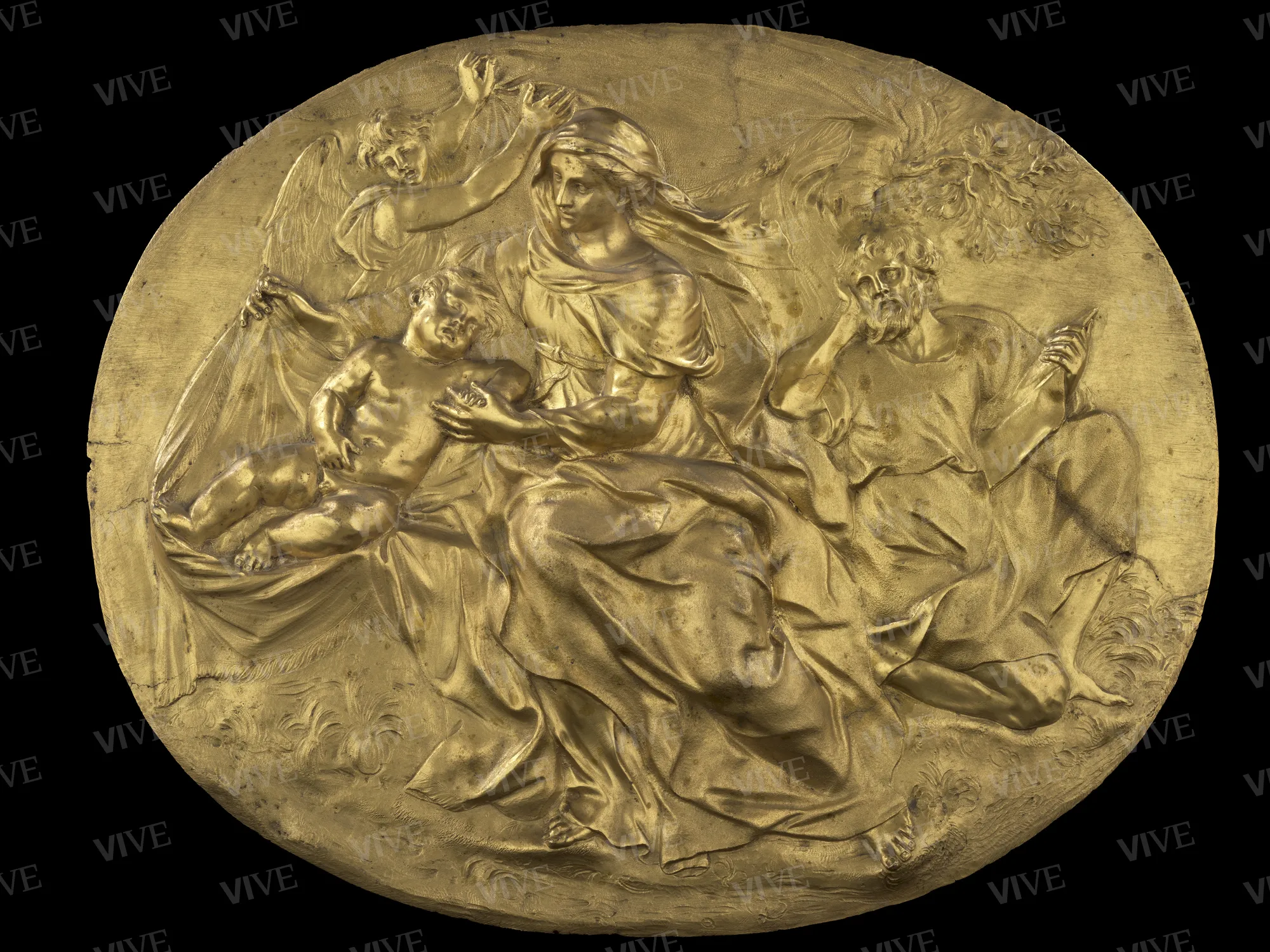
The gilded bronze oval depicts the Holy Family resting during their flight into Egypt and is part of a large group of sculptures based on a model attributed to Alessandro Algardi. There is no documentary evidence mentioning the work, but there is an engraving by Edward Le Davis that translates this relief, recalling Algardi’s authorship of the invention. The excellent quality of the casting in the Palazzo Venezia Museum supports the full authenticity of the work, whose execution, for formal reasons already highlighted by critics, can be dated to around 1635–1636.


The gilded bronze oval depicts the Holy Family resting during their flight into Egypt and is part of a large group of sculptures based on a model attributed to Alessandro Algardi. There is no documentary evidence mentioning the work, but there is an engraving by Edward Le Davis that translates this relief, recalling Algardi’s authorship of the invention. The excellent quality of the casting in the Palazzo Venezia Museum supports the full authenticity of the work, whose execution, for formal reasons already highlighted by critics, can be dated to around 1635–1636.
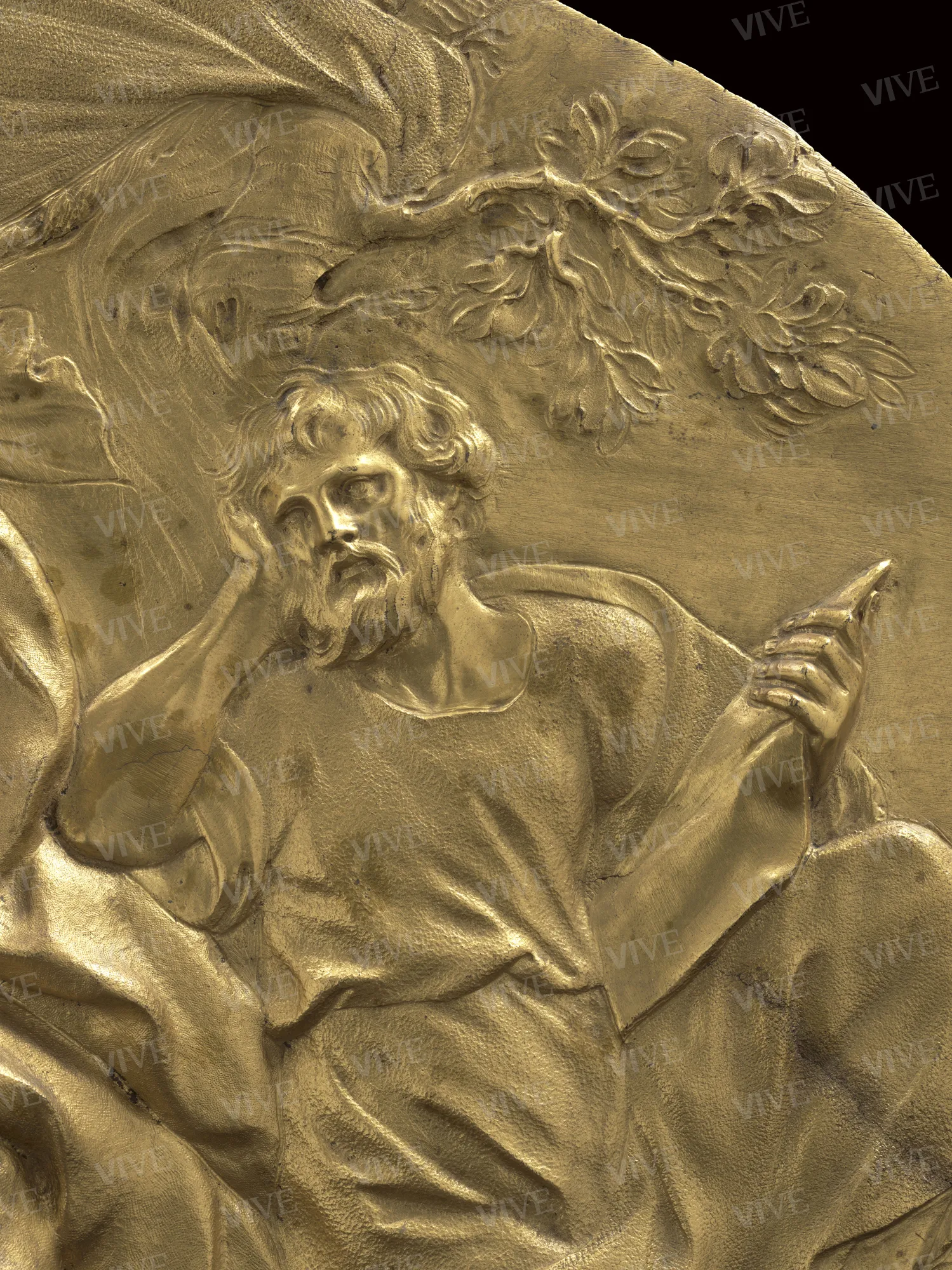
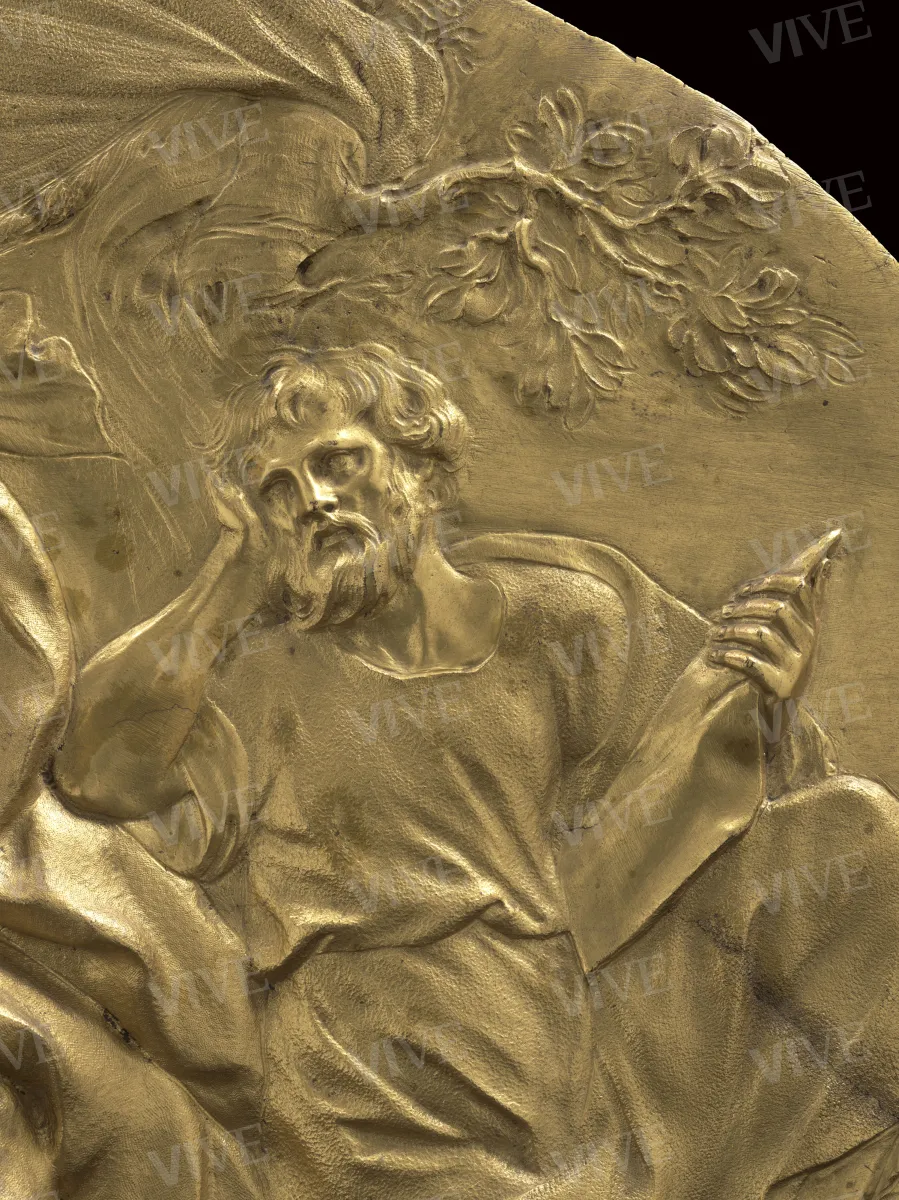
The gilded bronze oval depicts the Rest on the Flight into Egypt. In the center, the Virgin Mary sits enthroned on the barren ground, caught in the act of lifting her cloak to cover the sleeping Child to her right. Behind Mary, St. Joseph observes the scene pensively, kneeling in the shade of a tree whose branches are secured with a cloth that an angel in the background stretches over the heads of the three figures. The description of the landscape, hidden by the monumentality of the figures, is reduced to a synthetic graphic note that evokes nature through the engraved foliage and tufts of grass along the lower edge of the composition.
The relief came to the Museo di Palazzo Venezia in 1933 as a bequest from Henriette Tower Wurts, wife of the diplomat and eclectic American collector George Washington Wurts (on the Roman collection, see Voglia d’Italia 2017, ad indicem). Nothing is known about the original destination of the work or who commissioned it. The bronze was recognized as an autograph by Alessandro Algardi (1598–1654) by Pietro Cannata in 1982 (pp. 76–77, n. 76), and the attribution was accepted in the monumental monograph dedicated to the Bolognese artist by Jennifer Montagu (1985, II, 308, n. 4.C.11).
Previously, the same composition was known from a large group of examples, mostly in bronze, and the authorship of the model behind them had been assigned to Algardi, starting with John Pope Hennessy (1964, II, 615, n. 648). The scholar reasoned that the bronze in question was of inferior quality to that in the Victoria & Albert Museum (London; inv. A.69–1952), but he was also familiar with the gilded octagonal relief in the Fitzwilliam Museum (Cambridge, inv. M.1–1939) and, perhaps, also the oval one in the Metropolitan Museum of Art (New York, inv. 38.152.1), already published by John Goldsmith Phillips in 1940 (p. 129) as a possible work by Algardi’s pupil, Ercole Ferrata. Pope Hennessy’s opening remarks were followed by contributions from Olga Raggio (1968, 104) and Minna Heimbürger Ravalli (1973, 180). Raggio, in support of Algardi’s authorship of the Rest, linked the sculpture to an engraving by Edward Le Davis (d. c. 1692); the sheet, known in a single state (Paris, Bibliothèque Nationale, Ba. 1, Algardi), bears the inscription “Alexander Algardi inu – franc. Chauveau excudit C. R. – Edwardus le Davis fecit” (Montagu 1985, II, 309, n. 4.E.1). Montagu (1985, II, 308, n. 4.C.11), followed by subsequent critics, linked the invention on which the work in question depends to three autograph drawings by Algardi (London, Windsor Castle, inv. 902348; Museo de Arte Antigua, Lisbon, inv. 1168); Gabinetto dei Disegni e delle Stampe degli Uffizi, Florence, inv. 4568 S). To these studies we can add a drawing from the Metropolitan (New York, inv. 1997.374) which presents the Virgin in a pose and with gestures that can be correlated with the composition of the same figure in the relief discussed here (Bambach 1998, 27). The stylistic similarities, especially in the drapery characterized by a delicate contrast of volumes, which link the bronze in question to the Magdalene in the relief of the Ecstasy (1635) in Saint-Maximin-la-Sainte-Baume (Basilique de Sainte-Marie-Madeleine) and the figures in the relief of the Trinity (1636) in the lower church of Saints Luke and Martina in Rome, lead us to agree with the dating already proposed by Montagu (1985, II, 308, n. 4.C.11) between approximately 1635 and 1636. Cannata (2011, 161–162, n. 178) has identified a combination of “classicism and neo–Venetian manner” that brings the work in the Museo di Palazzo Venezia closer to the painting of Ludovico Carracci, Guido Reni, and Simone Cantarini. This idea can now be clarified, since the figure of the sleeping Child is modeled on works by Guido Reni, such as the cherub slumbering on the lap of Charity, painted in the early 1630s and now in New York (Metropolitan Museum of Art; Pepper 1984, 31, 261, n. 124) ) and also the sleeping Cupid handed down from an engraving by Francesco Curti (cf. Candi 2016, 274, n. 149). In the composition, more generic similarities can be identified with Cantarini’s graphic work, in particular with the series of prints on the same subject produced between 1637 and 1639 (cf. Bellini, Alberici 1980, 78–81, n. 16), often bordered with an octagonal cut that is also found in the shape of some similar castings of the relief under consideration here. An initial census of works referring to the same Algardian model was compiled by Montagu (1985, II, 307–309, nos. 4.C.1–C.15), which lists fifteen plastic versions of the Rest, of different dates and quality, one version painted in oil on copper (Ibid., n. 4. D.1), and a marble relief in the Pallavicini–Rospigliosi collection (Ibid., n. 4.D.2). In subsequent years, further plastic versions of the Rest have emerged, integrated into the debate by Cannata (2011, 161–162, n. 178; see also the summary table published in Vale 2011, 133–134). Among the most recently discovered examples, we note the important octagonal relief now preserved in the storerooms of the Museum of Sant’Agostino in Genoa (inv. MV 1097) from the collection of Agostino Franzoni, a well-known patron of Algardi (Boccardo 2013, 50–51, fig. 7).
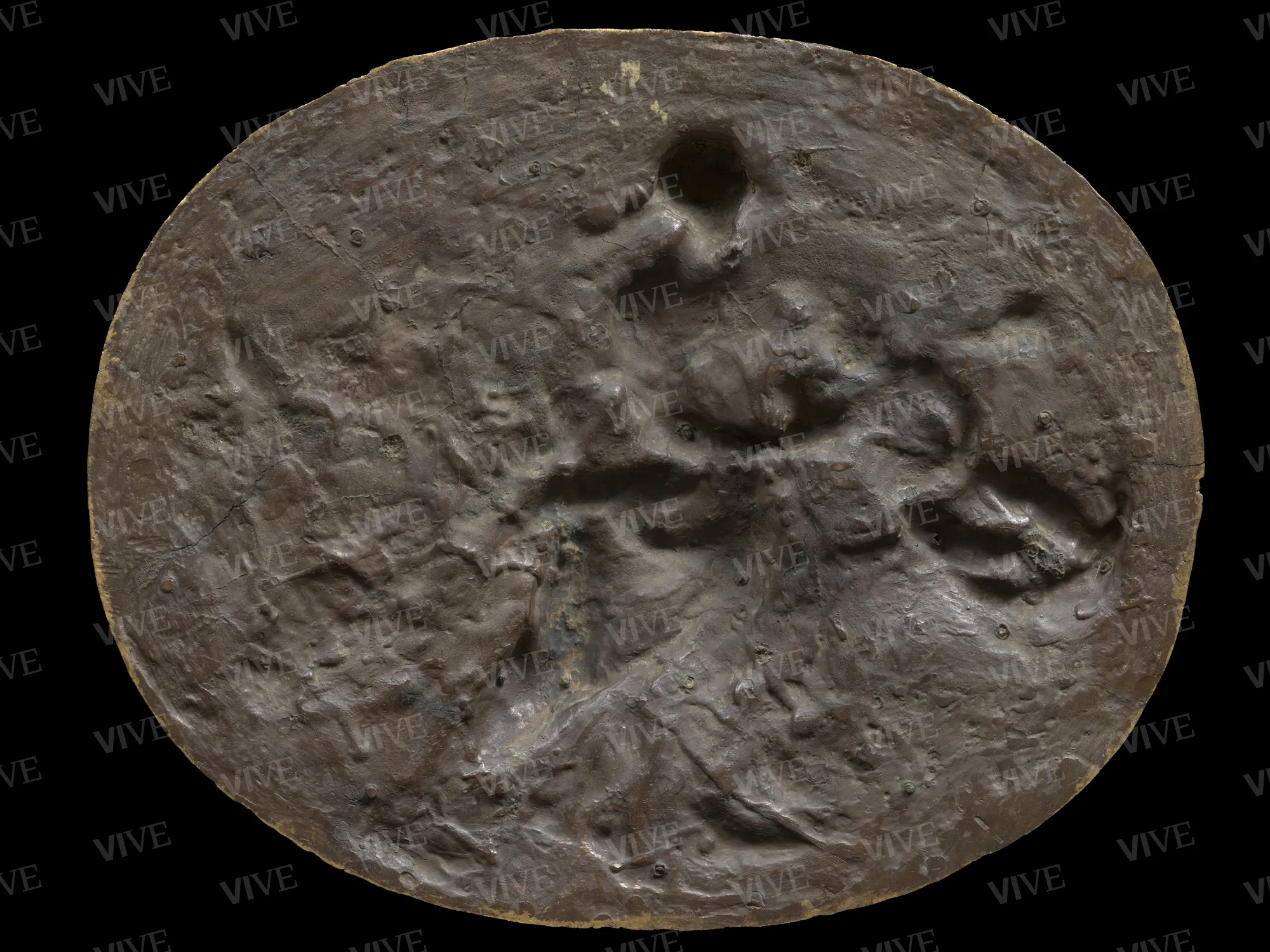
The relief in the Museo di Palazzo Venezia stands out for the superb quality of the casting, enhanced by the perfect state of preservation of the gilding and the work in general. The chiaroscuro effects of the relief are particularly noteworthy; through the skillful treatment of the surfaces, these appear sharp due to the impeccable retouching, polished in the flesh tones, and vibrant in the texture of the fabrics, which are covered with delicate cold-worked stippling on the metal.
Gerardo Moscariello
Entry published on 16 October 2025
Excellent. The relief in the Museo di Palazzo Venezia stands out for the superb quality of the casting, enhanced by the perfect condition of the gilding and the work in general.
Rome, Tower–Wurts collection (before 1933).
Rome, Museo Nazionale di Palazzo Venezia, 1933.
Rome, Museo Nazionale di Palazzo Venezia, Rilievi e placchette da XV al XVIII secolo, February–April 1982, 76–77, n. 76;
Athens, Georg., Georgia Museum of Art, Masterpieces of Renaissance and Baroque Sculpture from the Palazzo Venezia, October 5–November 24, 1996, 66–67, n. 14;
Rome, Palazzo delle Esposizioni, Algardi. L’altra faccia del barocco, January 21–April 30, 1999, 122–123, n. 13;
Rome, Palazzo della Cassa di Risparmio di Roma, Barocco a Roma. La meraviglia delle arti,April 1–July 26, 2015, 369–370, n. 46.
Goldsmith Phillips John, Renaissance Bronzes: A New Installation and Recent Acquisitions, in «The Metropolitan Museum of Art Bulletin», XXXV, 6, 1940, pp. 126-129;
Pope Hennessy John, Catalogue of Italian sculpture in the Victoria and Albert Museum, 3 voll., London 1964;
Raggio Olga, Catalogue of Italian Sculpture in the Victoria and Albert Museum by John Pope-Hennessy, Ronald Light-Bown, in «The Art Bulletin», LVI, 1, 1968, pp. 98-105;
Heimbürger Ravalli Minna, Alessandro Algardi scultore, Roma 1973;
Bellini Paolo, Alberici Clelia (a cura di), L’opera incisa di Simone Cantarini, catalogo della mostra (Milano, Castello Sforzesco, Museo Archeologico, 17 marzo-4 maggio 1980), Milano 1980;
Cannata Pietro (a cura di), Rilievi e placchette da XV al XVIII secolo, catalogo della mostra (Roma, Museo Nazionale del Palazzo di Venezia, febbraio-aprile 1982), Roma 1982, pp. 76-77, n. 76;
Pepper Stephen, Guido Reni. A Complete Catalogue of His wWorks with an Introductory Text, Oxford 1984;
Montagu Jennifer, Alessandro Algardi, 2 voll., New Heaven-London 1985, II, p. 308, n. 4.C.11;
Cannata, in Zuraw Shelly, Barberini Maria Grazia (a cura di), Masterpieces of Renaissance and Baroque Sculpture from the Palazzo Venezia, Rome, catalogo della mostra (Athens, Georg., Georgia Museum of Art, 5 ottobre–24 novembre 1996), Athens 1996, pp. 66-67, n. 14;
Bambach Carmen C, (a cura di), The Metropolitan Musuem of Art, Recent Acquisitions. A selection: 1997-1998, New York 1998;
Cannata, in Montagu Jennifer (a cura di), Algardi. L’altra faccia del barocco, catalogo della mostra (Roma, Palazzo delle Esposizioni, 21 gennaio–30 aprile 1999), Roma 1999, pp. 122-123, n. 13.
Johnston Catherine, in Montagu Jennifer (a cura di), Algardi. L’altra faccia del barocco, catalogo della mostra (Roma, Palazzo delle Esposizioni, 21 gennaio–30 aprile 1999), Roma 1999, p. 250;
Avery Victoria (a cura di), Renaissance and Baroque Bronzes from the Fitzwilliam Museum, Cambridge, catalogo della mostra (London, Daniel Katz Ltd., 11 giugno–29 luglio 2002), London 2002, pp. 140-143;
Cannata, in Barberini Maria Giulia, Sconci Maria Selene (a cura di), Guida al Museo Nazionale del Palazzo di Venezia, Roma 2009, p. 69, n. 83;
Cannata Pietro (a cura di), Museo Nazionale del Palazzo di Venezia. 3. Sculture in bronzo, Roma 2011, pp. 161-162, n. 178;
Vale Teresa Leonor, A presença de obras de arte italiana em Portugal: contributos para a difusão de modelos. Uma variação da Sagrada Família de Alessandro Algardi, no Palácio Nacional de Sintra, in «População e Sociedade», 19, 2011, pp. 123-135, passim;
Boccardo Piero, Vicende e identificazione delle opere di Algardi nella collezione Franzone e un inedito bronzo delle civiche raccolte genovesi, in Bruno Mariangela, Sanguineti Daniele (a cura di), La cappella dei signori Franzoni magnificamente architettata. Alessandro Algardi, Domenico Guidi e uno spazio del Seicento genovese, Atti del convengo (Genova, Palazzo Reale, 26 settembre 2011), Genova 2013, pp. 39-55;
Draghi, in Barberini Maria Giulia, Bussagli Marco, Anselmi Alessandra (a cura di), Barocco a Roma. La meraviglia delle arti, catalogo della mostra (Roma, Palazzo della Cassa di Risparmio di Roma, 1 aprile-26 luglio 2015), Milano 2015, pp. 369-370, n. 46;
Candi Francesca, D’après le Guide. Incisioni seicentesche da Guido Reni, Bologna 2016;
Pellegrini Emanuele (a cura di), Voglia d’Italia. Il collezionismo internazionale nella Roma del Vittoriano, catalogo di mostra (Roma, Palazzo Venezia, Gallerie Sacconi al Vittoriano, 7 dicembre 2017-4 marzo 2018), Napoli 2017.