Vittoriano


Four series of lectures and special openings
curated by Alfonsina Russo, Head of DiVa – Department for the valorization of cultural heritage, and Edith Gabrielli, General Director of VIVE – Vittoriano and Palazzo Venezia
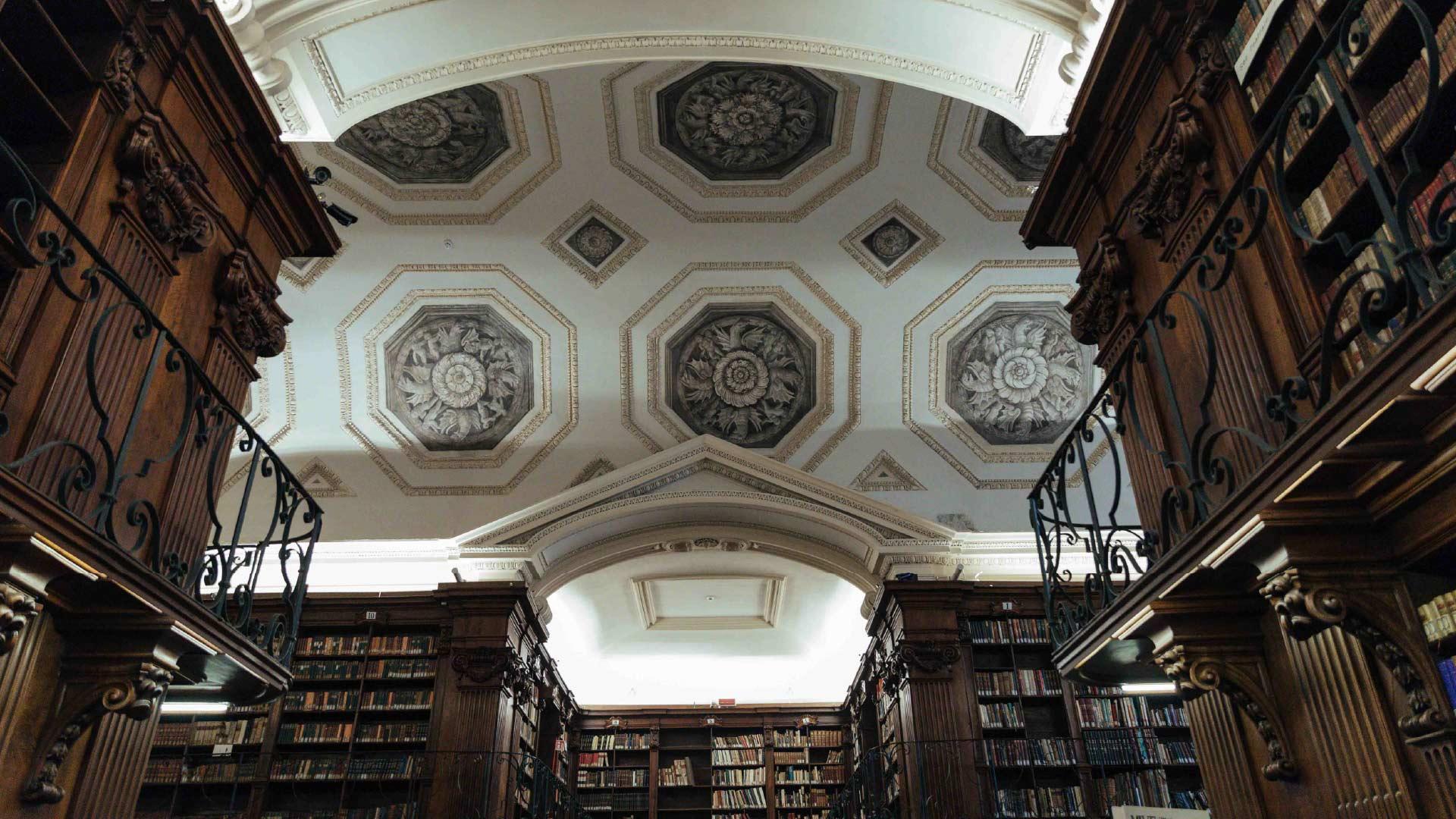
The Department for the enhancement of cultural heritage (DiVa) and Vittoriano and Palazzo Venezia (VIVE) are promoting Let’s Meet at Collegio Romano: Bibliotheca Maior Opens to the City, a program featuring four lecture series and special openings from March to December 2026. The events will take place in Sala della Crociera within the Palazzo del Collegio Romano, the current headquarters of the Ministry of Culture.
Both splendid and evocative, Sala della Crociera is situated on the second floor of the Collegio Romano, a majestic palace built between 1581 and 1584 at the behest of Pope Gregory XIII Boncompagni as the seat of the Studium of the Society of Jesus.
After housing the Bibliotheca Maior of the Jesuit Studium—one of the leading centers of knowledge in the early modern era—for several centuries, since 1989 the hall has served as a branch of the Library of Archaeology and Art History and is typically frequented only by scholars and specialists.
Let’s Meet at the Collegio Romano opens this site, one of the most fascinating gems of our cultural heritage, to the general public. The initiative aims to preserve the library’s scientific function while strengthening its public dimension through a structured valorization project.
We would like to thank Carocci Editore, Giulio Einaudi Editore, Luiss University Press, Il Mulino, and Editori Laterza for providing the books on display

Frontiers of archaeology: comparing experiences
Curated by Alfonsina Russo, Head of the Department for the valorization of cultural heritage of the Ministry of Culture
This series is dedicated to contemporary archaeological research. The initiative brings together specialists working in diverse geographical and institutional contexts, both within and outside Italy. Each session presents a specific case study, allowing the public to delve into the details of individual research projects and follow their objectives, methods, and results. At the same time, it will be possible to understand both the differences in approach related to operational contexts and scientific traditions, as well as methodological convergences and shared practices.
Speakers include Theodoros Mavrogiannis (University of Cyprus), Giuseppe Sassatelli (University of Bologna), John Scheid (Collège de France), and Nikolaos Stampolidis (University of Crete).
Tomorrow
Curated by Gabriele Pedullà, Full Professor of Italian literature, Scuola Normale Superiore di Pisa
Tomorrow: the most promising adverb of time, but also the most frightening and the one that most easily disappoints our expectations. It is the realm of science fiction: where the future was once recognized by its smooth walls and gleaming surfaces, since the late 1970s the idea has taken hold that we can expect, at most, a more dilapidated version of our present. Then, at the turn of the new century, it even seemed as though History was simply spinning in circles. This is not the case, of course: but since tomorrow has begun to make itself felt again, it has taken on a particularly unsettling and threatening character. It scares us, and the more afraid we are, the less we are able to face it. In this scenario of disorientation, four great contemporary intellectuals examine four classics, searching in the authors of yesterday for the most suitable tools to look ahead. Because - as Anna Seghers wrote - "if there is no more future, the past has existed in vain".
Speakers include Robert Gordon (University of Cambridge), Chiara Lagani, Robert Pogue Harrison (Stanford University) and Adolfo Scotto Di Luzio (University of Bergamo).
Traveling in Italy between the 16th and 17th Centuries: maps and guides to discover works, artists and collections
Curated by Raffaella Morselli, Full Professor of Early modern art history, Sapienza University of Rome
Between the 16th and 17th centuries, those who set out on a journey could navigate Italian cities, from Venice to Naples, through the use of guides, descriptions, pamphlets, and maps. Used by generations of artists, writers, patrons, scholars, pilgrims, and clergymen, these tools directed their gaze and knowledge toward the discovery of both the ancient and the contemporary. Through this lecture series, we will follow the stories of traveling artists, such as Rubens during his Italian wanderings, and observe Bologna, Venice, and Naples through the eyes of an early modern traveler.
Speakers include, in addition to Raffaella Morselli herself, Antonio Denunzio (Gallerie d’Italia), Michel Hochmann (École pratique des Hautes Études), and Angelo Mazza (Art and History Collections of the Fondazione Cassa di Risparmio in Bologna).
Artificial Intelligence concerns everyone: invisible infrastructures, hidden Interests, Culture, and Democracy in the Age of Algorithms
Curated by Roberto Navigli, Full Professor of Natural Language Processing, Sapienza University of Rome and co-founder of Babelscape
Artificial Intelligence is no longer a technology of the future: it is the invisible infrastructure that already organizes our present. It writes texts, guides purchases, suggests content, interprets cultural heritage, influences economic and political decisions, shapes language, and contributes to the circulation of digital information. But what does it mean to live in a society where algorithms are not mere tools, but permanent mediators between us and the world? This lecture series proposes a four-stage journey to understand AI beyond both enthusiasm and alarmism—starting with Large Language Models like ChatGPT and Claude—not only to understand how it works, but to develop critical awareness.
Speakers include, in addition to the curator Roberto Navigli, Gabriella Pasi (University of Milan-Bicocca), Arianna Traviglia (Italian Institute of Technology - Center for Cultural Heritage Technology), and Paola Velardi (Sapienza University of Rome).