Vittoriano


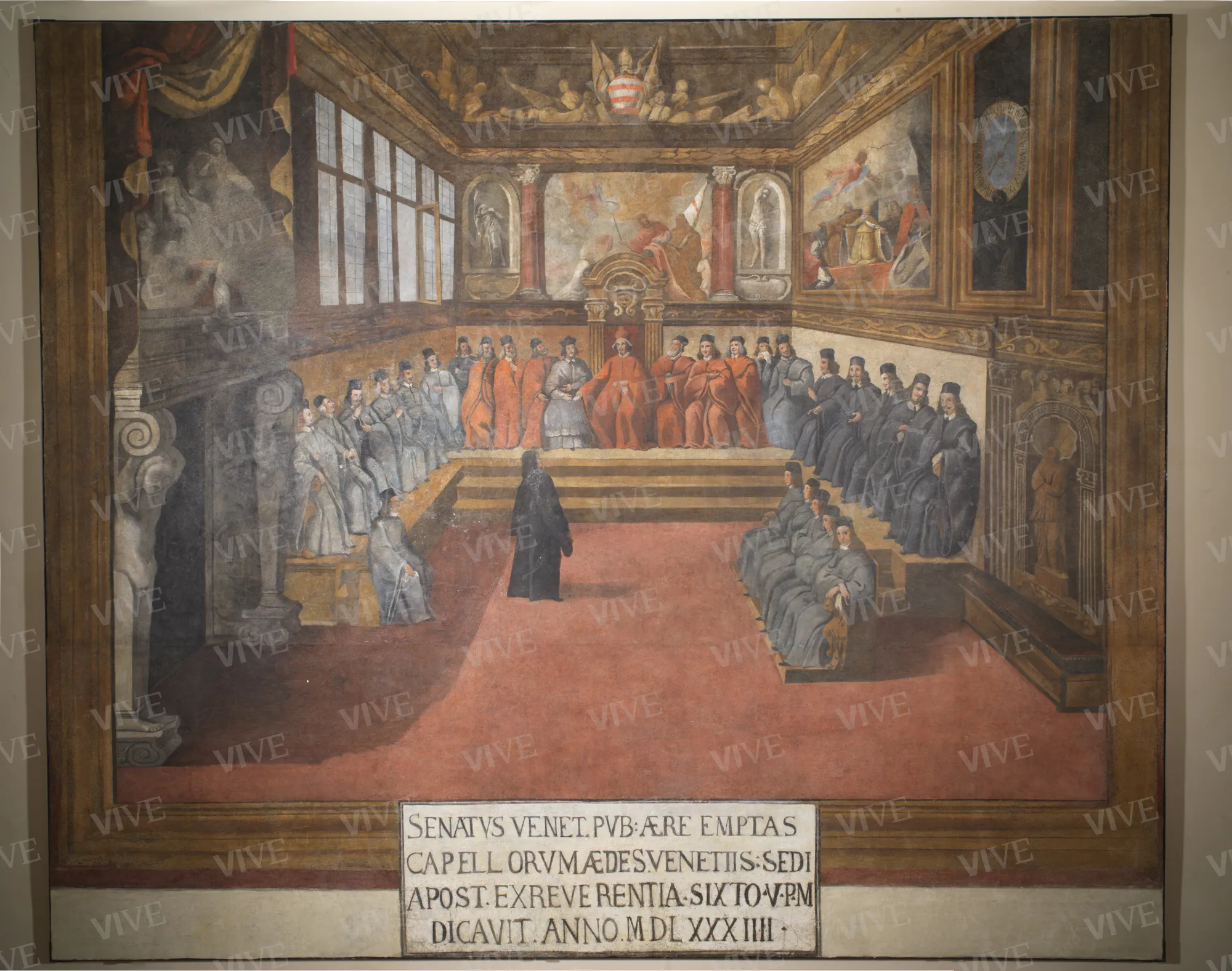
This piece commemorates the transfer of Palazzo Gritti from the Republic of Venice to Pope Sixtus V, which occurred on August 30, 1586. The scene is situated in the Sala del Collegio within the Doge’s Palace in Venice. Initially housed in a room of the Palazzetto di San Marco, the fresco, likely created in the early eighteenth century, was relocated towards the end of the nineteenth century to the Sala dei Paramenti. It was installed beneath the frieze illustrating The Labors of Hercules, as documented in contemporary images from that era.
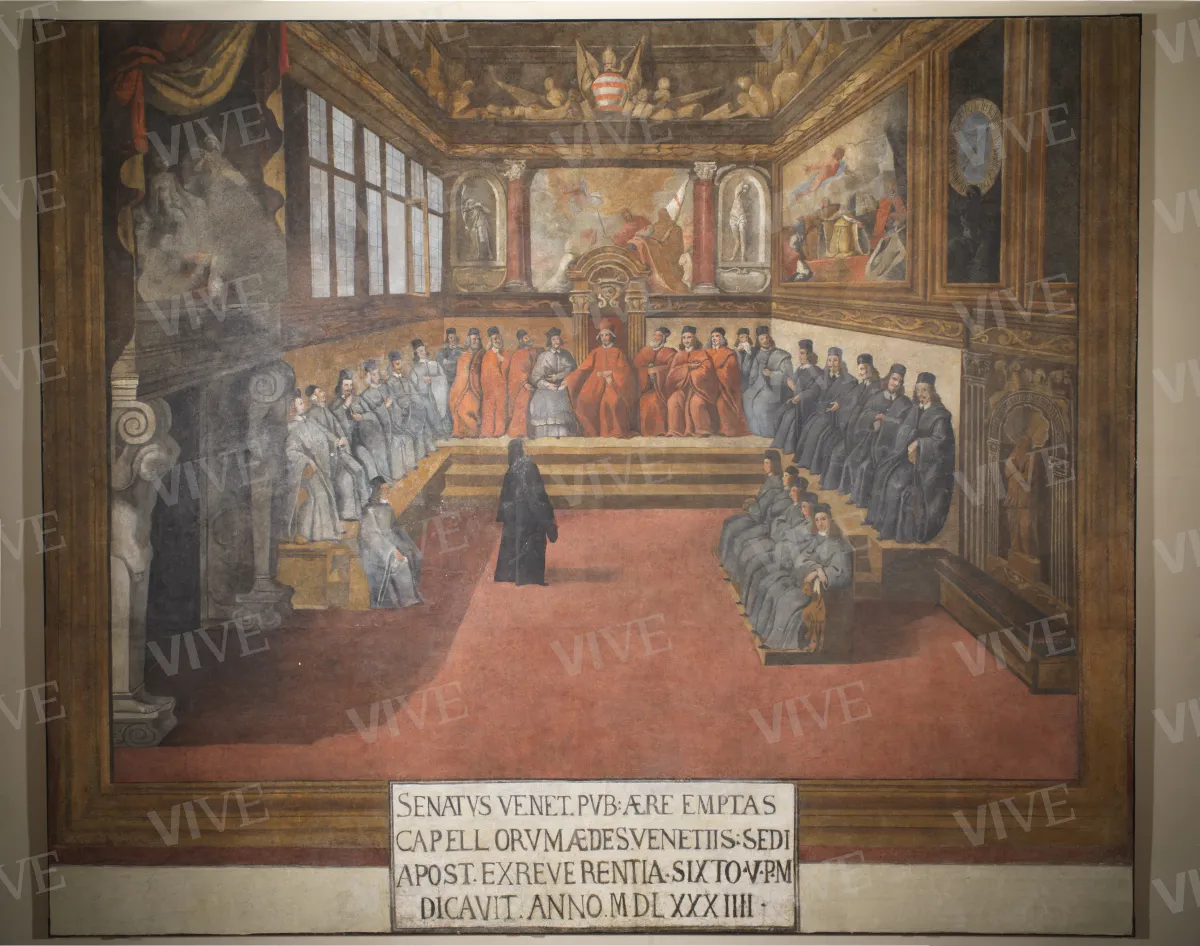
This piece commemorates the transfer of Palazzo Gritti from the Republic of Venice to Pope Sixtus V, which occurred on August 30, 1586. The scene is situated in the Sala del Collegio within the Doge’s Palace in Venice. Initially housed in a room of the Palazzetto di San Marco, the fresco, likely created in the early eighteenth century, was relocated towards the end of the nineteenth century to the Sala dei Paramenti. It was installed beneath the frieze illustrating The Labors of Hercules, as documented in contemporary images from that era.
The artwork commemorates the donation of Palazzo Gritti by the Republic of Venice to Pope Sixtus V, designating it as the residence for apostolic nuncios on August 30, 1586 (Gullino 2011, 74). The painting includes the following inscription: “SENATUS VENET. PUB. AERE EMPTAS CAPELLORUM AEDES VENETIIS SED APOST. EX REVERENTIA SISTO V M. DICAVIT ANNO MDLXXXIIII.” The act was executed in response to an earlier gift to the Serenissima from Pope Pius IV, who granted the Palazzo di San Marco on June 10, 1564. The palazzo, originally constructed in the early sixteenth century by Doge Andrea Gritti in San Francesco della Vigna, transferred to his heirs after his death in 1538. Over subsequent years, the property was leased to various prominent individuals before being sold to the Serenissima for 25,000 ducats (Gullino 2011, 74). Based on the inscription indicating that the palazzo belonged to the Cappello family, it is likely that during the papacy of Sixtus V, the residence had become associated with this distinguished Venetian lineage.
Currently housed in a room at the Museo di Palazzo Venezia , the painting was originally situated in the Palazzetto di San Marco, as documented by Pier Luigi Galletti (1757, V). Following the donation of the Palazzo di San Marco in 1564, the Palazzetto also served as the diplomatic headquarters for the Venetian ambassadors in Rome. According to Galletti, this project was complemented by a mural depicting Pius IV's grant of Palazzo Venezia to the Republic of Venice (inv. 10690). The fresco painting, attributed to an anonymous eighteenth-century artist, is currently preserved detached in one of the museum's rooms.
Documentation of the architectural and decorative work undertaken in the Palazzetto between 1723 and 1727, during Pietro Cappello’s (1676–1729) tenure as ambassador to Rome, indicates his involvement. Given Cappello’s documented interest in art (Benzoni 1975, 817–819; La storia del Palazzo di Venezia 2011a, 209–213), it is plausible that he commissioned these paintings, which commemorate the longstanding diplomatic and political relationship between the Holy See and the Republic of Venice.
The scene takes place in the Sala del Collegio at the Doge’s Palace in Venice, where Doge Pasquale Cicogna is depicted presenting the donation before the Maggior Consiglio. The composition is entirely based on the canvases of Pietro Malombra (1556–1618) depicting the same scene (Ridolfi 1648, I, 157; Pallucchini 1981, I, 48; II, 478 fig. 102; Piai 2012, 117–136). Among these works is the painting (inv. 10657), formerly misattributed to Jacopo Palma il Giovane, which also illustrates the episode of the 1586 donation. This piece is now housed in the Museum of Palazzo Venezia, having been donated by the cavaliere Marco Cappelli (Santangelo 1947, 3). The significantly compromised condition of the artwork can be attributed, at least in part, to its documented conservation issues. Historical records indicate that, in the late nineteenth century, the painting was relocated from its original setting in the Palazzetto to the Sala dei Paramenti, where it was positioned below the frieze illustrating The Labors of Hercules. Photographs and a 1920 watercolor by Ada Levi (also held at the Museo, inv. FN20958) demonstrate that the fresco of The Donation of Palazzo Gritti was previously displayed in a manner that partially obscured the decoration in the middle register of the wall, which features a sequence of cardinals who resided in Palazzo Venezia prior to 1564. Later, wallpaper was installed across the surface of the wall below the frieze depicting The Labors of Hercules, with an opening left solely for the prominent fresco representing The Donation of Palazzo Gritti. The current whereabouts of the other painting, which depicted The Donation by Pius IV and was removed in the early twentieth century (La storia del Palazzo di Venezia 2011b, 264), remain unknown. It is believed that the artwork may have been relocated to the Sala dei Paramenti, later renamed the Sala degli Affreschi (Hall of Frescoes) as noted by Corrado Ricci (Ricci 1916, VII).
Beginning in 1921, the room's layout underwent a complete transformation, with both the fresco depicting the cardinals' coats of arms and the one illustrating the donation of Palazzo Gritti being concealed behind panels. This is supported by period photographs as well as contemporary footage taken in the Palace's chambers. Documentation from Antonino Santangelo (1947, 3) confirms that the frescoes were still covered in 1947.
The specific date on which these works were transferred to other rooms within the palazzo has not been documented.
Maria Giulia Cervelli
Entry published on 16 October 2025
Compromised.
“SENATUS VENET. PUB. AERE EMPTAS CAPELLORUM AEDES VENETIIS SED APOST. EX REVERENTIA SISTO V M. DICAVIT ANNO MDLXXXIIII.”
Pier Luigi Galletti, Inscriptiones Venetae infimi aevi Romae extantes, Rome 1757, V: “SENATUS VENET. PUB. AERE EMPTAS CAPELLORUM AEDES VENETIIS SED APOST. EX REVERENTIA SISTO V M. DICAVIT ANNO MDLXXXIIII.”
Ridolfi Carlo, Le maraviglie dell’arte, 2 voll., Venezia 1648;
Galletti Pier Luigi, Inscriptiones Venetae infimi aevi Romae extantes, Roma 1757;
Ricci Corrado, Il Palazzo di Venezia, Milano 1916;
Santangelo Antonino (a cura di), Museo di Palazzo Venezia. Catalogo. 1. Dipinti, Roma 1947, p. 3;
Benzoni Gino, Pietro Cappello, in Dizionario Biografico degli Italiani, vol. XV, Roma 1975, pp. 817-819;
Pallucchini Rodolfo, La pittura veneziana del Seicento, 2 voll., Venezia 1981;
Gullino Giuseppe, Le afflizioni del dono, in Barberini Maria Giulia, De Angelis d'Ossat Matilde, Schiavon Alessandra (a cura di), La storia del Palazzo di Venezia: dalle collezioni Barbo e Grimani a sede dell'ambasciata veneta e austriaca, Roma 2011, pp. 67-78;
La storia del Palazzo di Venezia: dalle collezioni Barbo e Grimani a sede dell'ambasciata veneta e austriaca. Archivio di Stato di Venezia, in Barberini Maria Giulia, De Angelis d'Ossat Matilde, Schiavon Alessandra (a cura di), La storia del Palazzo di Venezia: dalle collezioni Barbo e Grimani a sede dell'ambasciata veneta e austriaca, Roma 2011, pp. 117-243 (La storia del Palazzo di Venezia 2011a);
La storia del Palazzo di Venezia: dalle collezioni Barbo e Grimani a sede dell'ambasciata veneta e austriaca. Archivio di Stato di Vienna, in Barberini Maria Giulia, De Angelis d'Ossat Matilde, Schiavon Alessandra (a cura di), La storia del Palazzo di Venezia: dalle collezioni Barbo e Grimani a sede dell'ambasciata veneta e austriaca, Roma 2011, pp. 247-293 (La storia del Palazzo di Venezia 2011b);
Barberini Maria Giulia, De Angelis d'Ossat Matilde, Schiavon Alessandra (a cura di), La storia del Palazzo di Venezia: dalle collezioni Barbo e Grimani a sede dell'ambasciata veneta e austriaca. Documenti, Roma 2011, pp. 247-293;
Piai Andrea, Un pittore all’ombra di Palma e Tintoretto, in Marinelli Sergio (a cura di), Aldèraban, 1, Venezia 2012, pp. 117-135.