Vittoriano


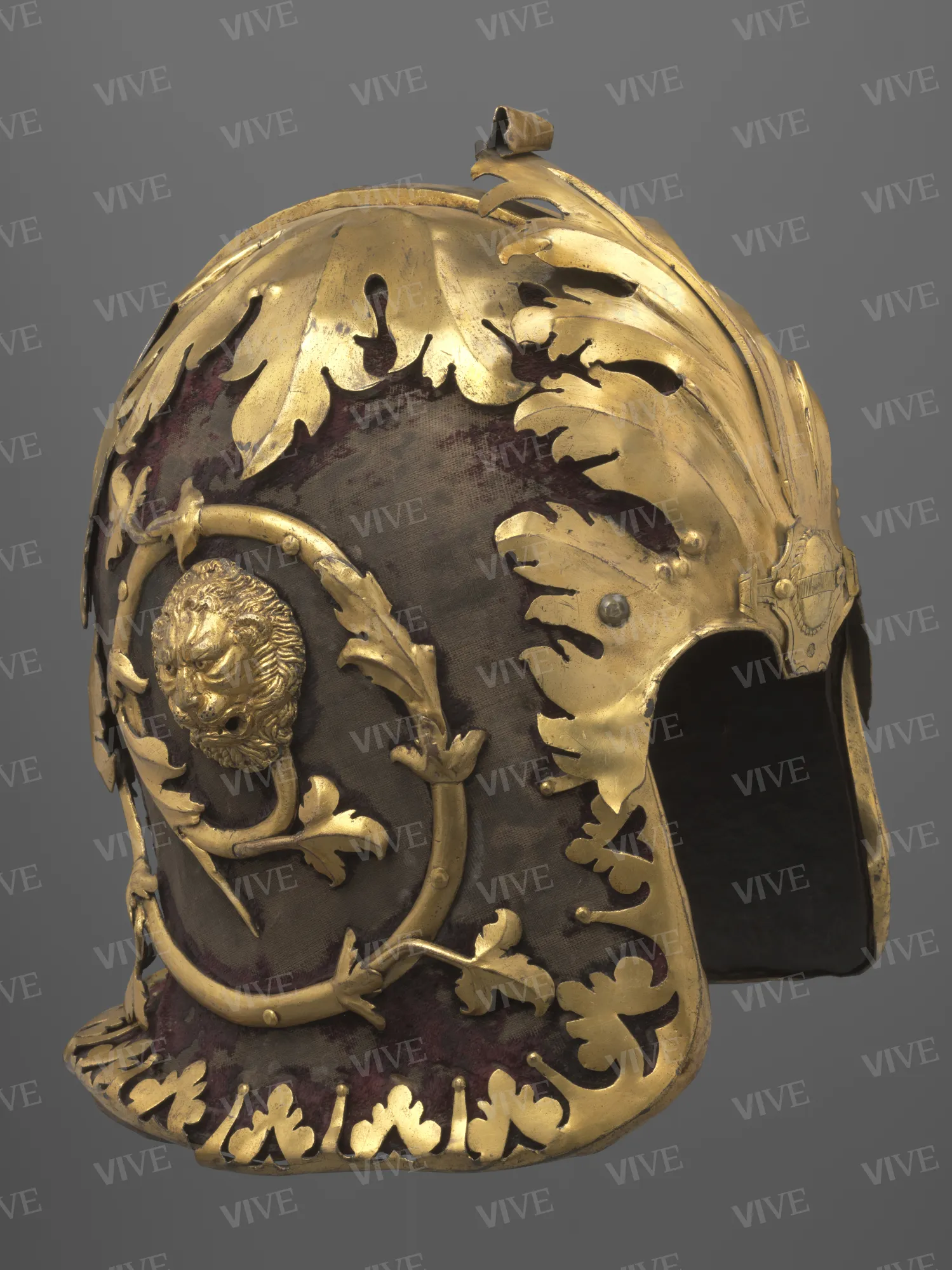
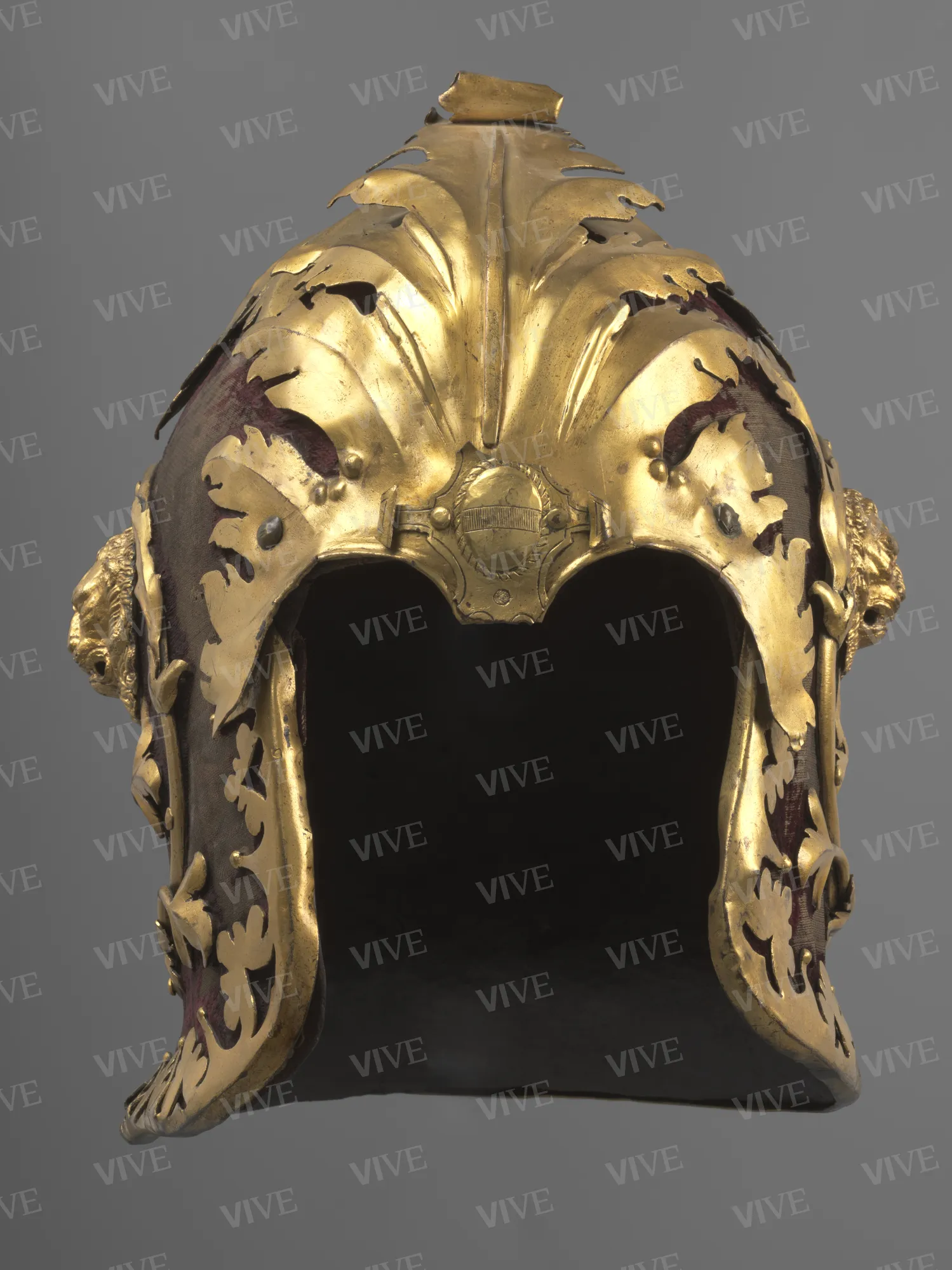
Made of iron, adorned with rich velvet accents and gilded copper leaves, this ceremonial barbute likely served in the processions accompanying the Doge of the Republic of Venice during the early seventeenth century. The dating of this piece is supported by a painting attributed to Caravaggio (Metropolitan Museum of Art, New York), created between 1609 and 1610, which depicts a soldier wearing a helmet closely resembling the example housed at the Museo di Palazzo Venezia.
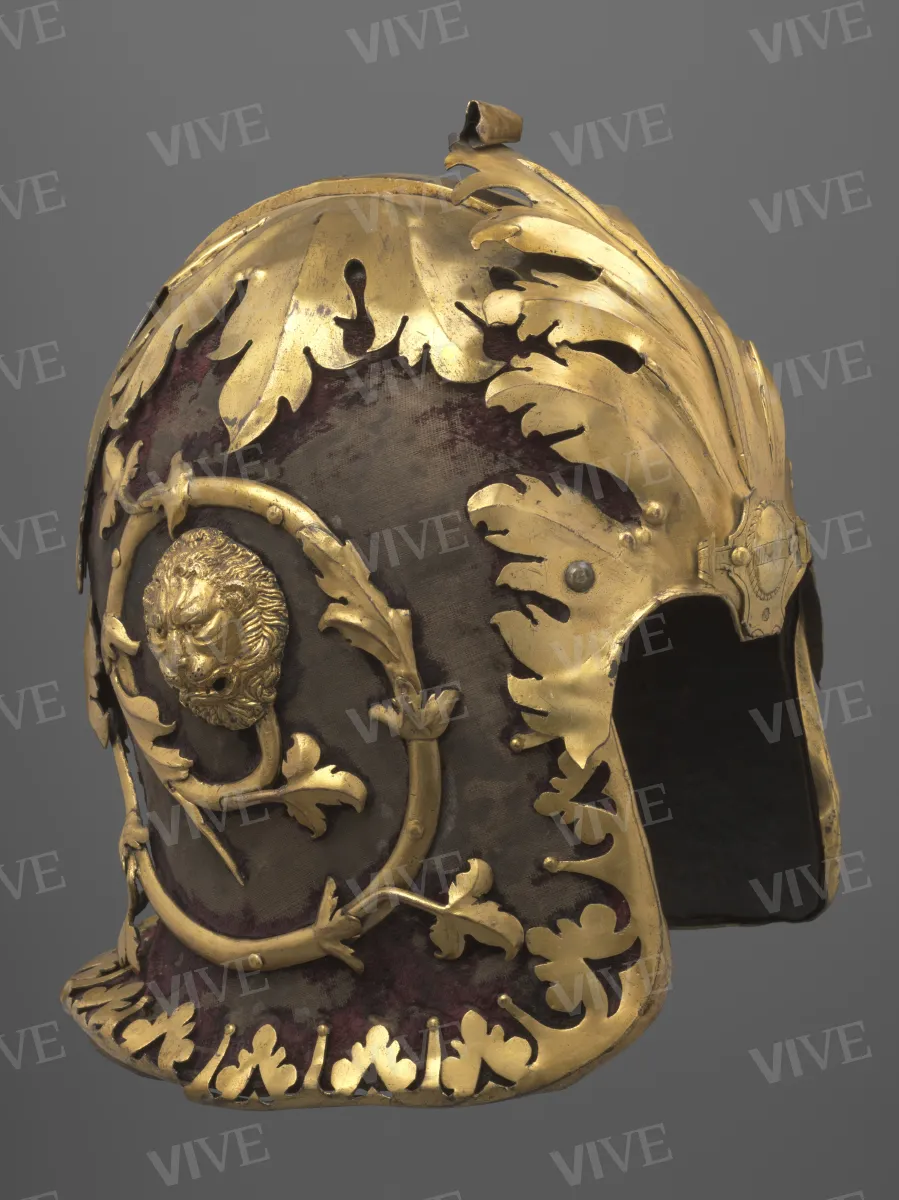

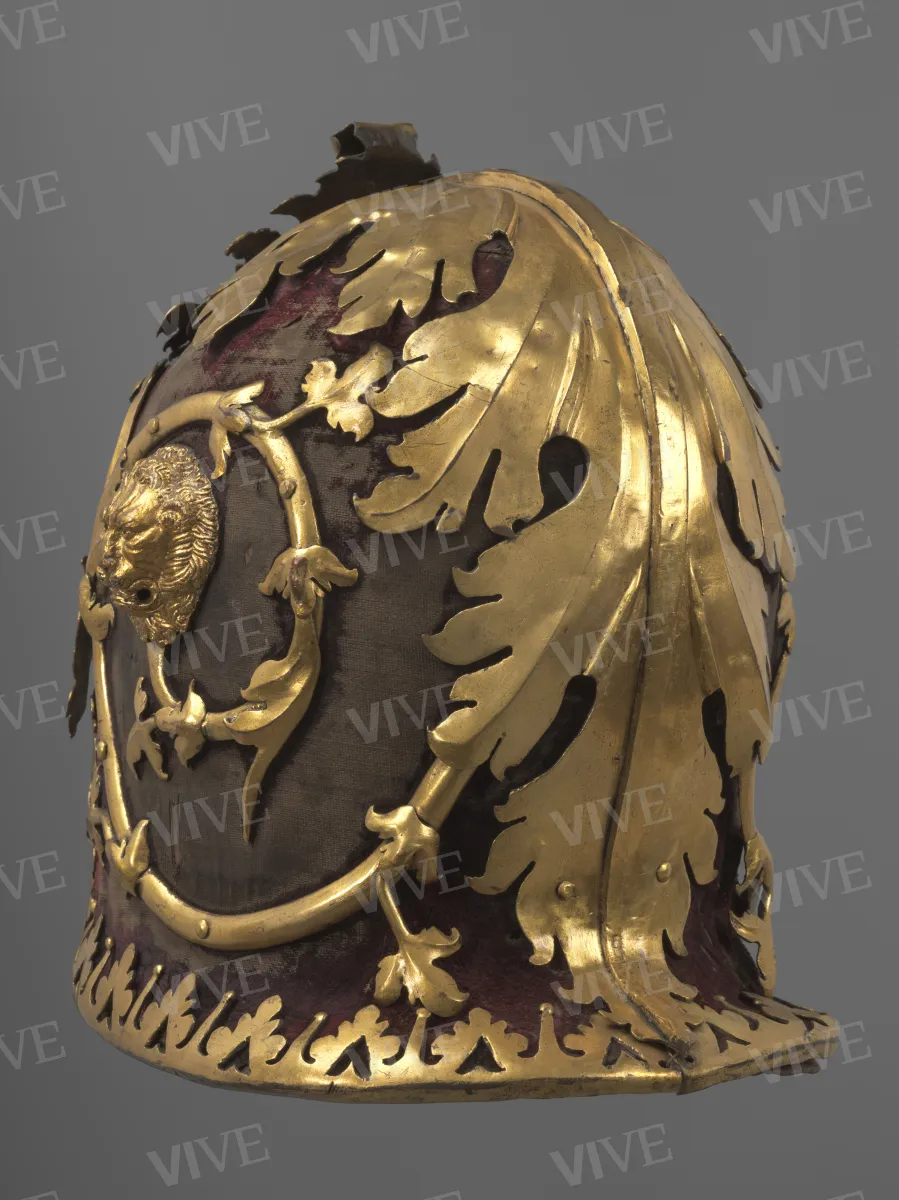
Made of iron, adorned with rich velvet accents and gilded copper leaves, this ceremonial barbute likely served in the processions accompanying the Doge of the Republic of Venice during the early seventeenth century. The dating of this piece is supported by a painting attributed to Caravaggio (Metropolitan Museum of Art, New York), created between 1609 and 1610, which depicts a soldier wearing a helmet closely resembling the example housed at the Museo di Palazzo Venezia.
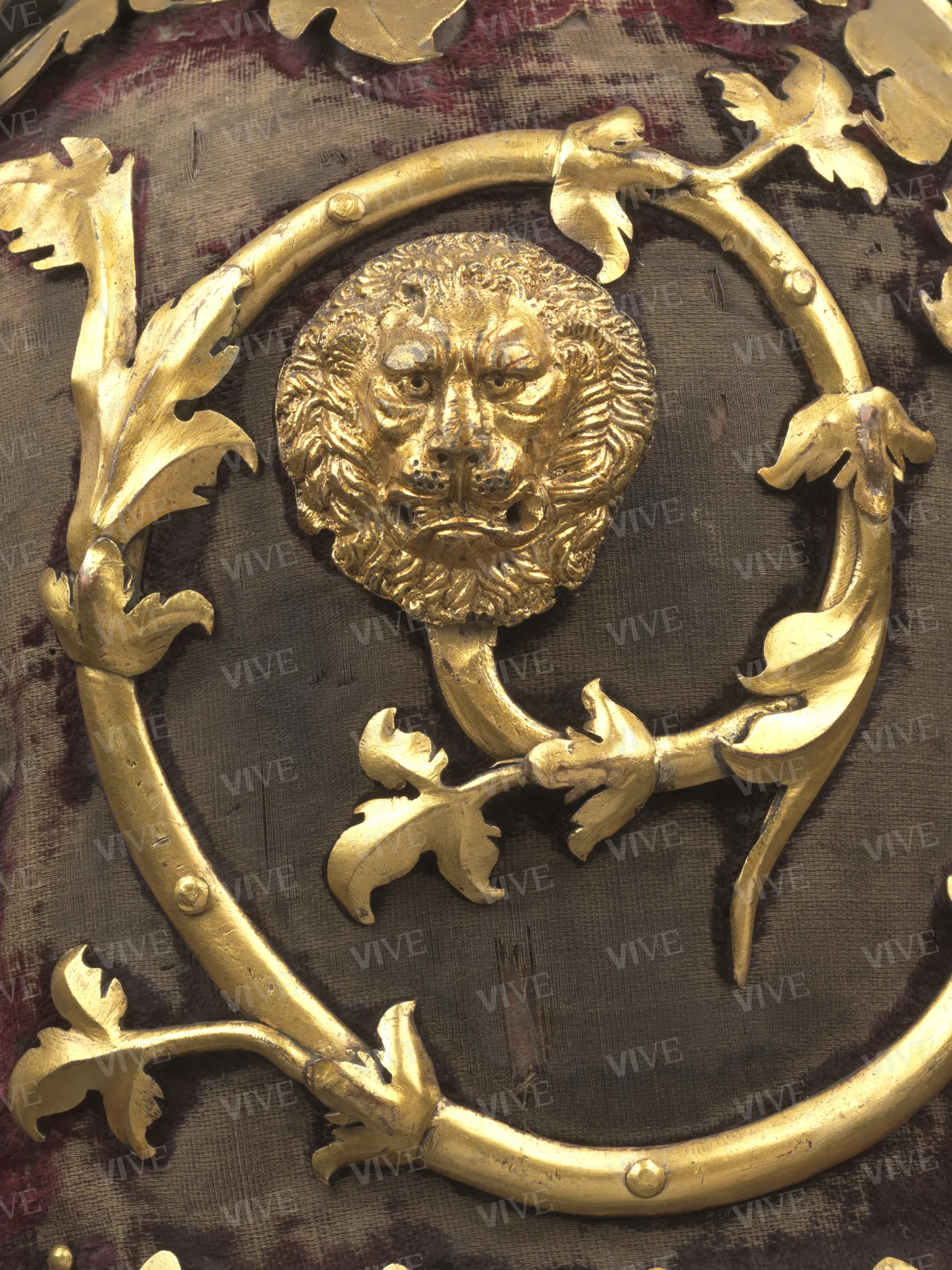
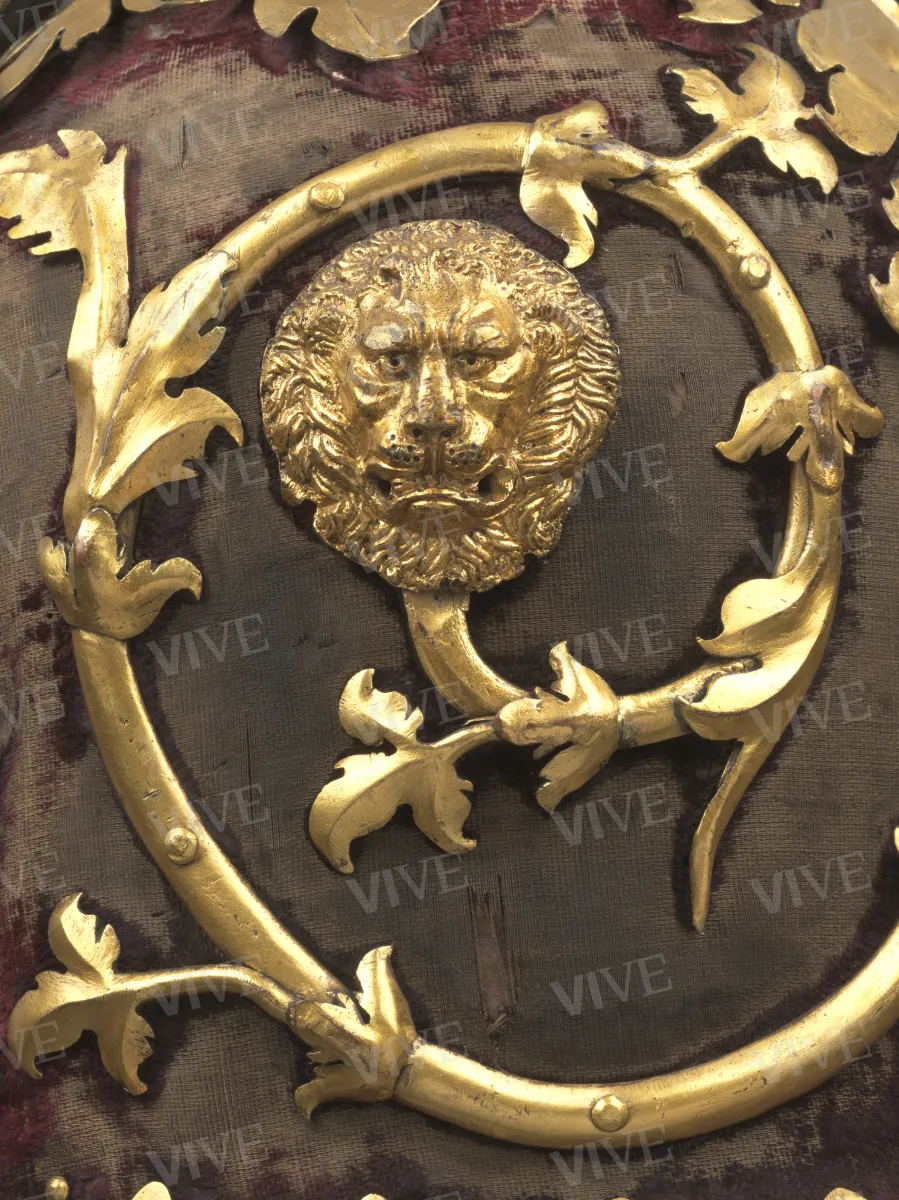
The barbute, also known as the "celata," was a form of war helmet utilized beginning in the fourteenth century. It was designed to offer comprehensive protection for a soldier's head, covering the area from the forehead to the nape of the neck. This example comprises a cap formed from an iron structure, subsequently enhanced with elaborate velvet and gilded metal decoration (Laking 1920–1922, II, 12, fig. 352). Crafted as a single piece, it features an elongated profile, an inverted U-shaped face opening with a mixtilinear outline, and a flared neck. The robust, tempered iron helmet likely originated in the fifteenth century and was repurposed in the seventeenth century to serve as an ornate and decorative parade garment. The addition can be attributed to the early seventeenth century within the Venetian milieu, as comparable helmets were utilized during ceremonial processions accompanying the Doge of the Serenissima in Saint Mark’s Square on specific occasions (Boccia, Coelho 1968, n. 124; di Carpegna 1969, 19, n. 88; see also Nickel, Phyrr, Tarassuk 1982, 25–27, n. 3 for a similar example). The helmet’s durable metal is entirely covered by red velvet—now abraded in multiple areas—over which an elaborate gilded copper ornament is affixed with rivets. This decorative element, shaped as acanthus leaves, frames the facial opening and ascends the dome, culminating in ornamental scrolls adorned with lion protomes displaying clenched jaws and a formidable expression. The lower rim is embellished with a succession of pinnacles and stylized foliage, reflecting motifs common in Venetian Renaissance architecture. Such distinctive ornamentation clearly situates the production of the barbute within Venice, where lavish specimens were crafted for the Doge’s processional regalia. Additionally, the front of the helmet features an oval heraldic escutcheon bordered by a twisted rope and a dark central stripe, rendered in metal using fine vertical knurling.
The absence of distinctive features and coloration prevents identification of the heraldic origin of this coat of arms, suggesting it may be a purely decorative element or a plaque added subsequently. Comparable Venetian-style barbutes lacking coats of arms are present in both the Doge’s Palace armory in Venice (inv. C 34, extensively examined by Franzoi 1990, pp. 72–73, item 22) and the Museo Nazionale del Bargello in Florence (inv. 1634C). Notably, while the barbute discussed here displays only a hole at the top—indicative of a former decorative piece—the examples from the Doge’s Palace and the Museo Nazionale del Bargello retain significant gilded copper ornamentation: the Florentine specimen features the upper half of a lion with an extended mane, whereas the Venetian example presents the stylized figure of a dragon, originally intended to support heraldic plumage. A chronological reference for dating this particular barbute can be found in a painting by Michelangelo Merisi da Caravaggio, housed at the Metropolitan Museum of Art in New York and formerly part of Cardinal Paolo Savelli's collection (inv. 1997-167; see also Nicolaci, Gandolfi 2011 for further bibliography). Created during the final months of Caravaggio’s life, between 1609 and 1610, the work—depicting The Denial of Saint Peter—features, to the left within the composition’s subdued palette, a helmet closely resembling the specimen under discussion worn by a soldier. Previously included in Stefano Bardini’s Florentine collection, the barbute was auctioned at Christie’s in July 1899 (Christie 1899, 11, n. 47; Cripps–Day 1925, 120), achieving a price of £400—the highest among the weapons offered in that sale, as noted in a catalog copy held by the Getty Research Institute in Los Angeles. An additional annotation attributes the acquisition to a certain Da Costa, which may refer to the Da Costas, Portuguese manufacturers of medals and military decorations since 1823 and known collectors of arms and armour. Subsequently, the helmet was acquired by Prince Ladislao Odescalchi (1846–1922) and ultimately, along with the remainder of the armory, purchased by the Italian state in 1959 and transferred to the Palazzo Venezia Museum in 1969. It is noteworthy that the Odescalchi collection did not originate as a family arsenal but resulted from strategic acquisitions across Italian (Florence, Rome) and international (Paris, London) markets beginning in the late nineteenth century, directed by Prince Ladislao's discerning preferences (Barberini 2007; Fossà 2007).
Giulia Zaccariotto
Entry published on 16 October 2025
Fair.
formerly Da Costa and previously Bardini collections, Florence (purchased at Christie’s in 1899, n. 47);
Rome, Collezione Ladislao Odescalchi (Odescalchi, n. 1660);
acquired by the Italian State, 1959;
Rome, Museo Nazionale di Palazzo Venezia, 1969.
Rome, Museo Nazionale di Palazzo Venezia. Antiche armi dal sec. IX al XVIII. Già Collezione Odescalchi, May–July 1969.
Christie, Mason & Wood, Catalogue of a Choice Collection of Pictures, Antiquities, Works of Art of the Middle Ages and Renaissance, from the Collection of Signor Stephano Bardini of Florence, 5th June 1899, London 1899;
Laking, Guy Francis, A Record of European Armour and Arms through Seven Centuries, 5 voll., London 1920-1922;
Cripps-Day, Francis Henry, A Record of Armour Sales - 1881-1924, London 1925;
Boccia Lionello Giorgio, Coelho Eduardo Teixeira, L’arte dell’armatura in Italia, Milano 1968;
di Carpegna Nolfo (a cura di), Antiche armi dal sec. IX al XVIII. Già Collezione Odescalchi, catalogo della mostra (Roma, Museo Nazionale di Palazzo Venezia, maggio-luglio 1969), con schede a firma del curatore, Roma 1969;
Nickel Helmut, Phyrr Stuart, Tarassuk Leonid (a cura di), The Art of Chivalry. European Arms and Armor from the Metropolitan Museum of Art, catalogo della mostra (New York, Metropolitan Museum of Art, 1982), New York 1982;
Franzoi Umberto, L'armeria di Palazzo Ducale di Venezia, Treviso 1990;
Barberini Maria Giulia, La collezione Odescalchi di armi antiche: storia della raccolta del principe Ladislao, in «Bollettino d’arte», s. VI, XCI, 2006 (2007), 137/138, pp. 101-114;
Fossà Bianca, Studio conservativo delle armi e armature Odescalchi. Nuove metodologie per la schedatura di una collezione, in «Bollettino d’arte», s. VI, XCI, 2006 (2007), 137/138, pp. 115-142;
Nicolaci Michele, Gandolfi Riccardo, Il Caravaggio di Guido Reni. La “Negazione di Pietro” tra relazioni artistiche e operazioni finanziarie, in «Storia dell’Arte», n.s., 130, 2011, pp. 41-64.