Vittoriano


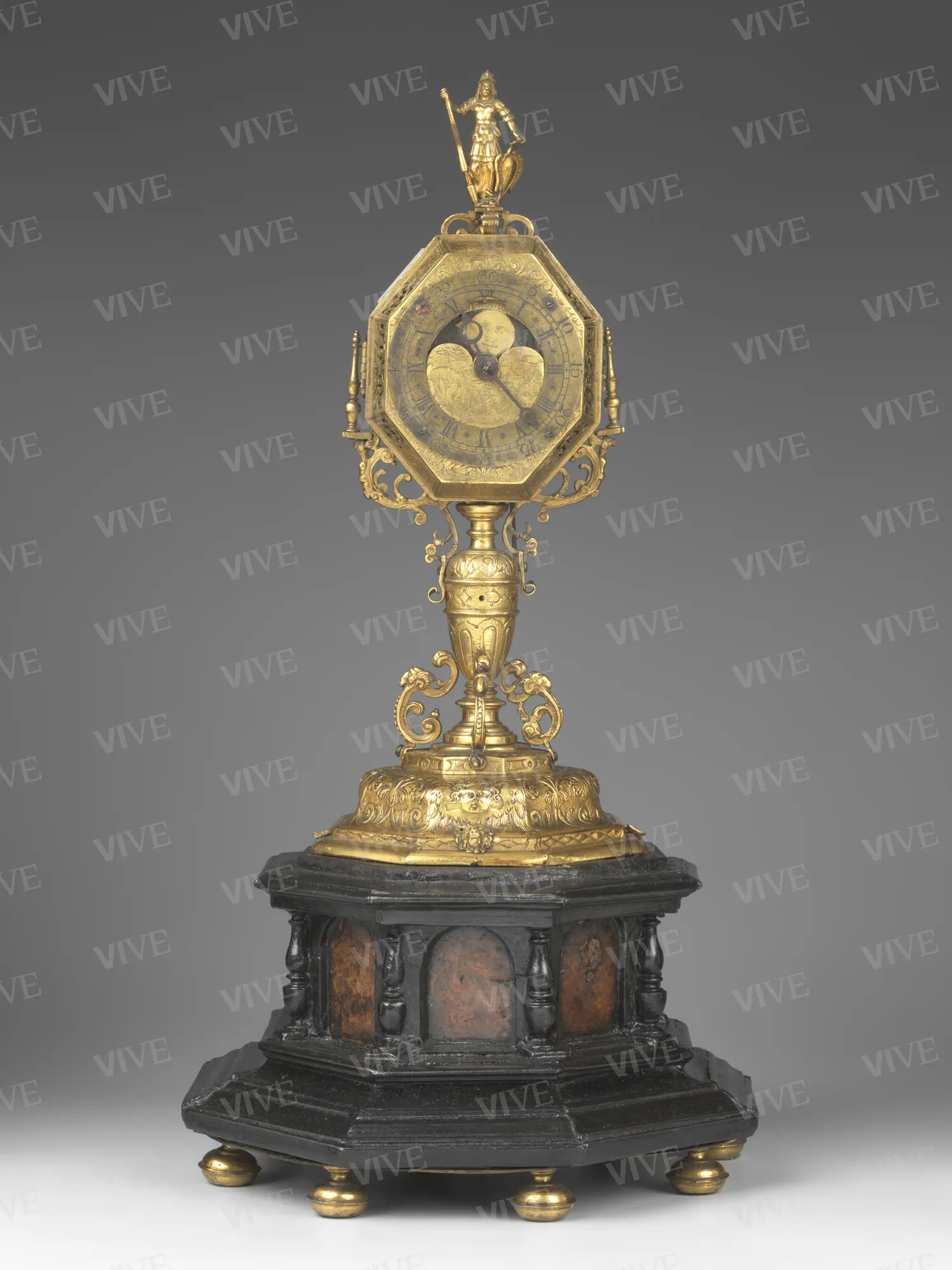
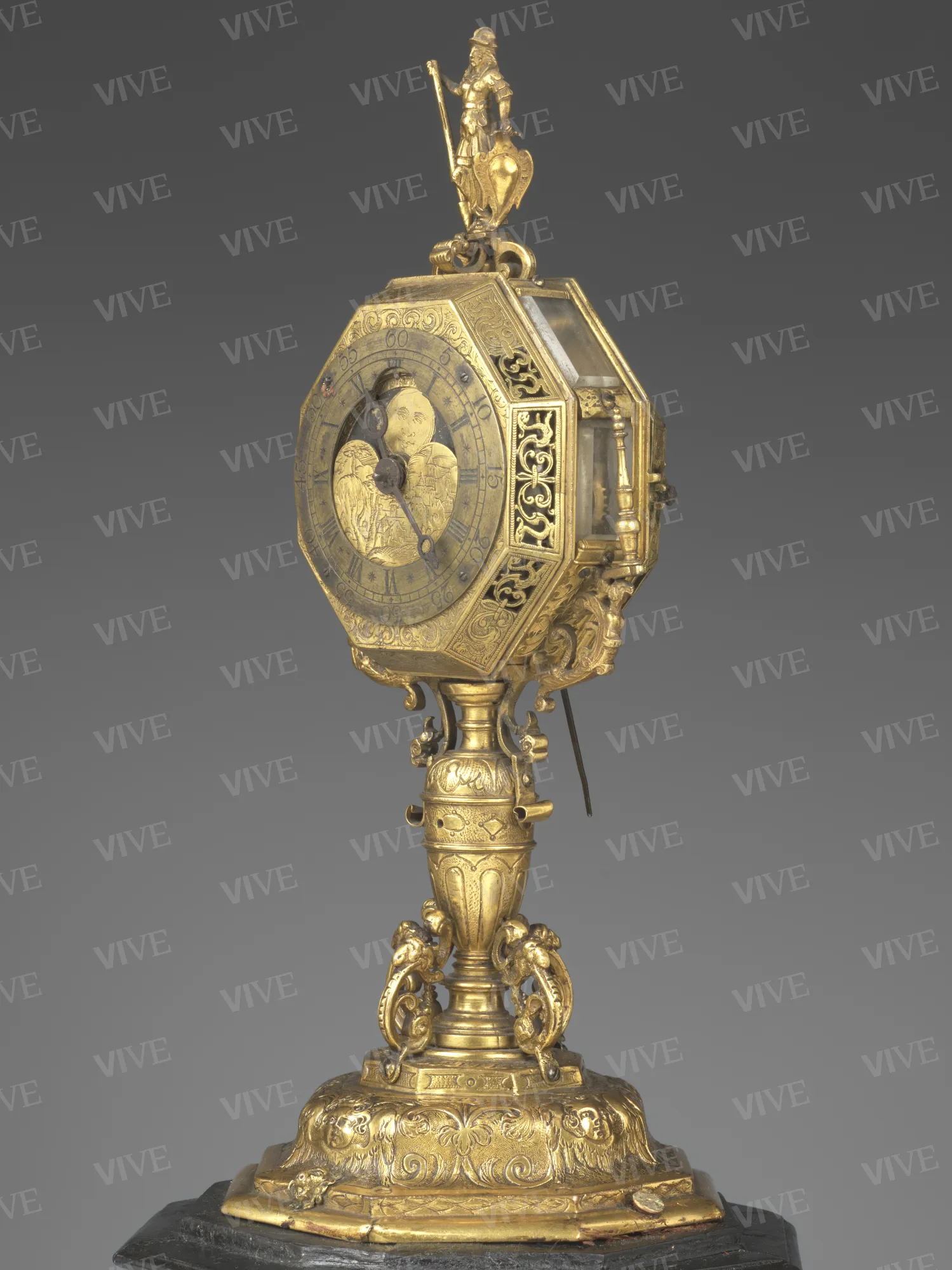
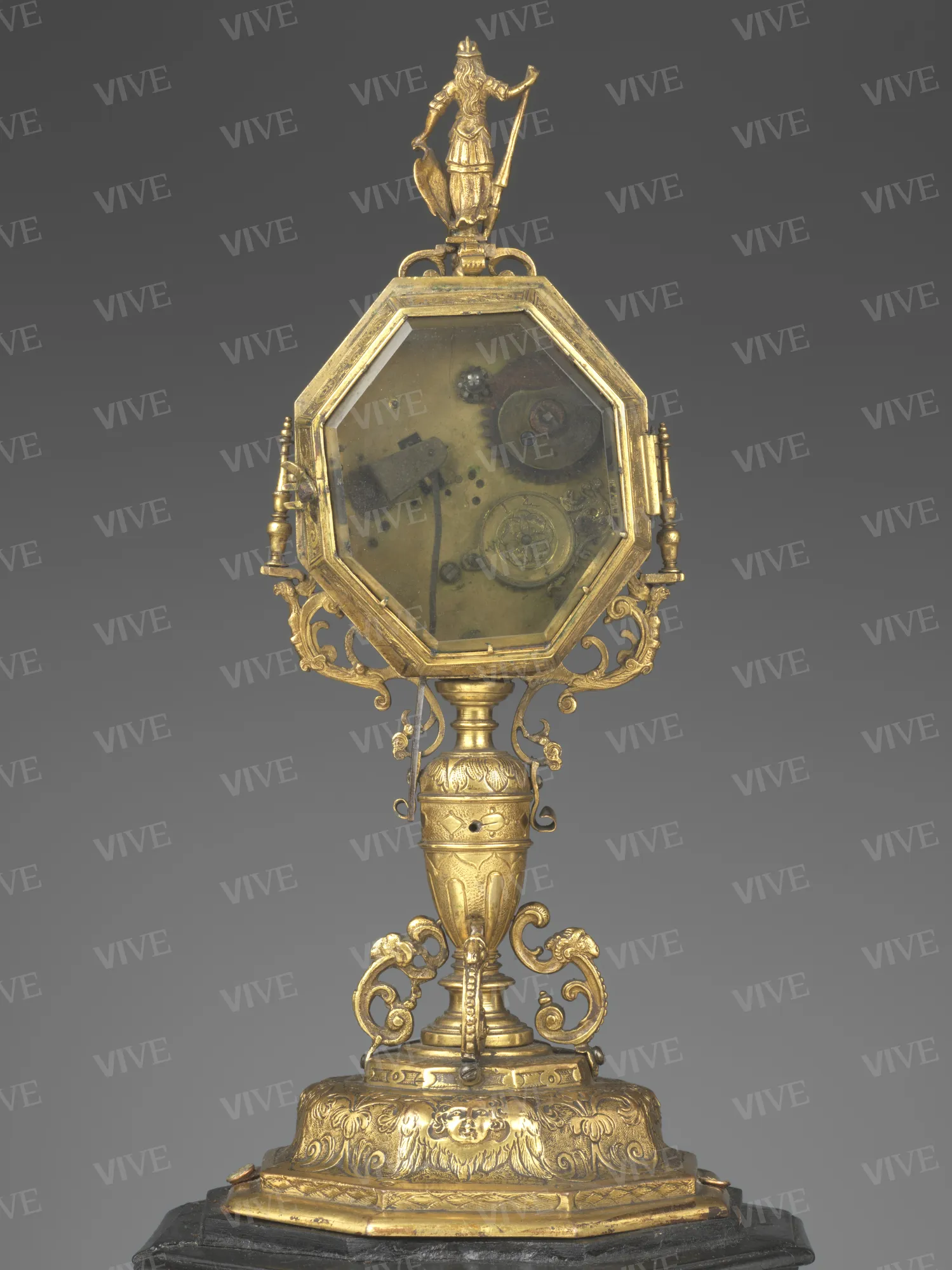
This octagonal table clock rests upon a wooden pedestal, featuring a shaped base adorned with winged cherub heads amidst leafy volutes. The vase-shaped body is enhanced with zoomorphic handles, while the octagonal case is distinguished by openwork sides and a glass door at the back. Atop the case sits an in-the-round figure of Minerva. The display, embellished with grotesques, includes a minute ring marked with Arabic numerals (5–60) and an hour ring with Roman numerals (I–XII). Centrally located, a round dial contains the moon disc above a semicircular plate engraved with a landscape scene. This piece is attributed to the German school from the first half of the seventeenth century.
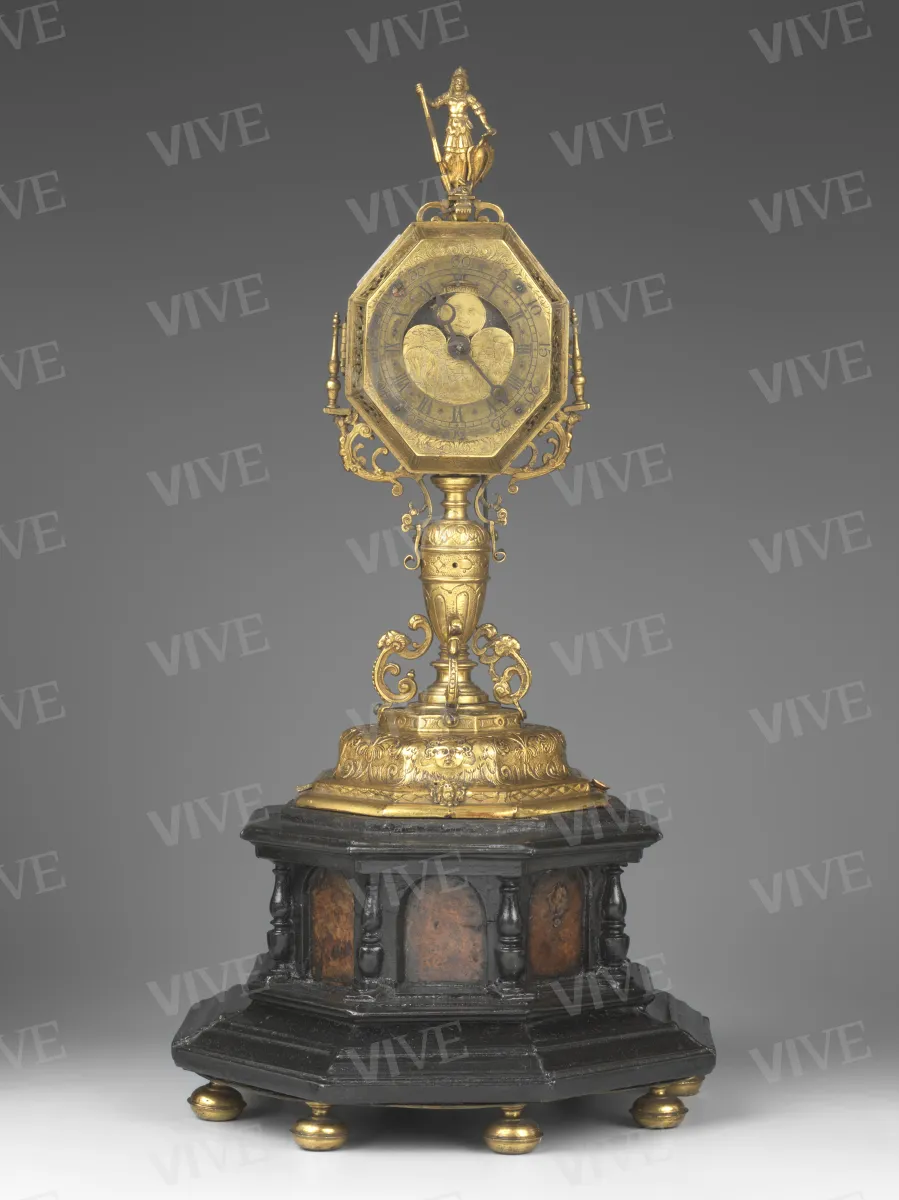

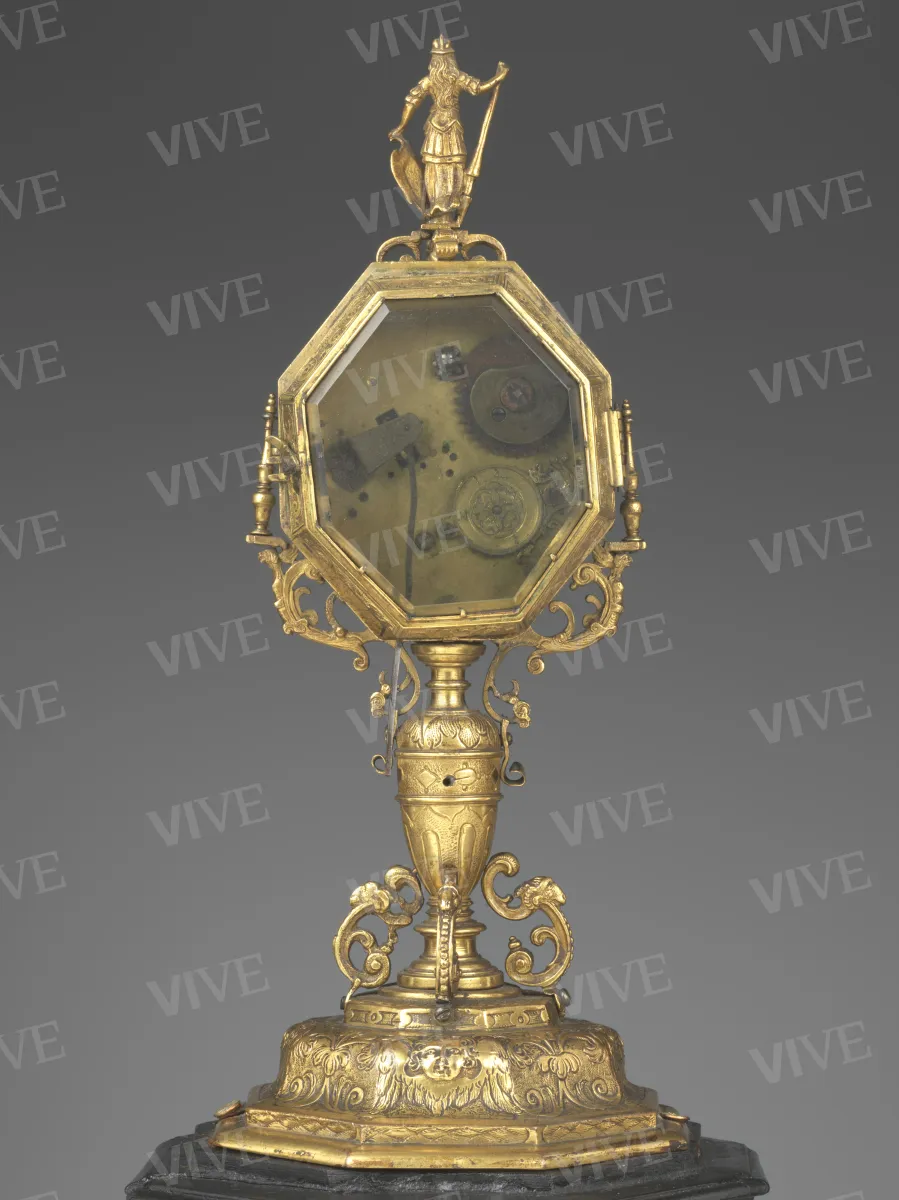

This octagonal table clock rests upon a wooden pedestal, featuring a shaped base adorned with winged cherub heads amidst leafy volutes. The vase-shaped body is enhanced with zoomorphic handles, while the octagonal case is distinguished by openwork sides and a glass door at the back. Atop the case sits an in-the-round figure of Minerva. The display, embellished with grotesques, includes a minute ring marked with Arabic numerals (5–60) and an hour ring with Roman numerals (I–XII). Centrally located, a round dial contains the moon disc above a semicircular plate engraved with a landscape scene. This piece is attributed to the German school from the first half of the seventeenth century.
The table clock, previously part of the Auriti Collection (1963), was attributed by Antonino Santangelo (1964, 48) to a workshop active in the Netherlands during the mid-seventeenth century. This attribution was subsequently affirmed by Pietro Cannata (2011, 173), who further identified its original provenance as an unspecified kunstkammer.
The piece exemplifies a style prevalent in Germany during the sixteenth and seventeenth centuries, particularly in Augsburg and Nuremberg, which became renowned for their production of mechanical clocks featuring advanced mechanisms and sophisticated designs. This achievement was largely attributable to the establishment of an effective guild system and the strong collaboration among technicians, goldsmiths, and foundry workers, supported by highly skilled engravers (Bruton 1979, 54, 56; Koeppe 2019, 198). Within this context, the composite structure of the support—comprising a shaped metal pedestal mounted on an octagonal wooden base—closely parallels the design of a “mirror” table clock created in Augsburg by Caspar Langenpucher in 1649 (Maurice 1976c, 73, no. 554). However, the Auriti clock lacks the arched reserves between projecting balustrades found at the base of Langenpucher's piece, a feature that is also present in a figurative clock by David Haissermann of Augsburg, circa 1610 (Emmendörffer 2016, 146–147).
The distinctive tripartite, pod-shaped design of the case is also observed in a table clock crafted in Augsburg by Andreas Stahel at the close of the sixteenth century (Maurice 1976a, 62, n. 459), as well as in a comparable example housed in the Victoria & Albert Museum, London, attributed to a German maker working during the mid-seventeenth century (inv. M.54–1952). The polygonal architecture of the case, notable for its incorporation of cut crystal slabs set within its thickness, finds typological parallels in a clock produced in Augsburg by Hans Buschmann in the second quarter of the seventeenth century (Maurice 1976b, 62, n. 460) and in a similar piece marked by Martin Zoller (active in Augsburg, 1590–1633), currently held in the Metropolitan Museum of Art, New York (inv. 32.100.225). The object's decorative repertoire, executed in-the-round with sculptural forms, openwork techniques, and engraving, features zoomorphic herms, fantastical creatures, and sea monsters—motifs reminiscent of those found in goldsmith designs published by Christoph Jamnitzer in Nuremberg in 1610 (Jamnitzer 1966, pp. 14, 36, 39, 41, 55, 58). Within this context, the rural landscape engraved on the semicircular plate at the dial's centre closely resembles, in its detailing, a plaque dated 1572 attributed to the Nuremberg goldsmith Hans Jamnitzer, previously referenced in a series dedicated to the so-called Children of the Planets (Weber 1975, 161, no. 275). The case is surmounted by an in-the-round representation of Minerva, depicted with armour, shield, and spear, embodying her role as the “goddess of prudence and inventor of all arts” (Cartari 1996, 317).
Daria Gastone
Entry published on 16 October 2025
Buono. Ossidazione.Good. Some oxidation.
Collezione Giacinto Auriti, 1963.
Typed inventory card, P.V. 10873, n.n., n.d., Archivio del Museo Nazionale del Palazzo di Venezia;
Santangelo Antonino, La collezione Giacinto Auriti. Piccoli bronzi placchette incisioni oggetti di uso, bozza dattiloscritta, 46, Archivio del Museo Nazionale del Palazzo di Venezia;
ICCD OA, NCTN 1200865124, compiled by Dell’Ariccia A., 2004.
Santangelo Antonino, Museo di Palazzo Venezia. La Collezione Auriti, Roma 1964, p. 48;
Jamnitzer Christoph, Neuw Grottessken Buch, Franz Heinrich Gerhard (a cura di), Graz 1966, pp. 14, 36, 39, 41, 55, 58;
Weber, in Weber Ingrid, Deutsche, niederländische und französische Renaissanceplaketten 1500-1650, I, München 1975, p. 161, n. 275;
Maurice, in Maurice Klaus, Die deutsche Räderuhr, II, München 1976, p. 62, n. 459 (Maurice 1976a);
Maurice, in Maurice Klaus, Die deutsche Räderuhr, II, München 1976, p. 62, n. 460 (Maurice 1976b);
Maurice, in Maurice Klaus, Die deutsche Räderuhr, II, München 1976, p. 73, n. 554 (Maurice 1976c);
Bruton Eric, The History of Clocks and Watches, London 1979, pp. 54, 56;
Cartari Vincenzo, Le imagini dei dei de gli antichi, Auzzas Ginetta, Martignago Federica, Pastore Stocchi Manlio, Rigo Paola (a cura di), Vicenza 1996, p. 317;
Cannata, in Cannata Pietro, Museo Nazionale del Palazzo di Venezia. Sculture in bronzo, Roma 2011, p. 173, n. 195;
Emmendörffer Christoph, Maximilianmuseum. Augsburgs Schatzkammer, Mering 2016, pp. 146-147;
Koeppe Wolfram, Clocks and Automata. The Art of Technological Development, in Koeppe Wolfram, Making Marvels. Science and Splendor at the Courts of Europe, catalogo della mostra (New York, Metropolitan Museum of Art, 25 novembre 2019-1 marzo 2020), New York 2019, pp. 195-203.