Vittoriano


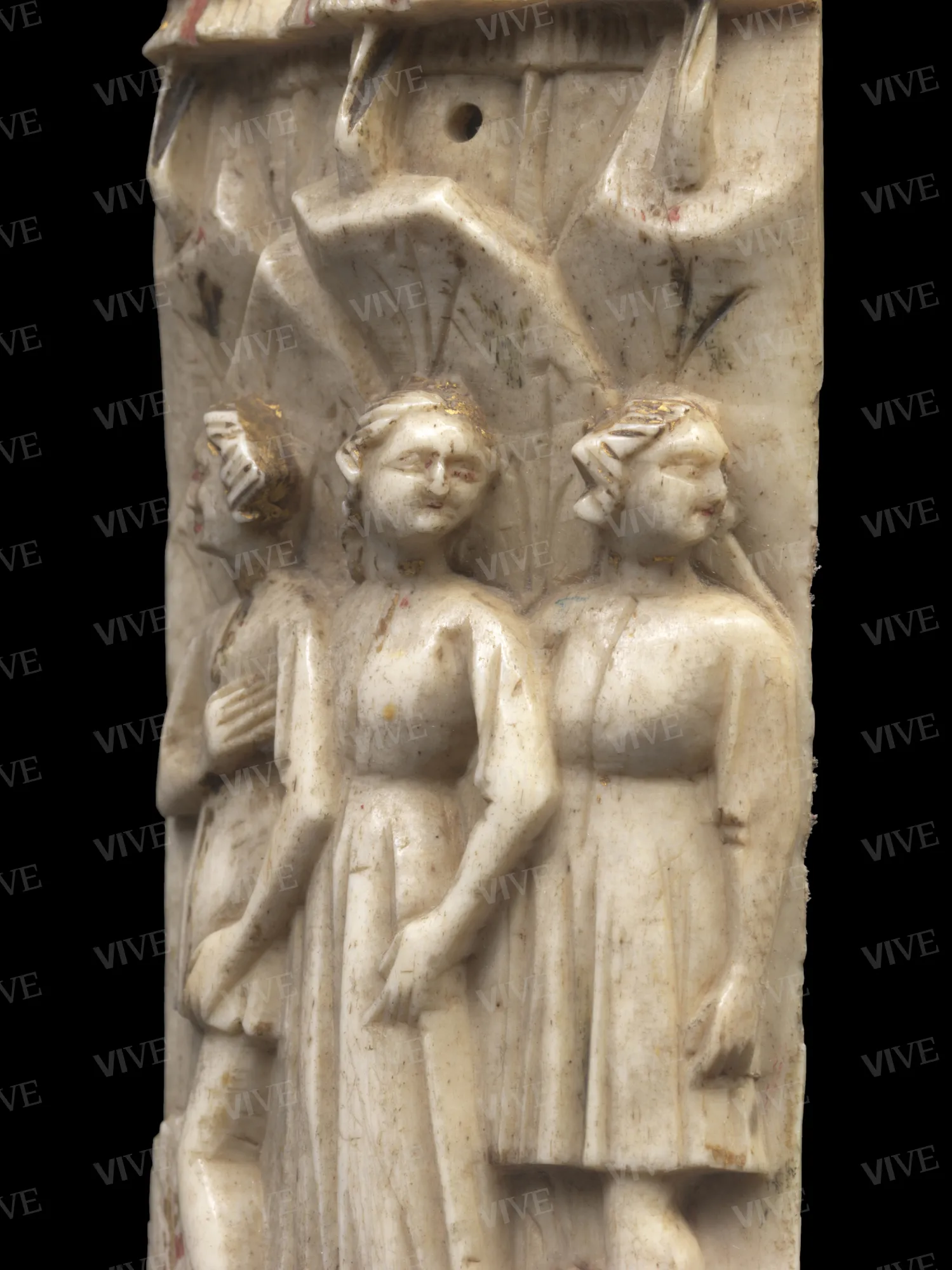
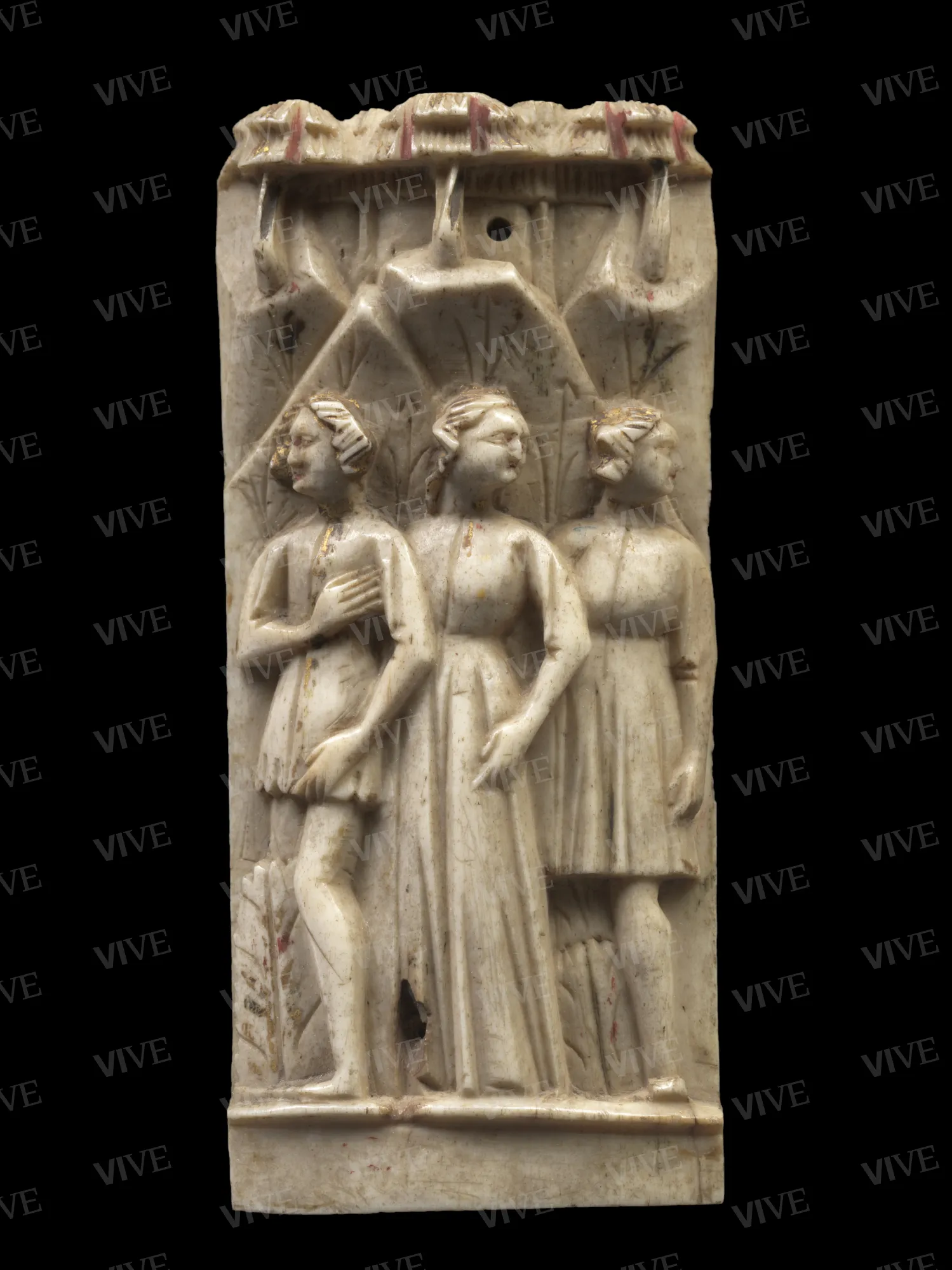
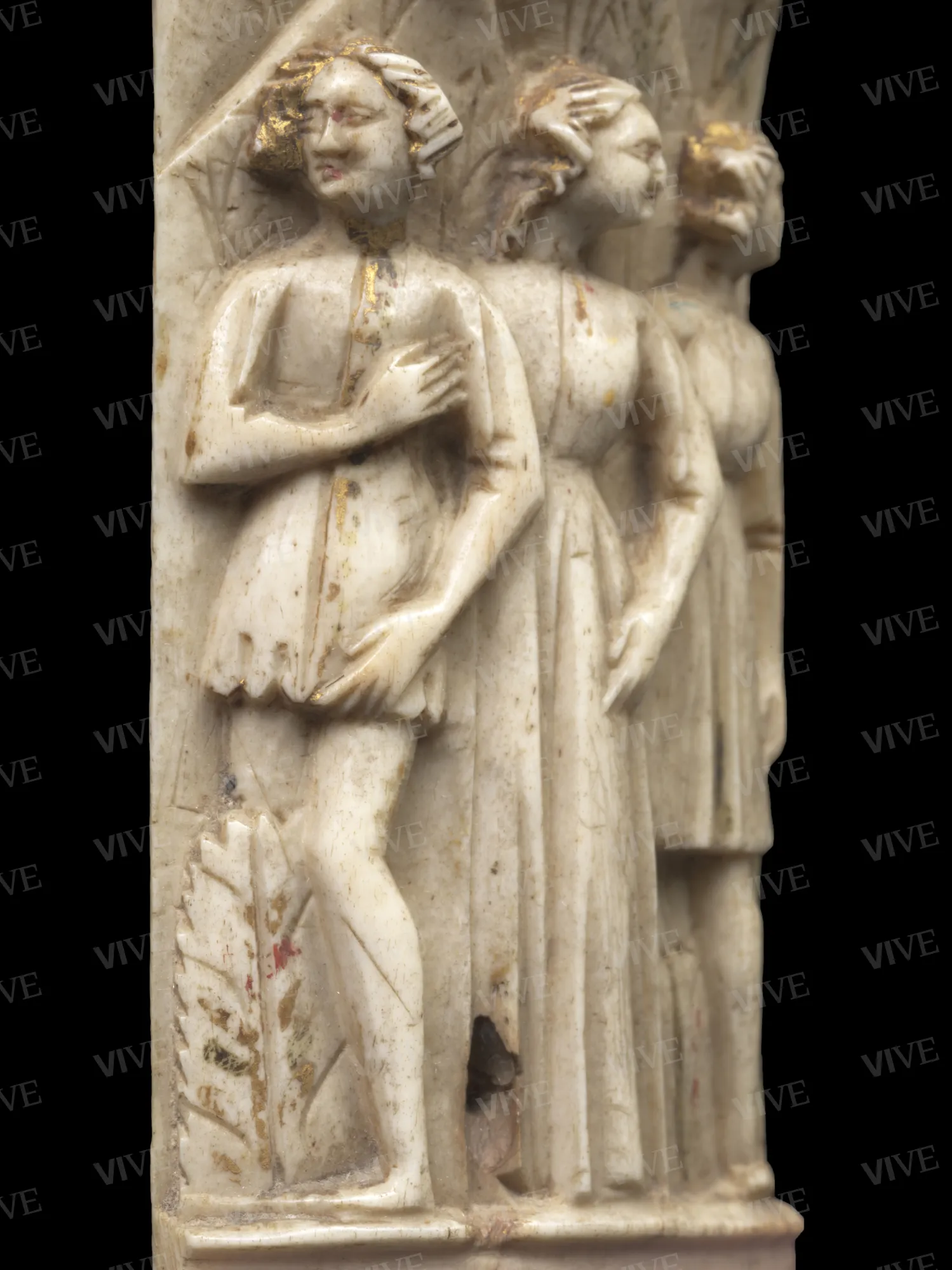
This small plaque depicts three figures: two young men wearing a short frock buttoned in the front and a woman, in the center, wearing a long dress fitted tightly at the waist. The figures are looking in opposite directions. The background is a hilly landscape with inflorescences and umbrella-shaped trees with striped foliage. Below, above a smooth molding, two leaves are placed at the foot of the two young men. Gilding can still be seen on the crowns and necklines of the dresses; a red pigment, however, can also be seen in the trees and leaves.
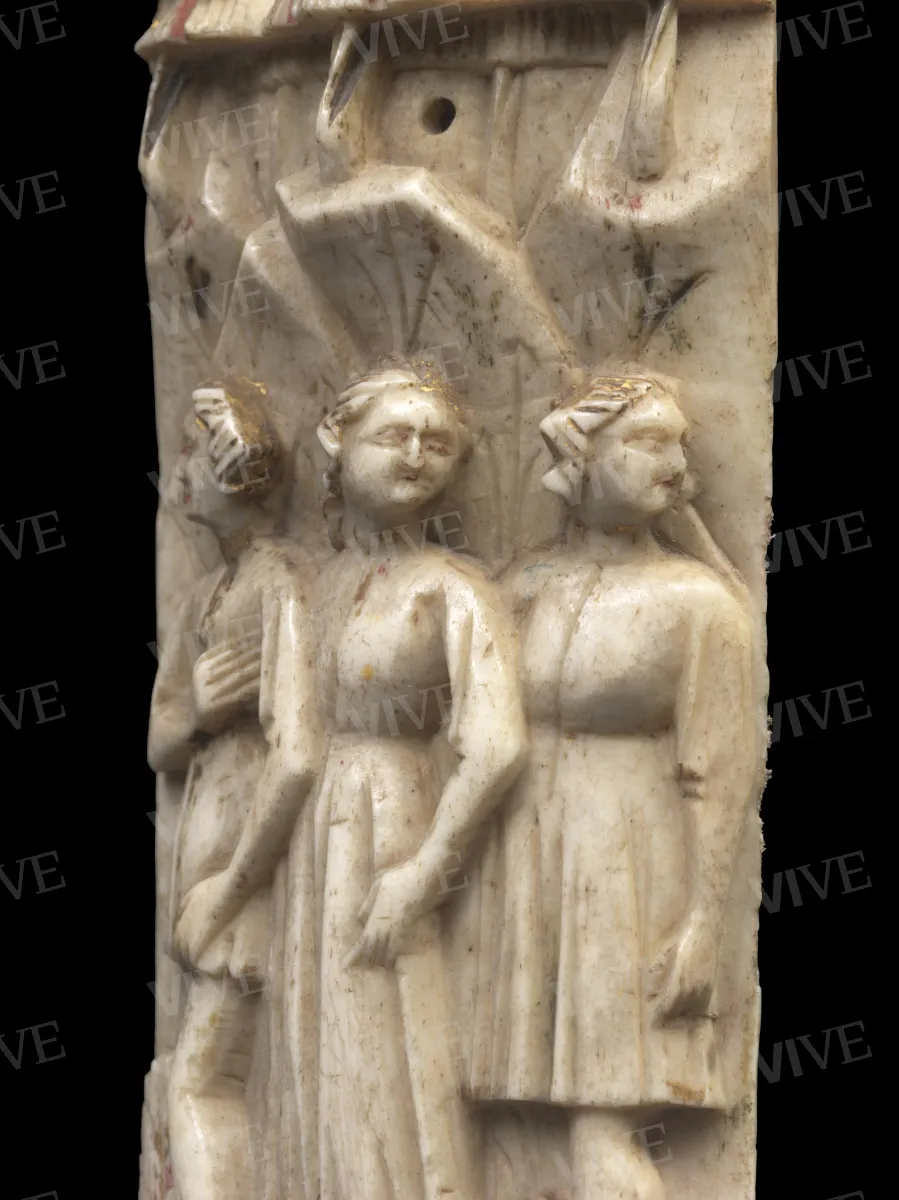
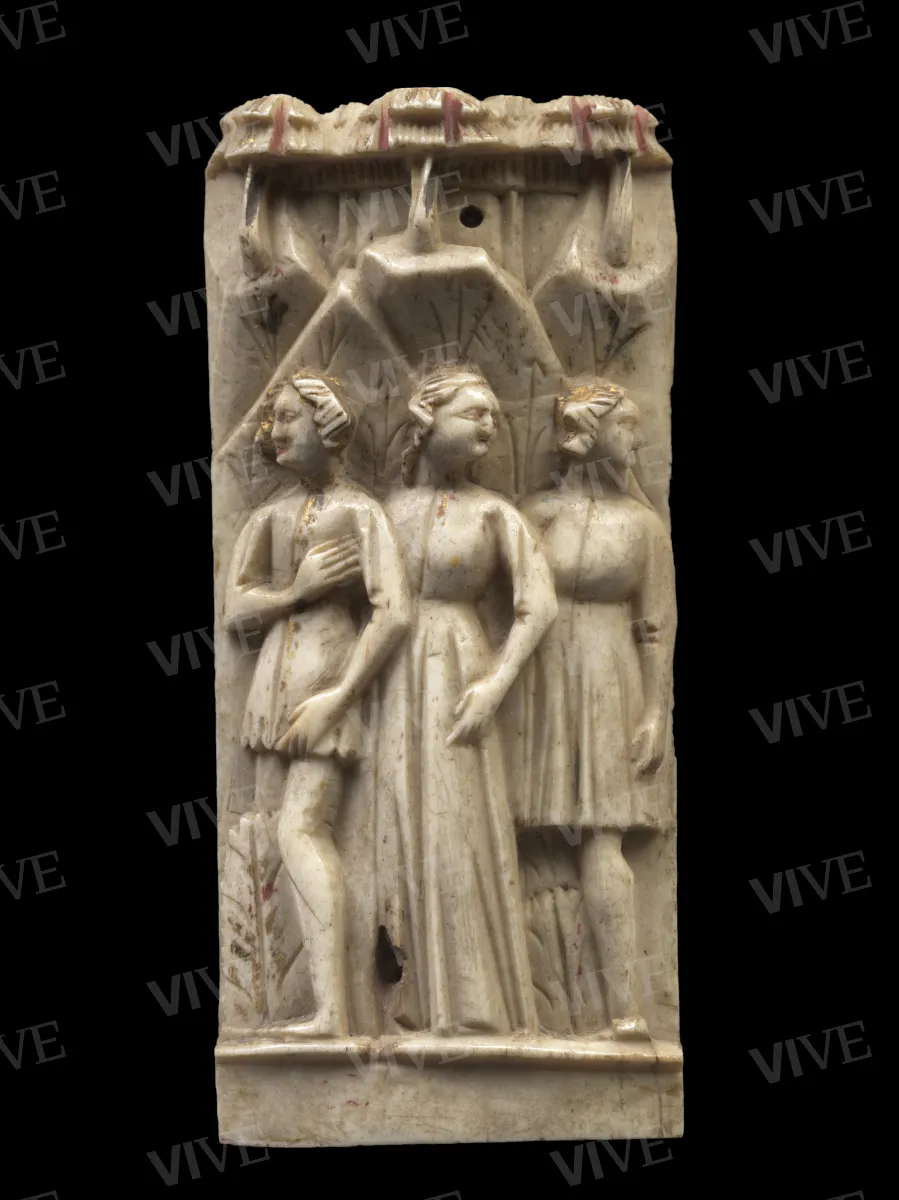
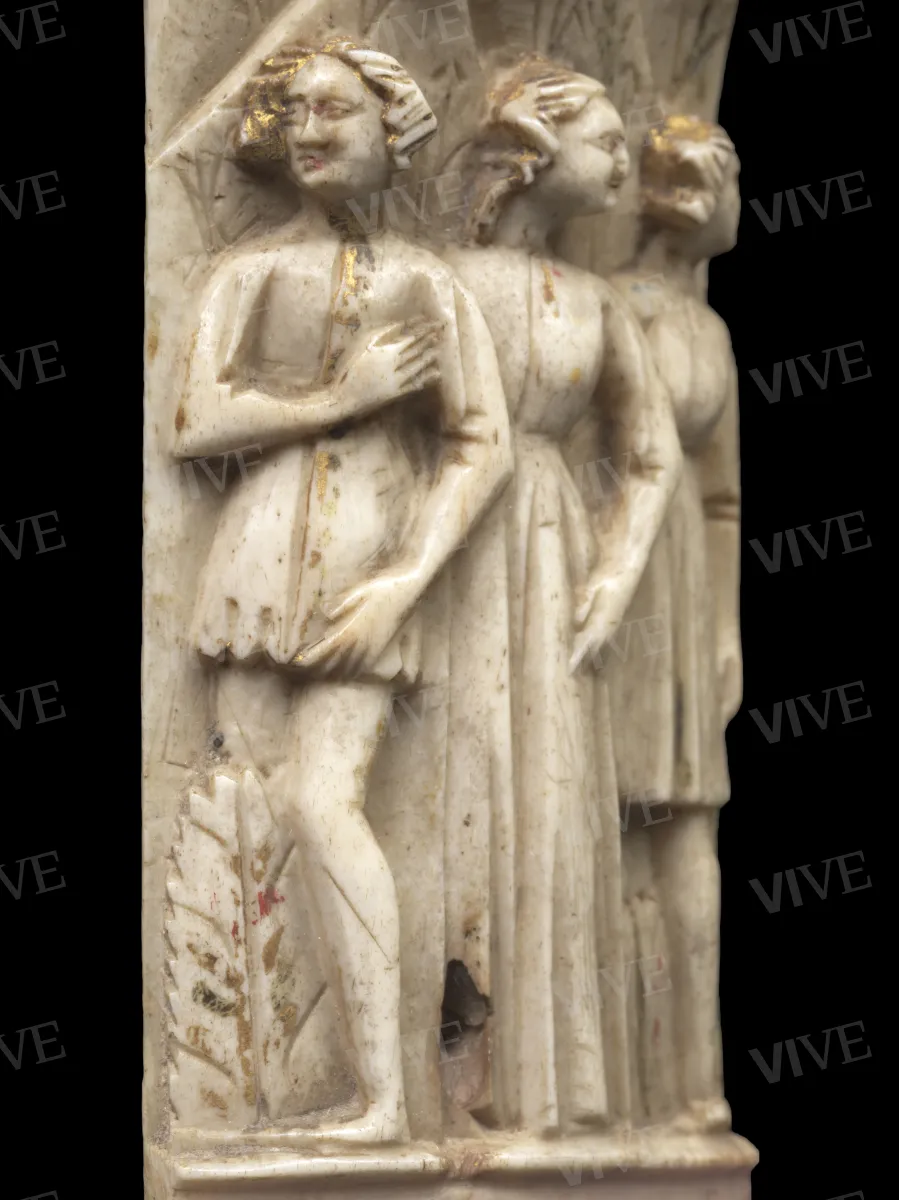
This small plaque depicts three figures: two young men wearing a short frock buttoned in the front and a woman, in the center, wearing a long dress fitted tightly at the waist. The figures are looking in opposite directions. The background is a hilly landscape with inflorescences and umbrella-shaped trees with striped foliage. Below, above a smooth molding, two leaves are placed at the foot of the two young men. Gilding can still be seen on the crowns and necklines of the dresses; a red pigment, however, can also be seen in the trees and leaves.
This small plaque comes from the exterior decoration of a small chest characterized by the juxtaposition of carved bones forming a cycle of courtly scenes. This technique is typical of artifacts identified as Embriachi and that date back to the activity of the workshop founded first in Florence and then in Venice by the Florentine merchant Baldassarre Ubriachi or Embriachi. This workshop, which in its early productive phase was directed by the “master of bone work” Giovanni di Jacopo, specialized in the production of objects such as chests, portable altars, and also large caskets and triptychs, all displaying polished, carved bones from animals such as oxen or pigs whose positioning on a wooden support made it possible to create figurative cycles. Caskets are among the most numerous products within the copious early production and, in light of their conspicuous stylistic differences, some have been made for their classification and periodization (Schlosser 1899; Merlini 1989; Martini 1993; Tomasi 2003). Due to its peculiar traits, the small plaque under consideration falls within the earliest phase of the activity the workshop of Baldassarre Ubriachi or Embriachi, and at least in part re-presents stylistic features typical of a workshop active prior to the Embriachi workshop that scholars identify as the Workshop of the Nailed Figures. In this workshop—so called because of the characteristic attachment of plaques to the wooden support by using visible nails—small caskets were made using the same Embriachi procedures but whose depictions had no apparent narrative ambition (Merlini 1989, pp. 277–279; Davies 2014). The presence of more than two figures in the same bone carving, the gilding at the hairline, the tree fronds daubed with red pigment, and the large plant elements such as the leaves at the feet of the young man on the left, can be isolated as typical elements of the Workshop of the Nailed Figures borrowed from the Embriachi workshop in its early years. These particularities are found, among others, in the nailed-figure casket in the Pinacoteca Tosio Martinego in Brescia (Merlini 1989, p. 276, fig. 20). Although the recent hypothesis of dating to the same years the last activity of the Workshop of the Nailed Figures and the debut of the Embriachi workshop (Davies 2014a) is plausible, this small plaque, while borrowing elements from the older workshop, differs from its stereotypical depictions by introducing a newer, more modern sense of movement and space. Indeed, it recalls the casket, datable to around 1390, from the Sainte-Chapelle in Paris now in the Victoria and Albert Museum in London (Davies 2014b). It shares with the Palazzo Venezia fragment the deployment of naturalistic elements found in the backgrounds and characterized by delicate brush strokes emulating blades of grass. Yet another element that can be compared to the Roman plaque is a casket from the domain of Baldassarre Ubriachi or Embriachi that is datable to around the last decade of the fourteenth century presented at Sotheby’s (New York, January 30, 2014). These references, then, would suggest that the creation of the Palazzo Venezia bone carving can be dated to the late fourteenth century as part of the Baldassarre Ubriachi workshop.
Giampaolo Distefano
Entry published on 12 February 2025
Good.
von Schlosser Julius, Die Werkstatt der Embriachi in Venedig, in «Jahrbuch der Kunsthistorischen Sammlungen des Allerhöchsten Kaiserhauses», 20, 1899, pp. 220-282;
Bernardini Giorgio, Il nuovo Museo di Palazzo Venezia. Arte Bizantina - Oggetti in osso e in avorio, in «Rassegna d’arte», XVII, 1917, pp. 25-44 (p. 40);
Merlini Elena, La “Bottega degli Embriachi” e i cofanetti eburnei fra Trecento e Quattrocento: una proposta di classificazione, in «Arte cristiana», 76, 1989, pp. 267-282;
Martini Luciana, Alcune osservazioni sulla produzione di cofanetti "embriacheschi" e sulla loro storiografia, in Martini Luciana (a cura di), Oggetti in avorio e osso nel Museo Nazionale di Ravenna. Sec. XV-XIX, Ravenna 1993, pp. 20-34;
Tomasi Michele, Miti antichi e riti nuziali: sull’iconografia e la funzione dei cofanetti degli Embriachi, in «Iconographica», 2, 2003, pp. 126-145;
Davies Glynn, in Davies Glynn, Williamson Paul (a cura di), Medieval Ivory Carvings. 1200-1550, II, London 2014, pp. 792-793, n. 263, (Davies 2014a);
Davies Glynn, in Davies Glynn, Williamson Paul (a cura di), Medieval Ivory Carvings. 1200-1550, II, London 2014, pp. 794-799, n. 264, (Davies 2014b);
Important Old Master Paintings and Sculpture, Sotheby’s, New York, 30 gennaio 2014;
Tomasi Michele, La bottega degli Embriachi e gli oggetti in legno e osso in Italia fra Tre e Quattrocento, in Castronovo Simonetta, Crivello Fabrizio, Tomasi Michele (a cura di), Avori medievali. Collezioni del Museo Civico d’Arte Antica di Torino, Savigliano 2016, pp. 151-153;
Chiesi Benedetta, Gli Embriachi e le botteghe dell’Italia settentrionale fra Tre e Quattrocento, in Ciseri Ilaria (a cura di), Gli avori del Museo Nazionale del Bargello, Milano 2018, pp. 334-335.