Vittoriano


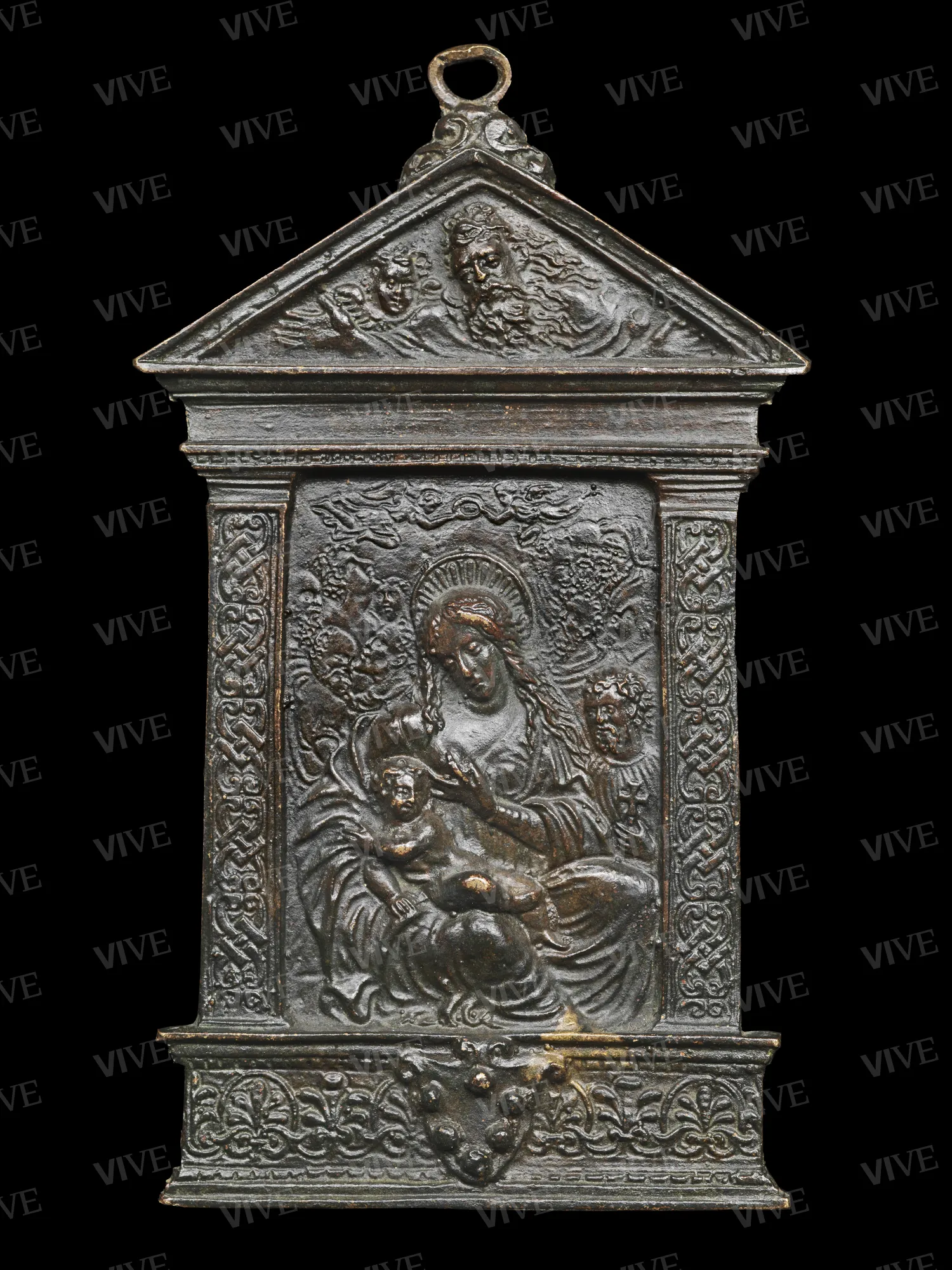
LThe plaque, which depicts the Nursing Madonna, was created by Galeazzo Mondella, a Veronese goldsmith also known as Il Moderno. The coat of arms at the bottom represents the prestigious Florentine Medici family, although it is not possible to attribute this work to a specific patron. The composition is derived from an invention likely originated by Leonardo, and is recognized in Giampietrino’s Madonna and Child, currently housed in the Borghese Gallery in Rome.
LThe plaque, which depicts the Nursing Madonna, was created by Galeazzo Mondella, a Veronese goldsmith also known as Il Moderno. The coat of arms at the bottom represents the prestigious Florentine Medici family, although it is not possible to attribute this work to a specific patron. The composition is derived from an invention likely originated by Leonardo, and is recognized in Giampietrino’s Madonna and Child, currently housed in the Borghese Gallery in Rome.
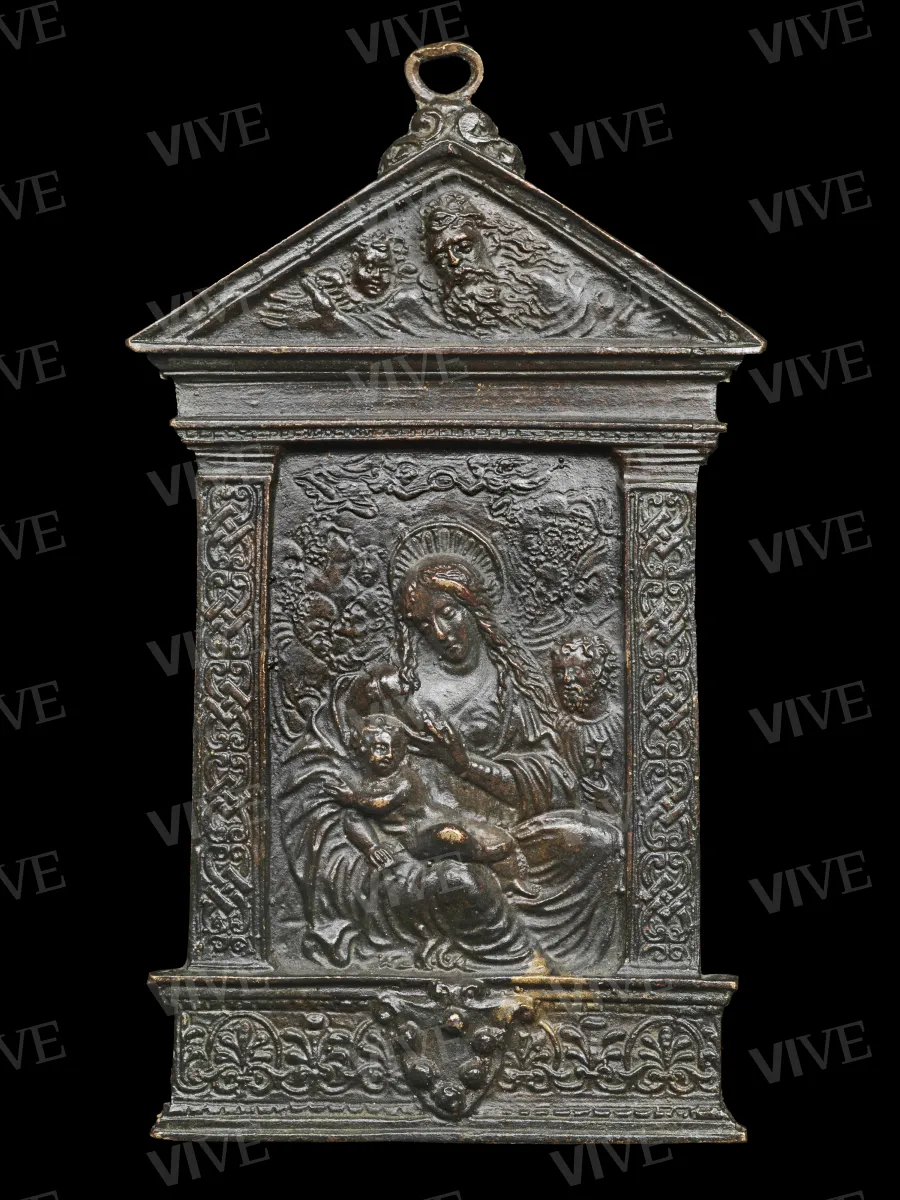
The composition, which follows the structure of the “pax” kissed by the priest and the faithful in Catholic liturgy, is set in a classical frame in the form of a tympanum. In the central space, the Madonna and Child are depicted in relief in the iconography of the Nursing Madonna (Virgo lactans), while in the background on the right, a bearded male figure, possibly Saint Joseph, appears with a cross in his hand. In the background, ten male heads are depicted watching the scene, with two angels in flight preparing to crown the head of the Madonna. The Almighty appears in the tympanum space with his arms wide open, accompanied by a small angel’s head. The pillars feature a dense intertwining of knots, while the base is decorated with palmettes and bears the Medici coat of arms with six balls in the center. The ten figures in very low relief behind the Virgin may be identified as apostles, saints, or a crowd of faithful and non-faithful individuals, or perhaps angels (Rossi 2006). The thickest part of the plaque is the knee of the Child. While earlier critics had identified bronze as the material used in this artwork, further examination has revealed that the yellowish tone of brass is visible in areas where the dark lacquer has eroded (particularly on the face of the Madonna and most notably on the back). Another instance of the plaque, preserved in the parish church of Albinea (Reggio Emilia), is also composed of brass. Scholars, beginning with Middeldorf and Goetz (1944), have correctly attributed the origin of this composition to Leonardo’s circle in Milan (Cannata 1982; Gasparotto 2008). The same composition, potentially originating from Leonardo’s design, is observed in two early sixteenth-century paintings depicting the Madonna and Child by Gian Pietro Rizzoli, known as Giampietrino (circa 1480/1485–1553), housed in the Galleria Borghese (inv. 456) and the Pallavicini collection (Zeri 1959). Initially, scholars focused primarily on the compositional similarities: Middeldorf and Goetz asserted that “the composition [...] is Leonardesque and corresponds to that of Giampietrino,” while Cannata (1982) acknowledged the “indisputable relationship between the two paintings.” However, more recent scholarship has examined the connection between the brass plaque and the Borghese painting: Jestaz (1997) questioned which came first (“Did the painter inspire the goldsmith or vice versa?“) and suggested the precedence of the painting; Bergbauer (2010), doubting the bronze’s derivation from the painting, cautiously proposed that the plaque may have been the source for pictorial versions created in Milan following a Leonardo invention. Both works may derive from a common pictorial or graphic model. Specifically, the pose of the Child emulates a formula developed by Leonardo during his studies for the Madonna del Gatto (circa 1478–1480), particularly the drawing housed in the Uffizi Drawings and Prints Department (inventory number 421 E recto; Zeri 1959), which was extensively utilized by his students. Additionally, the rotated position of the Child is also observed in Marco d’Oggiono’s Madonna delle violette and Francesco Napoletano’s Madonna Lia (Ballarin 2010). The plaque exhibits references to Leonardo’s style, notably in the “knot” decorations on the side bands, which are reminiscent of those painted in the Sala delle Asse at the Castello Sforzesco in Milan. This motif is prevalent in Leonardo’s artistic practice (Bambach 1991). However, as suggested by Rossi (2006), the depiction of the Almighty in the tympanum aligns the plaque with the Venetian cultural sphere, indicating a convergence between Mantegna’s influence and Northern Italian Leonardism. The plaque housed in Palazzo Venezia, originating from the Collezione Santamaria (Cannata 1982), is one of Il Moderno’s most renowned works (1467–1528) and has been reproduced in various iterations and forgeries over time (Pollard 1989). The Medici coat of arms, indicative of an adaptation commissioned by the renowned Florentine family, appears in various documented examples, including in Santa Barbara (Morgenroth collection, Middeldorf, Goetz 1944; Pollard 1989) and Cleveland (in gilded silver, Wixom 1975). Other coats of arms are present in different instances: in Venice (Ca’ d’Oro and Molthein collection; Cannata 1982), Berlin (Bange 1922), the British Museum (Pollard 1989), and Ecouen (Bergbauer 2010). An unidentified coat of arms on the base and an inscription on the lintel (“FER. SIG. CAN.cus”), denoting the canon who commissioned it, can be observed in Berlin (Bode 1904), Oxford (Warren 2014), and the province of Reggio Emilia (Ligabue 2010; modified as “TLR. SIG. CAN.cus”). Among the variations, noteworthy are those without background figures and those lacking a coat of arms, such as the example in the Baglioni collection in Bergamo (Rossi 1976). A plaque in Belluno showcases significant iconographic deviations, including the addition of a long-haired figure and the substitution of the cross with a palm branch or stick (inv. 3660, also missing the tympanum and base; Venturi 1910; Jestaz 1997). One example, likely from the sixteenth or seventeenth century, includes figures, trophies, and decorations (Imbert, Morazzoni 1941; Washington, National Gallery of Art, inv. 1942.9.247). Jestaz mentions two versions in Paris: One features two saints, while the other lacks background figures and shows a basilica with the inscription “Virgo Lavretana” in the frieze.
Giulio Pietrobelli
Entry published on 12 June 2025
Good. Black lacquer.
Medici coat of arms on the base.
Rome, Collezione Santamaria;
Rome, Museo Nazionale di Palazzo Venezia, undated.
Mantua, Placchette e rilievi di bronzo nell’età di Mantegna, Mantova, Museo della Città, Palazzo San Sebastiano, September 16, 2006–January 14, 2007.
Molinier Émile, Les bronzes italiens de la Renaissance. Les plaquettes. Catalogue raisonné, Paris 1886, I, pp. 119-120, n. 162;
Bode Wilhelm, Königliche Museen zu Berlin. Beschreibung der Bildwerke der Christlichen Epochen. Die Italienischen Bronzen, Berlin 1904, p. 63, n. 735, tav. L;
Migeon Gaston (a cura di), Musée National du Louvre. Catalogue des bronzes & cuivres du Moyen Age, de la Renaissance et des temps modernes, Paris 1904, p. 320, n. 415;
Venturi Lionello, I bronzi del Museo Civico di Belluno, in «Bollettino d’arte», IV, 1910, 9, pp. 353-366, fig. 6;
Bange Ernst Friedrich (a cura di), Die Italienischen Brozen der Renaissance und des Barock: Riliefs und Plaketten, Berlin 1922, pp. 61-62, nn. 447- 448, tav. 50;
Imbert Eugenio, Morazzoni Giuseppe (a cura di), Le placchette italiane. Secolo XV-XIX. Contributo alla conoscenza della placchetta italiana, Milano 1941, pp. 54-55, nn. 101-102, tav. XIX;
Middeldorf Ulrich, Goetz Oswald, Medals and Plaquettes from the Sigmund Morgenroth Collection, Chicago 1944, p. 33, n. 226;
Zeri Federico, La Galleria Pallavicini in Roma. Catalogo dei dipinti, Firenze 1959, pp. 139-140, n. 234, tav. 234;
Wixom William, Renaissance Bronzes from Ohio Collections, The Cleveland Museum of Art, Cleveland 1975, n. 39;
Rossi Francesco (a cura di), La raccolta Baglioni, catalogo della mostra (Bergamo, Accademia Carrara, 27 marzo-6 giugno 1976), Bergamo 1976, pp. 68-69, n. 104;
Cannata Pietro (a cura di), Rilievi e placchette dal XV al XVIII secolo, catalogo della mostra (Roma, Museo di Palazzo Venezia, febbraio-aprile 1982), Roma 1982, pp. 51-52, n. 29;
Pollard Graham, The Plaquette Collections in the British Museum, in «Studies in the History of Art», 22, 1989, pp. 227-245;
Bambach Carmen, Leonardo, Tagliente, and Dürer: “la scienza del far di groppi“, in «Achademia Leonardi Vinci. Journal of Leonardo Studies and Bibliography of Vinciana», 4, 1991, pp. 72-98;
Jestaz Bertrand, Catalogo del Museo Civico di Belluno. Le placchette e i piccoli bronzi, Belluno 1997, pp. 58-59, 156, n. 33;
Rossi, in Rossi Francesco (a cura di), Placchette e rilievi di bronzo nell’età di Mantegna, catalogo della mostra (Mantova, Museo della Città, Palazzo San Sebastiano, 16 settembre 2006-14 gennaio 2007), Mantova, Milano 2006, p. 77, n. 62;
Gasparotto Davide, Antico e Moderno, in Trevisani Filippo, Gasparotto Davide (a cura di), Bonacolsi L’Antico. Uno scultore nella Mantova di Andrea Mantegna e di Isabella d’Este, catalogo della mostra (Palazzo Ducale, Appartamento di Isabella d’Este in Corte Vecchia, 13 settembre 2008-6 gennaio 2009), Milano 2008, pp.88-97;
Ballarin Alessandro, Leonardo a Milano. Problemi di Leonardismo milanese tra Quattrocento e Cinquecento. Giovanni Antonio Boltraffio prima della pala Casio, con la collaborazione di Marialucia Menegatti, Barbara Maria Savy, 4 voll., Padova-Verona 2010;
Bergbauer Bertrand, Moderno et les peintres. Autour des dérivés anversois d’une plaquette italienne, in «Revue de l’art», 167, 2010, pp. 31-40, fig. 15;
Ligabue Giuseppe, Una “pace” fra Albinea e Palazzo Venezia, in «Reggio Storia», XXXII, aprile-giugno 2010, 127, pp. 28-36;
Warren Jeremy (a cura di), Medieval and Renaissance Sculpture. A Catalogue of the Collection in the Ashmolean Museum, Oxford. Volume 3. Plaquettes, Oxford 2014, pp. 851-852, nn. 305-306.