Vittoriano


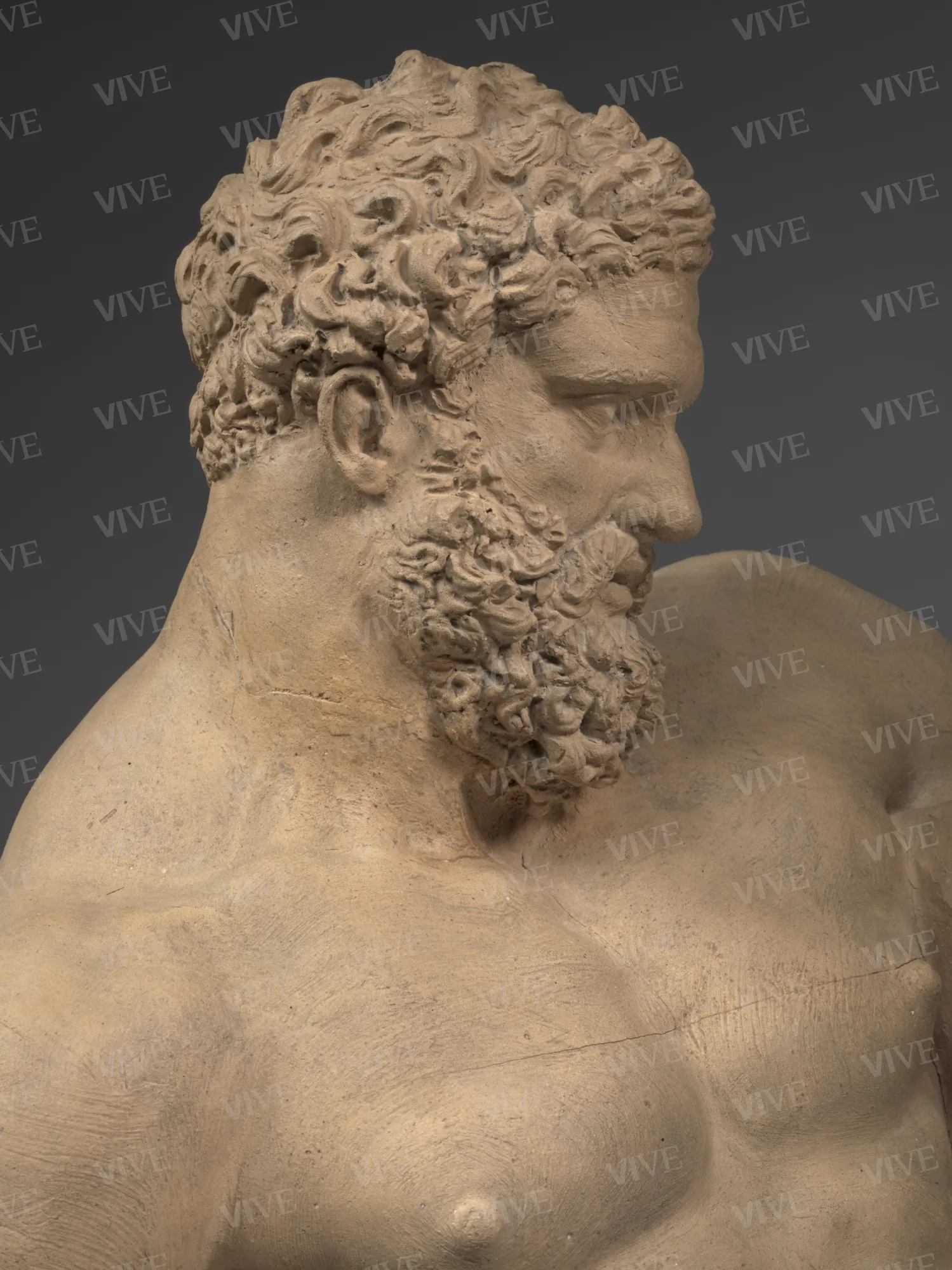
This terracotta sculpture is a reduced-scale rendition of the renowned ancient Farnese Hercules statue. The figure depicts Hercules at rest, leaning against a rock adorned with his characteristic attributes: the lion skin and club. His posture places his weight on the right leg, with the left slightly advanced. Behind his hip, the hero discreetly holds the apples taken from the garden of the Hesperides in his right hand. This piece originated from the workshop of the distinguished sculptor Bartolomeo Cavaceppi.


This terracotta sculpture is a reduced-scale rendition of the renowned ancient Farnese Hercules statue. The figure depicts Hercules at rest, leaning against a rock adorned with his characteristic attributes: the lion skin and club. His posture places his weight on the right leg, with the left slightly advanced. Behind his hip, the hero discreetly holds the apples taken from the garden of the Hesperides in his right hand. This piece originated from the workshop of the distinguished sculptor Bartolomeo Cavaceppi.
This terracotta piece is a scaled replica of the renowned Farnese Hercules (Barberini 1994, 86, 87, n. 2; Giometti 2011, 115, n. 131), an ancient marble sculpture attributed to Glicone and dating to the third century CE. Originally displayed at the Palazzo Farnese until 1787, the work underwent restoration by Carlo Albacini before being transferred to Naples (Rausa 2010, 17–20, n. 1).
Since the sixteenth century, this work has been reproduced in smaller formats and is regarded as one of the most esteemed ancient masterpieces. During the eighteenth century, it was replicated in various materials and sizes by numerous artists based in Rome, which was a prominent destination for travelers and art enthusiasts.
The sculpture under consideration belongs to a collection of terracottas associated with Bartolomeo Cavaceppi (1716–1799), whose studio housed models created by renowned artists as well as replicas of ancient works for multiple objectives. Located on the Via del Babuino, his workshop held significant influence within the Roman artistic community and was notable for its specialization in the trade of antiquities (Piva 2010, 59–64). Cavaceppi maintained connections with prominent individuals, such as Johann Joachim Winckelmann, whose aesthetic principles he adopted and applied to the restoration of ancient marbles. Renowned as the leading restorer of his era, Cavaceppi authored the significant publication Raccolta di antiche Statue (1768–1769), which featured representations of several of his works (Meyer, Piva 2011). Upon his death, the sculptor bequeathed “every last nail and the smallest flake” to the Academy of San Luca, intending that his extensive collection of models and sculptures serve educational purposes. Following litigation initiated by the artist’s relatives against the Roman institution, a portion of these works was subsequently acquired by the Torlonia family (Gasparri, Ghiandoni 1994). The terracotta pieces, which are replicas of ancient artworks and generally regarded as less significant, were introduced to the Roman market at the close of the nineteenth century. They were subsequently acquired by the tenor Evangelista (Evan) Gorga, an avid collector (Collezioni Gorga 1948; Cionci 2004). Following an agreement between the singer and the Ministry of Education, the items were incorporated into the collections of the Museo Nazionale di Palazzo Venezia in 1949 and subsequently placed in storage. They were later identified and appropriately restored to Cavaceppi in 1990 (Barberini 1994a, 79–84).
Likely intended as a model for the study of antiquity and to demonstrate exaggerated anatomical features, the terracotta is referenced in the 1802 inventory of models from Cavaceppi’s studio (B.I.A.S.A., Manoscritto Lanciani 5, f. 60r; cited in Barberini 1994b, 86–97, cat. 2). Subsequently, it appears in the catalog of the Gorga collection (Collezione Gorga 1948, 8), and is later recorded in the inventories of the Museo Nazionale di Palazzo Venezia (Inventari, libro IX, f. 91v).
Minor imperfections, including partial detachment of the left foot from the base caused by clay shrinkage during firing, suggest that the sculpture may not have been intended for commercial sale. Given its dimensions, the work likely falls into the category of antique models exhibited in copyists' workshops to demonstrate to visitors the range of sculptures available for reproduction. In support of this, Cavaceppi’s workshop was characterized by the Danish writer Frederike Brun during her visit to Rome in 1794 as a vast Marmorboutique (Howard 1982, 195).
The depiction of Hercules demonstrates meticulous attention to detail, with the surface completed using a cloth to achieve a porous texture reminiscent of natural skin. Conversely, the ruggedness of the rock is represented in a more simplified manner through consistent strokes applied with a modeling tool.
Valeria Rotili
Entry published on 16 October 2025
Fair. The left hand and a portion of the left foot are absent as a result of breakage. Watercolor stucco is present on the right ankle, exhibiting discoloration that has occurred over time.
1993: Ivy Gabrielides.
Rome, Collezione Bartolomeo Cavaceppi 1800;
Rome, Collezione Torlonia, 1800;
Rome, Collezione Evangelista (Evan) Gorga, 1949;
Rome, Museo Nazionale di Palazzo Venezia, 1949.
Rome, Museo del Palazzo di Venezia, Bartolomeo Cavaceppi (1717–1719), January 15–March 15, 1994, cat. 2.
Rome, B.I.A.S.A., Lanciani Manuscript 5, Catalogs of the Cavaceppi Collection, 1802–1810, f. 60r;
Rome, Museo Nazionale del Palazzo Venezia, Inventari, book IX, f. 91v, n. 72;
Collezioni Gorga. Raccolte archeologiche e artistiche, Roma 1948;
Howard Seymour, Bartolomeo Cavaceppi, Eighteenth-century restorer, New York-London 1982;
Gasparri Carlo, Ghiandoni Olivia, Lo studio Cavaceppi e le collezioni Torlonia, in «Rivista dell’Istituto Nazionale d’Archeologia e Storia dell’Arte», XVI, 1993 (1994);
Barberini Maria Giulia, “Delli modelli che si trovano nello studio Cavaceppi”. Le terrecotte del Museo di Palazzo Venezia, in Barberini Maria Giulia, Gasparri Carlo (a cura di), Bartolomeo Cavaceppi scultore romano (1717-1799), Roma 1994, pp. 79-84 (Barberini 1994a);
Barberini Maria Giulia, in Barberini Maria Giulia, Gasparri Carlo (a cura di), Bartolomeo Cavaceppi scultore romano (1717-1799), Roma 1994, pp. 86-87, n. 2 (Barberini 1994b);
Cionci Andrea, Il tenore collezionista. Vita, carriera lirica e collezioni di Evan Gorga, Firenze 2004;
Piva Chiara, Bartolomeo Cavaceppi tra mercato e restauro, in Brook Carolina, Curzi Valter (a cura di), Roma e l’antico. Visione e Realtà nel '700, catalogo della mostra (Roma, Fondazione Roma 30 novembre 2010-6 marzo 2011), Genève 2010, pp. 59-64;
Rausa , in Carlo Gasparri (a cura di), Le sculture Farnese. III. Le sculture delle Terme di Caracalla. Rilievi e varia, Verona 2010;
Giometti Cristiano (a cura di), Museo Nazionale del Palazzo di Venezia. 4. Sculture in terracotta, Roma 2011, p. 115, cat. 131;
Meyer Susanne Adine, Piva Chiara, L’arte di ben restaurare. La "Raccolta d’antiche statue (1768-1772)“ di Bartolomeo Cavaceppi, Firenze 2011.