Vittoriano


The artwork portrays the mourning of Christ immediately following his removal from the cross. Central to the composition is the figure of Jesus, whose body is encircled by the Virgin Mary on the left, Saint John the Evangelist, and Mary Magdalene, who averts her face on the right. Illumination radiates from Christ’s body, giving a dramatically intense effect to the painting. Several versions of this work exist, and it is widely regarded as an autograph piece by Orazio Borgianni, dating to the final years of his artistic career.

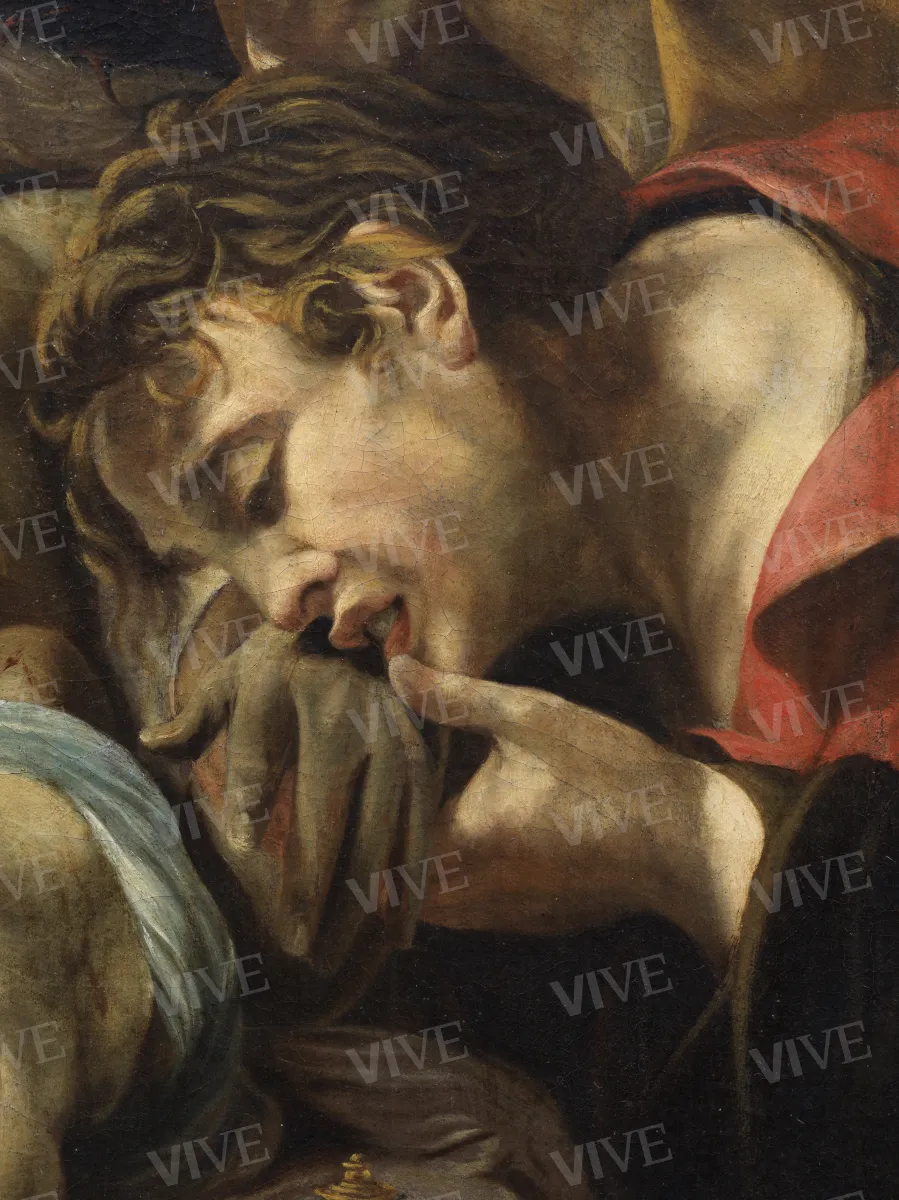
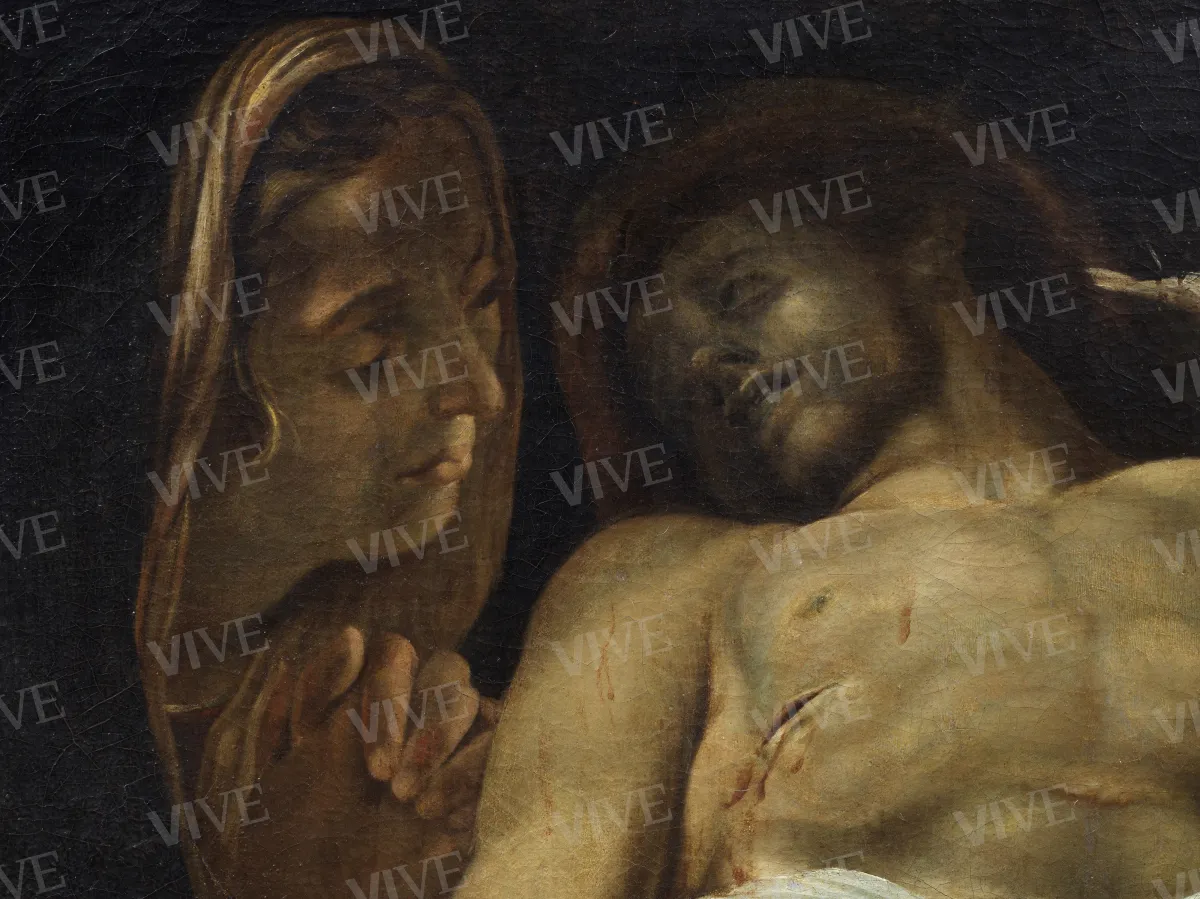
The artwork portrays the mourning of Christ immediately following his removal from the cross. Central to the composition is the figure of Jesus, whose body is encircled by the Virgin Mary on the left, Saint John the Evangelist, and Mary Magdalene, who averts her face on the right. Illumination radiates from Christ’s body, giving a dramatically intense effect to the painting. Several versions of this work exist, and it is widely regarded as an autograph piece by Orazio Borgianni, dating to the final years of his artistic career.
The work depicts the lamentation over the tormented body of Christ, who has just been deposed, surrounded by the figures of the Virgin, Saint John the Evangelist, and Mary Magdalene.
The painting was listed as a work by Pomarancio in the inventories of Cardinal Tommaso Ruffo's collections, who served as apostolic nuncio of Ferrara and Bologna. It is unclear from the records whether the attribution referred to Niccolò Circignani, Antonio Circignani, or Cristoforo Roncalli, each known by the same nickname (De Angelis 2013, 191, 212 nos. 166, 168). In 1919, Prince Don Fabrizio Ruffo di Motta Bagnara bequeathed the artwork to the Galleria Nazionale di Arte Antica. After the Second World War, it became part of the Museo Nazionale di Palazzo Venezia.
The subject, described as "filled with painful pathos" (Facchinetti 2006, 83) and frequently addressed by Orazio Borgianni (1574–1616), was presented as an autograph work at the 1922 Florence exhibition titled Pittura italiana del Seicento e del Settecento. Roberto Longhi (1961, I, 496) later assessed this piece as a copy of the version from his collection, which is currently housed at the Fondazione Roberto Longhi in Florence. Longhi reaffirmed this view approximately twenty years earlier (1943, 43: "copy of my original"), a position subsequently supported by Federico Zeri (1955, 6).
Conversely, when considering the various established versions of this composition featuring three mourning figures, Antonino Santangelo (1947, 46) identified the canvas as an autograph work by Orazio Borgianni. This attribution was subsequently endorsed by Harold Wethey (1964, 158) and Alfred Moir (1967, I, 47), and further substantiated by Gianni Papi (1993, 133, 137).
Both the canvas in question and that of the Longhi Foundation correspond to Borgianni’s print with the same subject, which is signed and dated 1615. This date serves as an approximate latest possible date for the execution of both paintings (Papi 2020, 126). The print is dedicated to Francisco de Castro, and based on this detail, Marco Gallo (1997, 108, 112–113) has proposed that the Spanish ambassador to Rome was likely the patron of the painting at the Longhi Foundation, later replicated by Borgianni in the version at Palazzo Venezia, which is referred to as “the painter’s second original” (Papi 1993, 137). According to this interpretation, the painting would have been created after Francisco de Castro commissioned Borgianni to create the altarpiece depicting Saint Charles visiting plague victims (1612–1613), originally housed in the church of Sant’Adriano al Foro and now in the Curia Generalizia dell’Ordine della Mercede (Papi 2020, 116–119, n. 13).
Other examples with the same composition, but lacking the figure of Mary Magdalene, can be found in the Galleria Spada in Rome, the Koelliker collection, and as a fresco in the sacristy of the Roman church of San Salvatore in Lauro.
The depiction of the reclining Christ viewed from a pronounced low angle has been associated by scholars with Mantegna’s Lamentation over the Dead Christ, which was recorded in 1603 as part of Pietro Aldobrandini’s collection in Rome and is now held in the Brera. This connection was first established by Voss (1924, 465) and later supported by Zeri (1954, 44) and Gallo (1997, 107–113). Additionally, Gianni Papi (2020, 126) identified another iconographic influence: Lelio Orsi’s Dead Christ between Charity and Justice, held in the Galleria Estense in Modena. This refined Mannerist work was subsequently reinterpreted by Borgianni through a lens of forceful naturalism.
Maria Giulia Cervelli
Entry published on 16 October 2025
Good.
Rome, Cardinal Tommaso Ruffo’s collection, until 1753;
Rome, Prince Fabrizio Ruffo di Motta Bagnara’s collection, until 1919;
Rome, Museo Nazionale di Palazzo Venezia, since 1919.
Florence, Palazzo Pitti, Mostra della pittura italiana del Seicento e del Settecento s, March–October 1922.
IInventory of Cardinal Tommaso Ruffo (February 21, 1753) drawn up by Sebastiano Conca and Giovanni Sorbi, Archivio di Stato di Roma, 30 Notai Capitolini, vol. 3818, f. 382r: “Altro di simil misura rappresentante il Signore morto con tre figure del Pomaranci, sc. 100” (De Angelis 2010, 69).
Tarchiani Nello, Mostra della pittura italiana del Seicento e del Settecento, 1922, p. 42, n. 138;
Voss Hermann, Die Malerei des Barock in Rom, Berlin 1924;
Longhi Roberto, Ultimi studi sul Caravaggio e la sua cerchia, in «Proporzioni», 1, 1943, pp. 5-63;
Santangelo Antonino (a cura di), Museo di Palazzo Venezia. Catalogo. 1. Dipinti, Roma 1947, p. 46;
Zeri Federico (a cura di), Catalogo del Gabinetto Fotografico Nazionale. 3. I dipinti del Museo di Palazzo Venezia in Roma, Roma 1955;
Longhi Roberto, Scritti giovanili 1912-1922, Firenze 1961, I, pp. 111-124, 493-512;
D’Onofrio Cesare, Inventario dei dipinti del cardinal Pietro Aldobrandini compilato da G. B. Agucchi nel 1603, in «Palatino», 8, 1964, pp. 15-20, 158-162, 202-211;
Wethey Harold, Orazio Borgianni in Italy and Spain, in «The Burlington Magazine», 106, 1964, pp. 147-150;
Moir Alfred, The Italian Followers of Caravaggio, 2 voll., Cambridge 1967;
Papi Gianni, Orazio Borgianni, Soncino 1993;
Gallo Marco, Orazio Borgianni pittore romano (1574-1616), Roma 1997;
Facchinetti Simone, Il Cristo morto, un caso di fortuna storica, in Facchinetti Simone, Uccelli Alessandro (a cura di), I Mantegna di Brera, Milano 2006, pp. 75-93;
Sconci Maria Selene, Orazio Borgianni “Cristo morto con tre dolenti”, in Barberini Maria Giulia, Sconci Maria Selene (a cura di), Guida al Museo Nazionale di Palazzo Venezia, Roma 2009, p. 35;
De Angelis Maria Antonietta, I dipinti del cardinale Tommaso Ruffo (1653-1753). La quadreria di un alto prelato nella Roma del Settecento, in Debenedetti Elisa (a cura di), Collezionisti, disegnatori e pittori dell’Arcadia del purismo, 2, Roma 2010, pp. 53-92;
De Angelis Maria Antonietta, L’ultimo soggiorno a Roma del cardinale Tommaso Ruffo (1738-1753), in Pavone Mario Alberto (a cura di), Il collezionismo del cardinale Tommaso Ruffo tra Ferrara e Roma, Roma 2013, pp. 171-212;
Papi Gianni (a cura di), Orazio Borgianni. Un genio inquieto nella Roma di Caravaggio, catalogo della mostra (Roma, Palazzo Barberini, 6 marzo-1 novembre 2020), Milano 2020.