Vittoriano


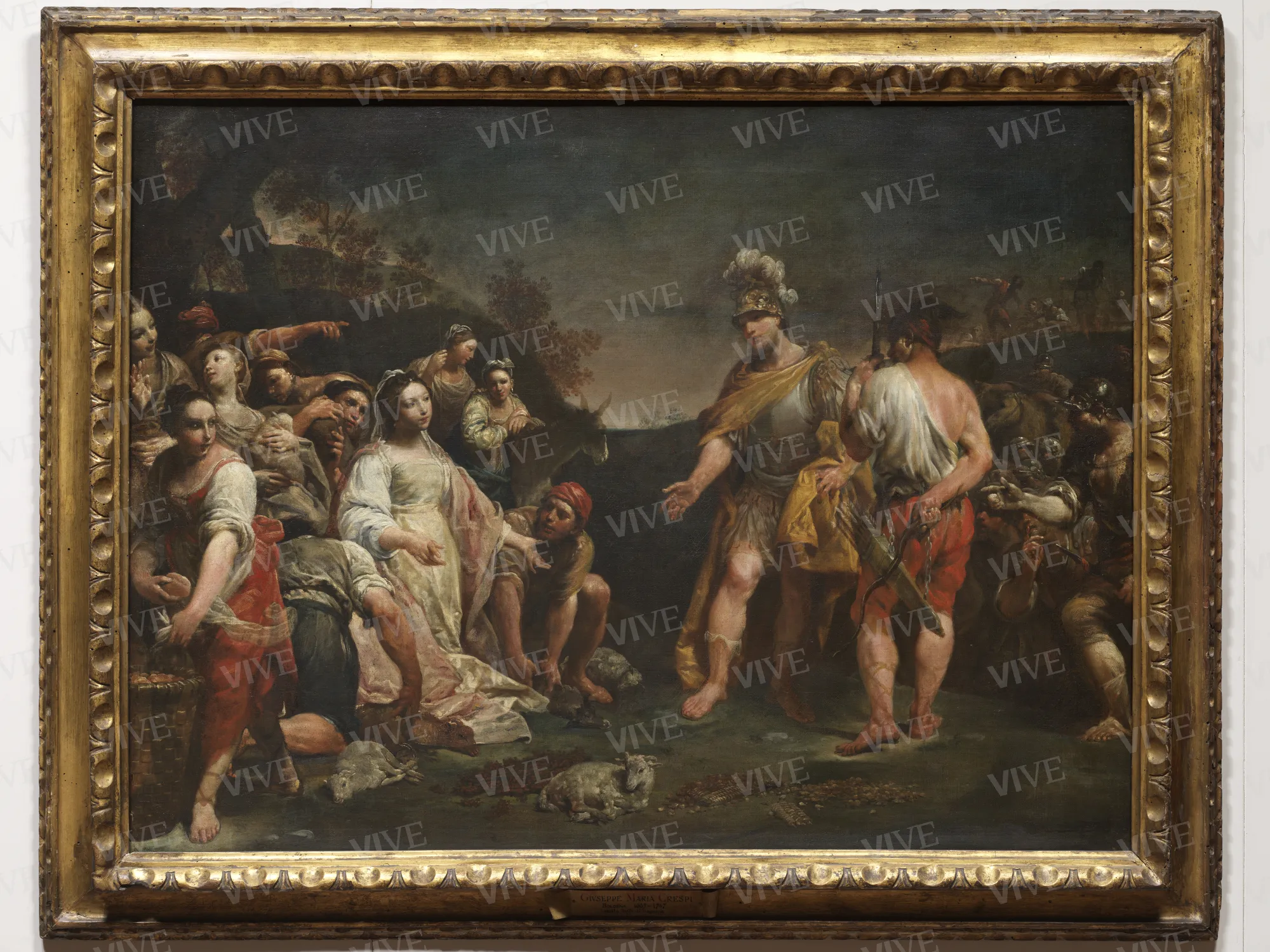
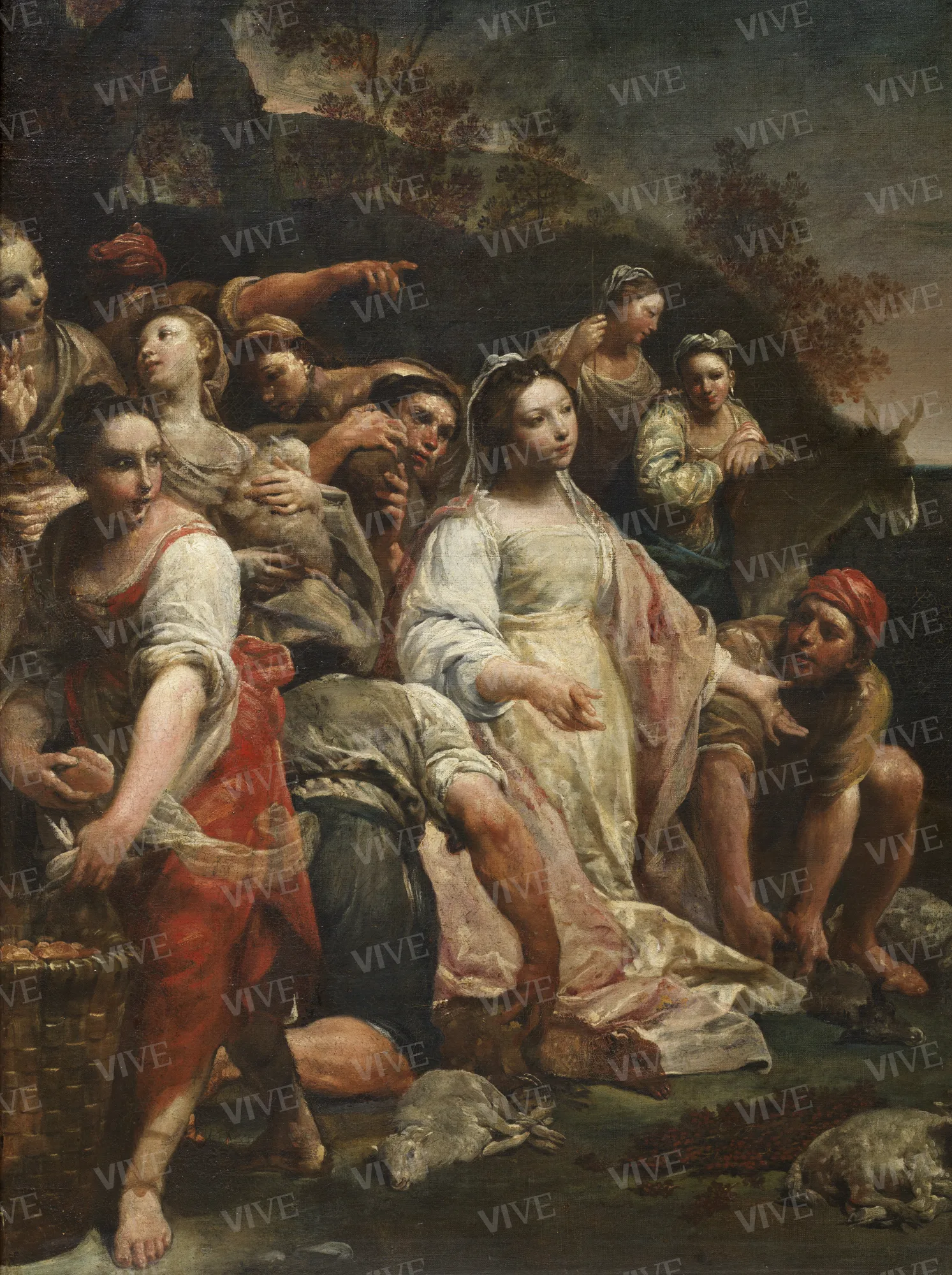
This canvas, along with its companion piece, The Finding of Moses (inv. 876), was commissioned in Bologna from Giuseppe Maria Crespi by Cardinal Tommaso Ruffo between 1721 and 1727. It portrays the biblical encounter between David, who would become king of Israel, and Abigail, spouse of the shepherd Nabal. Nabal had shown disloyalty toward David, leading David to consider eliminating all male members of Nabal’s household. Upon discovering his intent, Abigail, acting independently of her husband, approached David and provided food and livestock as depicted in the painting, successfully appealing for mercy.
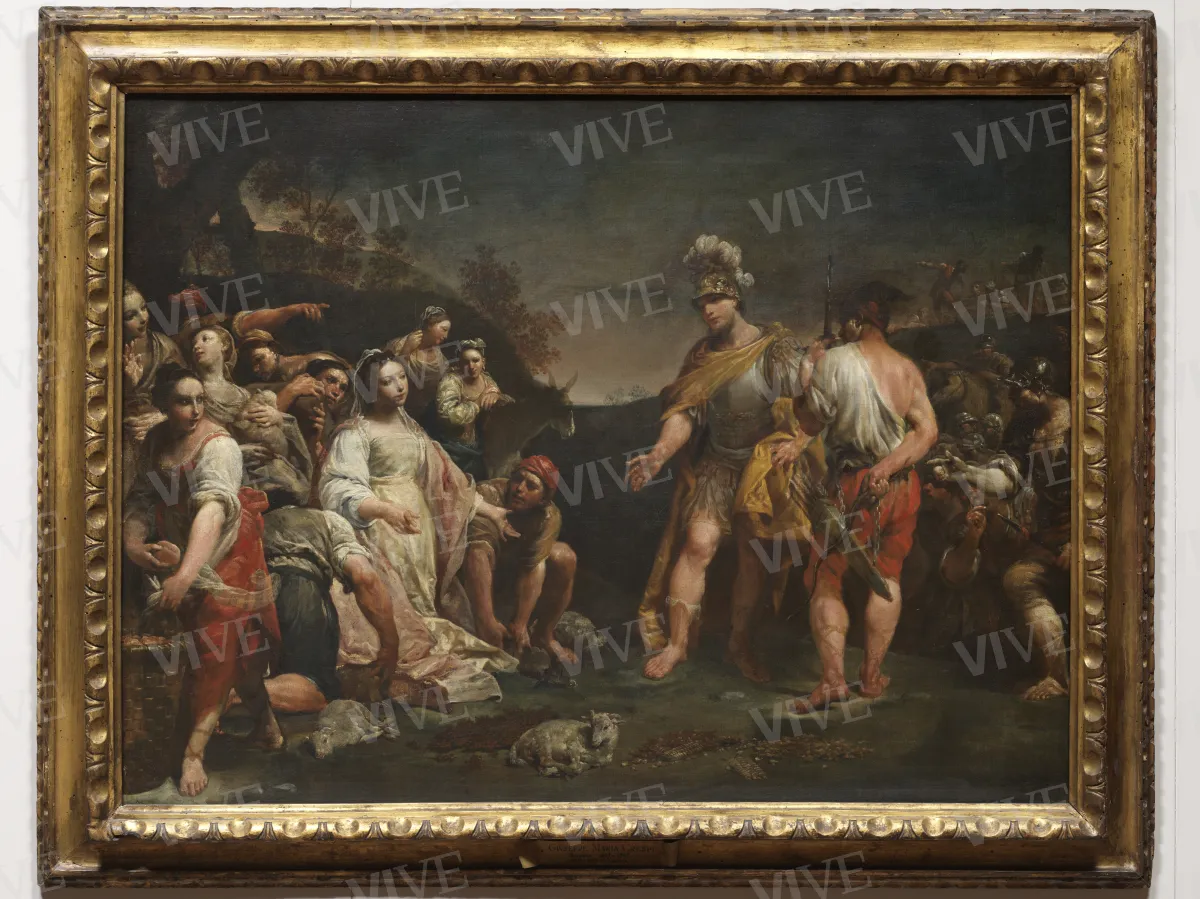
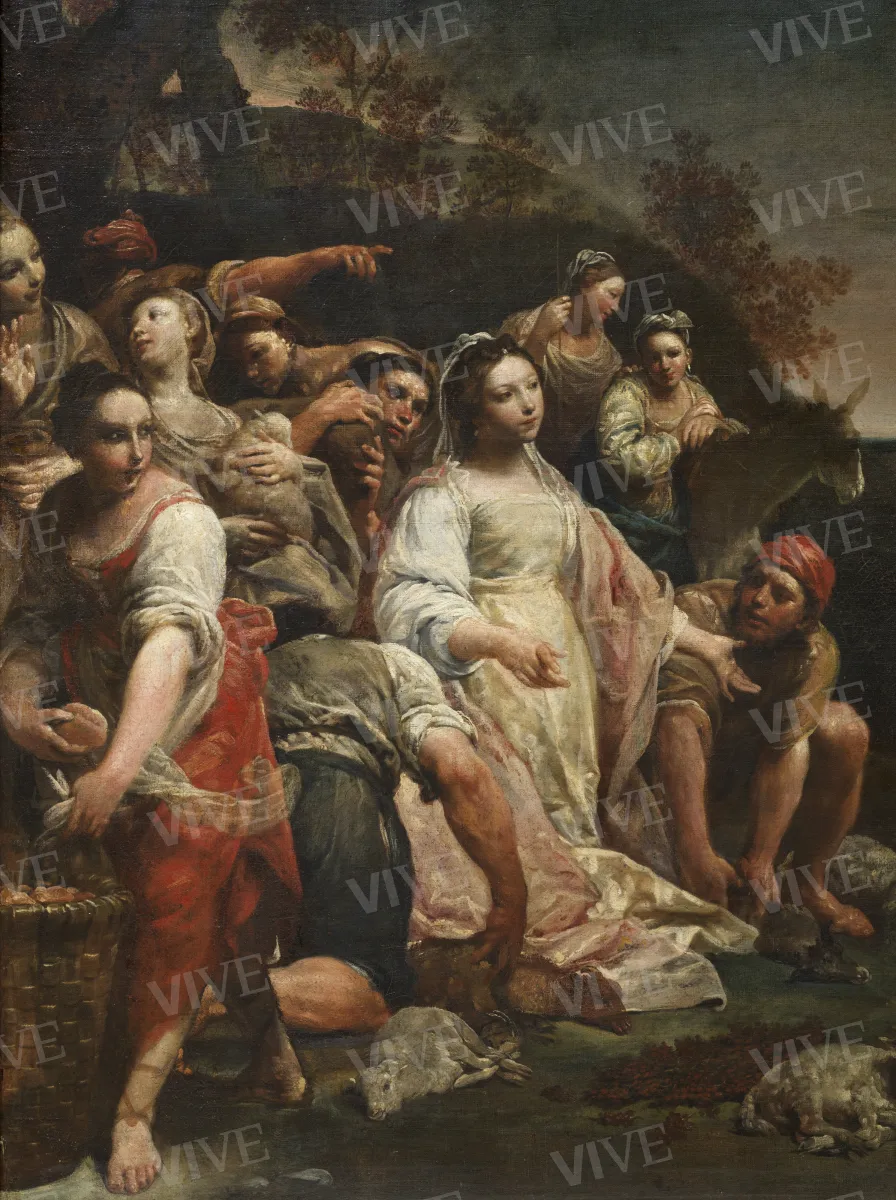
This canvas, along with its companion piece, The Finding of Moses (inv. 876), was commissioned in Bologna from Giuseppe Maria Crespi by Cardinal Tommaso Ruffo between 1721 and 1727. It portrays the biblical encounter between David, who would become king of Israel, and Abigail, spouse of the shepherd Nabal. Nabal had shown disloyalty toward David, leading David to consider eliminating all male members of Nabal’s household. Upon discovering his intent, Abigail, acting independently of her husband, approached David and provided food and livestock as depicted in the painting, successfully appealing for mercy.
The painting was commissioned from Giuseppe Maria Crespi (1665–1747) by Cardinal Tommaso Ruffo (1663–1753), a noted Neapolitan collector, during his tenure as apostolic legate in Bologna from 1721 to 1727 (Agnelli 1734; Zanotti 1739).
Set against a twilight landscape, the biblical account of David and Abigail's encounter (1 Samuel, 25:2–43) is depicted. While traveling near Mount Carmel in Galilee with his followers, David was dismissed by Nabal, a shepherd and Abigail’s husband, who declined to offer assistance despite having previously benefited from David’s aid. In response to this affront, David resolved to seek retribution by planning the destruction of all male members of Nabal’s household. Upon learning of the impending threat, Abigail approached with her attendants, bringing provisions and livestock to request clemency for her household. David, influenced by her appeal, chose not to proceed with his intended actions. Subsequently, following the death of her husband, Abigail became David's wife.
The composition centers on Abigail, who is depicted in an elegant ivory-white robe accented with pearlescent highlights and draped in a pink cloak. Her extended arms convey generosity, while her composed expression reflects Guido Reni’s influence through its abstract restraint and the subtle luminosity of her complexion. Positioned behind her are several figures displaying tension through their postures and animated gestures, lending the scene an element of unfiltered realism consistent with Crespi’s artistic approach (Viroli 1990, 150). To the right of the composition, partially illuminated from the shadows, stand David’s soldiers; notably, one raises his index finger to his lips, a gesture denoting silence. This iconographic motif was widely adopted by painters in the Emilia region from the sixteenth century onward, as seen in works such as Pellegrino Tibaldi’s frescoes in Palazzo Poggi, Bologna (c. 1550) and Annibale Carracci’s ceiling in the Galleria Farnese, Rome (c. 1599).
As observed by Roberto Longhi (1948, 20–21) and subsequently by Renato Roli (1977), this painting, like its companion piece The Finding of Moses (inv. 876), demonstrates the artist’s clear intent to adopt a courtly and classicist style, likely in response to the patron's preferences. Nevertheless, even “on the occasion of these biblical subjects transferred to Arcadia” (Roli 1977, 27), Crespi maintained his commitment to a realistic approach, favouring direct representation that highlights humility within devotional intimacy, as seen in the renowned Seven Sacraments series (c. 1712, Dresden), or in scenes from everyday private life. The painting, which had consistently remained within the Ruffo family collections alongside its companion piece, was donated to the Italian State in 1915 by Senator Fabrizio Ruffo di Motta Bagnara (1843–1917). As a result, it became part of the holdings of the newly established Regio Museo del Palazzo di Venezia.
A high-quality replica of the canvas, matching the original format and dimensions, previously identified within the Milanese antiques market (Merriman 1980, p. 238; Finarte Milano, November 23, 1972, lot 10; subsequently at Phillips London, October 29, 1996, lot 34), has recently resurfaced at Dorotheum in Vienna. It is attributed to Crespi’s workshop, listed as oil on canvas, 75.5 × 105.5 cm (May 12, 2022, lot 284).
Giulia Daniele
Entry published on 16 October 2025
Good.
Rome, Collezione Cardinal Tommaso Ruffo, 1663–1753;
donation by Don Fabrizio Ruffo di Motta Bagnara, 1915–1919.
Bologna, Salone del Podestà, Mostra celebrativa di Giuseppe M. Crespi, June–July 1948;
Bologna, Pinacoteca Nazionale e Accademia di Belle Arti Palazzo Pepoli Campogrande, Giuseppe Maria Crespi (1665–1747), September 7–November 11, 1990.
Agnelli Jacopo, Galleria di pitture dell’E.mo, e R.mo Principe Signor Cardinale Tommaso Ruffo Vescovo di Palestrina, e di Ferrara. Rime e prose, In Ferrara: Per Bernardino Pomatelli Stampatore Vescovile, 1734, pp. 14-15;
Zanotti Giampietro, Storia dell’Accademia Clementina di Bologna aggregata all’Instituto delle Scienze e dell’Arti, 2 voll., in Bologna, per Lelio dalla Volpe, 1739, vol. 2, p. 56;
Crespi Luigi, Vite de’ pittori bolognesi, non descritte nella Felsina pittrice, in Roma, nella stamperia di Marco Pagliarini, 1769, p. 214;
Hermanin Federico, Il Palazzo di Venezia, Roma 1948, pp. 232-233;
Museo di Palazzo Venezia. Catalogo. 1. Dipinti, Santangelo Antonino (a cura ndi), Roma 1947, p. 23;
Arcangeli Francesco, Gnudi Cesare (a cura di), Mostra celebrativa di Giuseppe M. Crespi, catalogo della mostra (Bologna, Salone del Podestà, giugno-luglio 1948), Bologna 1948, p. 38, n. 38;
Longhi Roberto, Premessa, in Arcangeli Francesco, Gnudi Cesare (a cura di), Mostra celebrativa di Giuseppe M. Crespi, catalogo della mostra (Bologna, Salone del Podestà, giugno-luglio 1948), Bologna 1948, pp. 11-22;
Catalogo del Gabinetto Fotografico Nazionale. 3. I dipinti del Museo di Palazzo Venezia in Roma, Zeri Federico (a cura di), Roma 1955, p. 6, n. 34;
Merriman Mira Pajes, The Paintings of Giuseppe Maria Crespi, tesi di dottorato, New York, Columbia University, 1968, pp. 154-155, n. 12;
Roli Renato, Pittura bolognese (1650-1800). Dal Cignani ai Gandolfi, Bologna 1977, pp. 27, 107, n. 169b;
Merriman Mira Pajes, Giuseppe Maria Crespi, Milano 1980, pp. 238-239, n. 15;
Spike Jon T., Giuseppe Maria Crespi and the Emergence of Genre Painting in Italy, Firenze 1986, pp. 146-147;
Viroli, in Emiliani Andrea, Rave August B. (a cura di), Giuseppe Maria Crespi (1665-1747), catalogo della mostra (Bologna, Pinacoteca Nazionale e Accademia di Belle Arti Palazzo Pepoli Campogrande; 7 settembre-11 novembre 1990), Bologna 1990, pp. 150-151, n. 75.C26.