Vittoriano


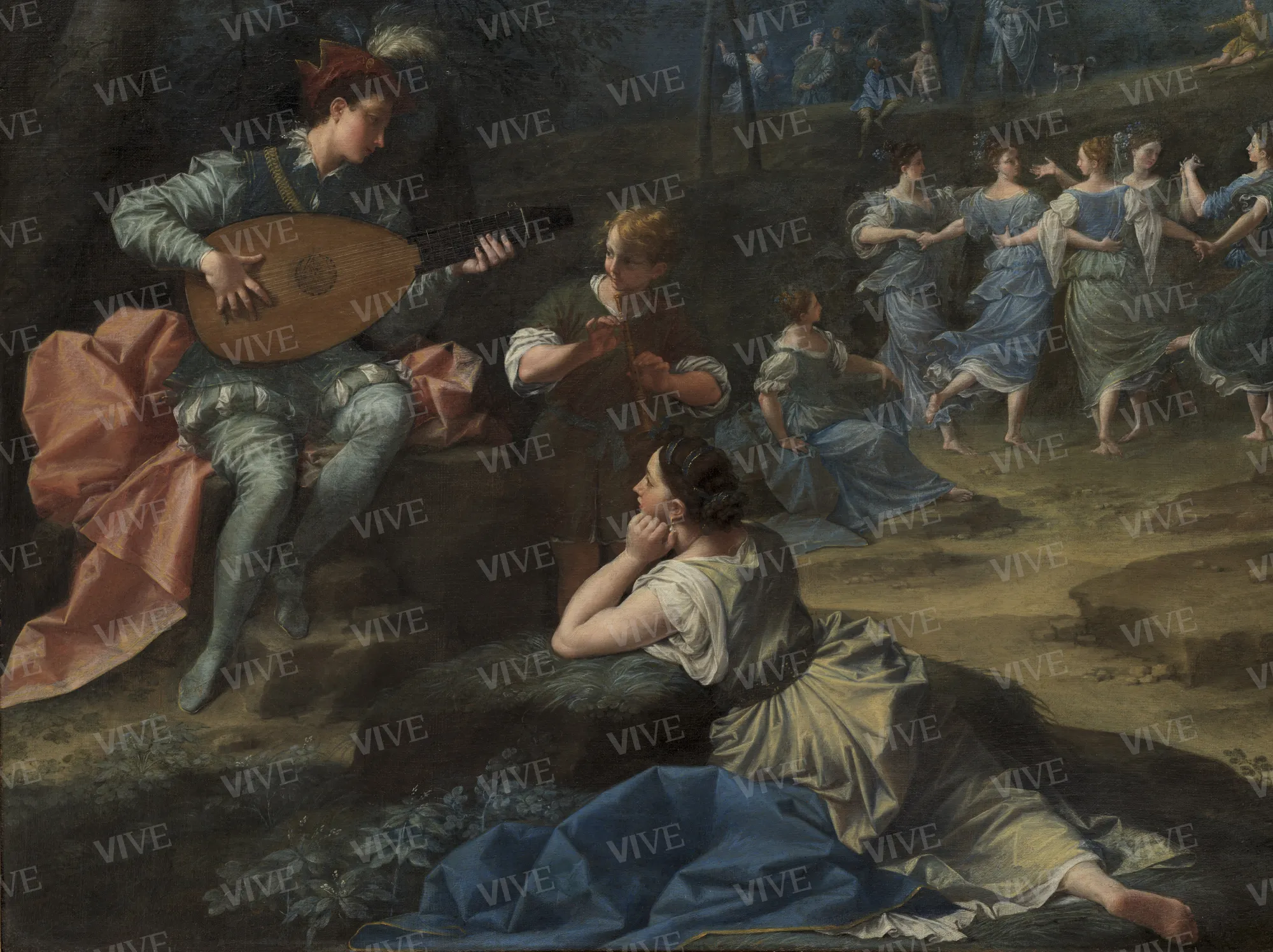
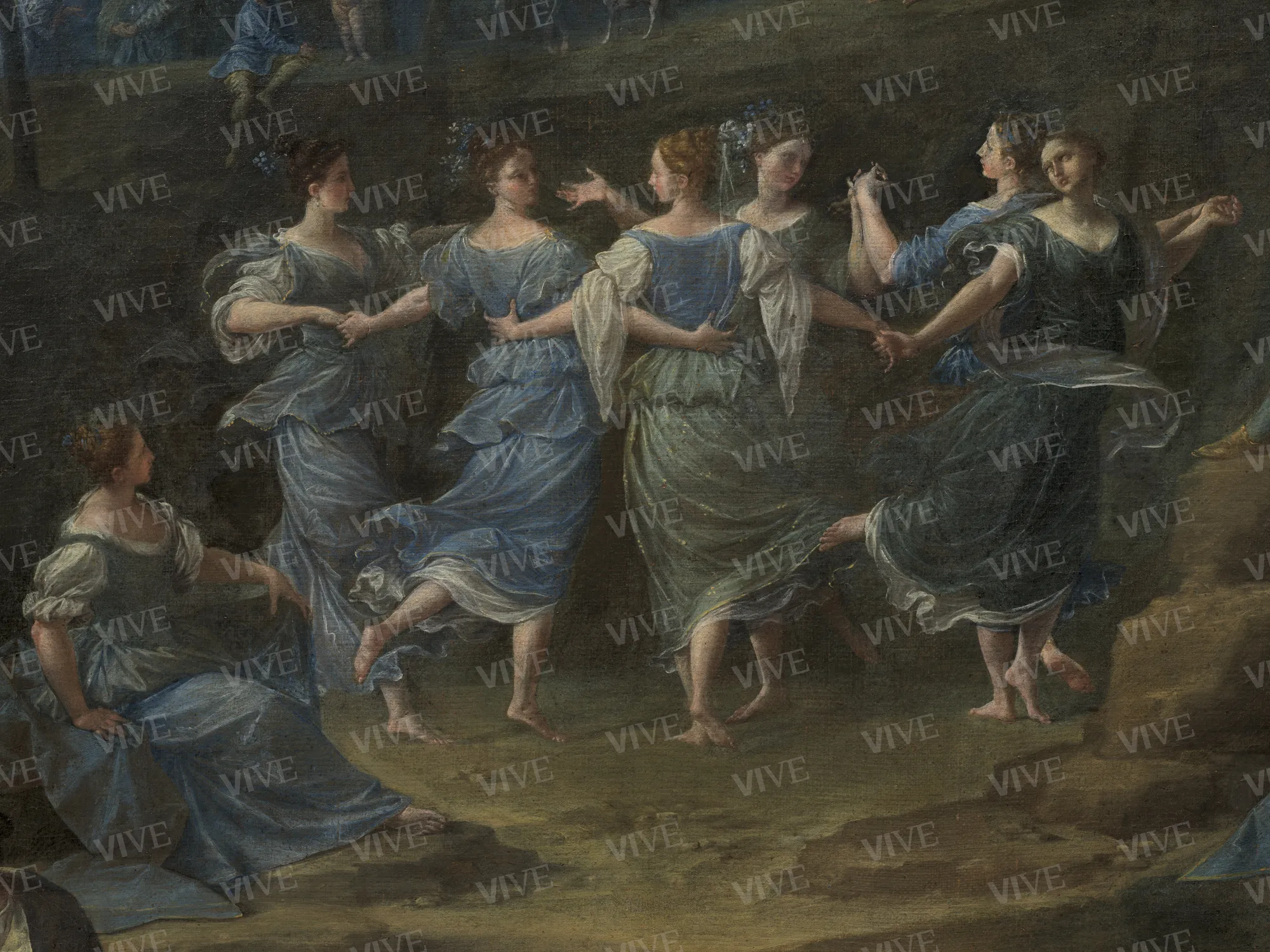
This painting, attributed to Donato Creti (a distinguished artist of eighteenth-century Bologna), depicts a rural landscape defined by dense vegetation and distant mountains. In the foreground, a young man in refined attire performs on the lute, joined by a flutist, while a girl reclines with her back to the musicians at their feet. Further into the scene, six nymphs are shown dancing as another musician provides accompaniment. Additional figures appear in the background, engaged in conversation.
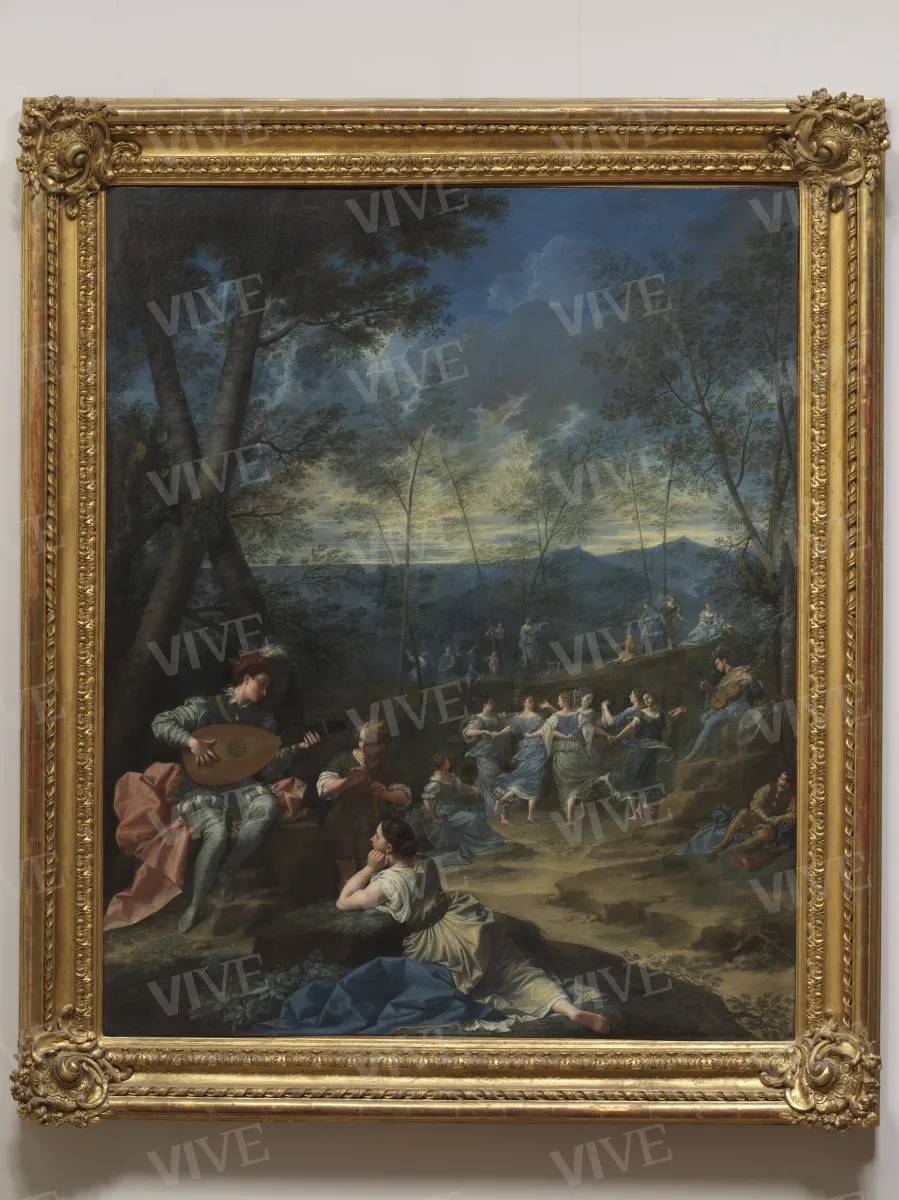
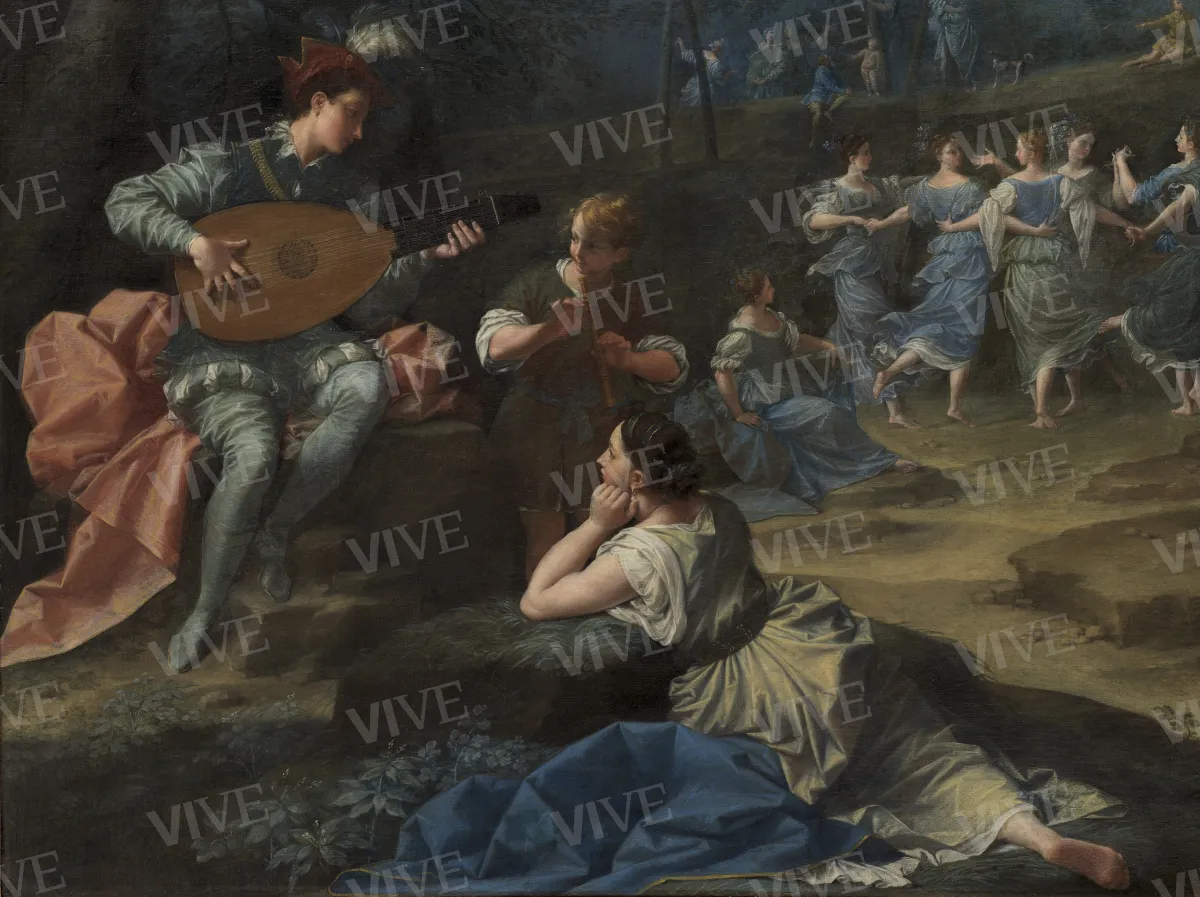
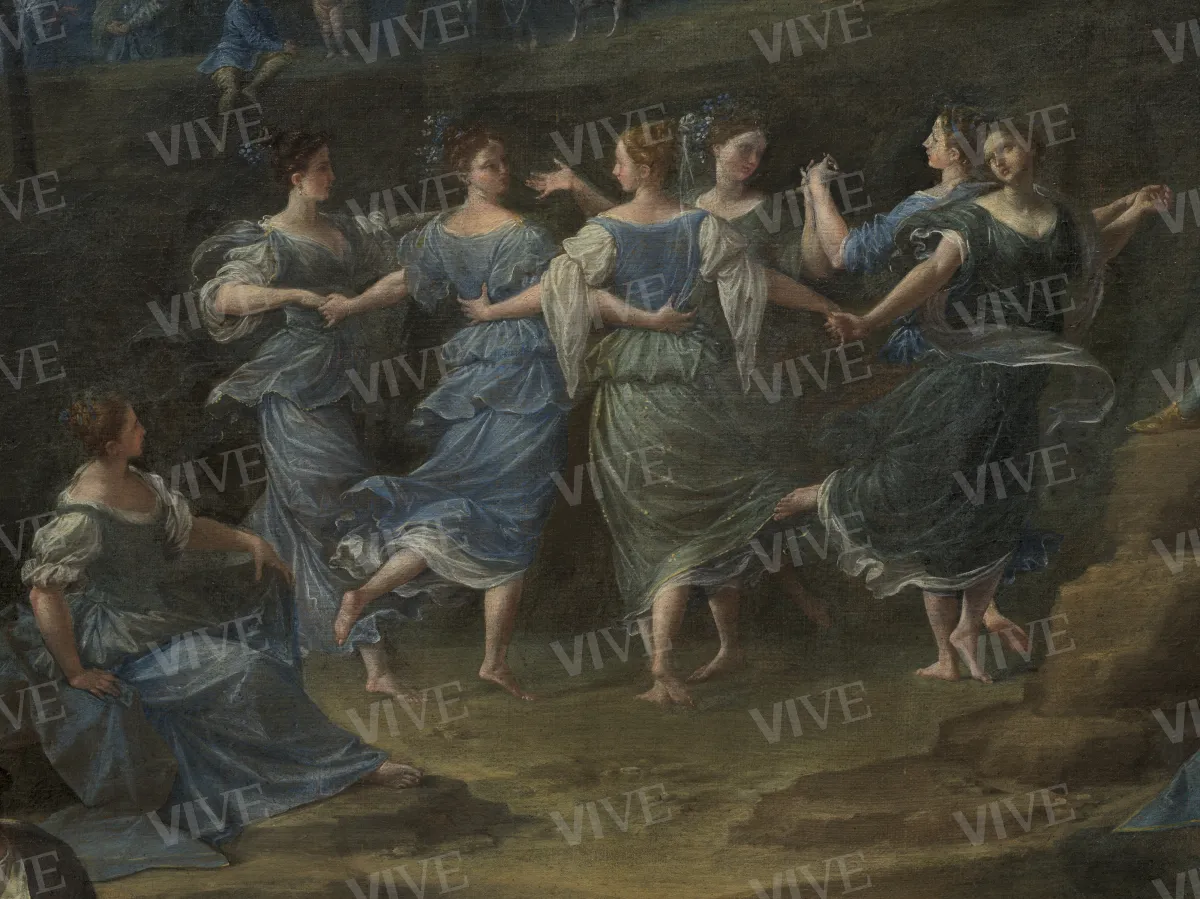
This painting, attributed to Donato Creti (a distinguished artist of eighteenth-century Bologna), depicts a rural landscape defined by dense vegetation and distant mountains. In the foreground, a young man in refined attire performs on the lute, joined by a flutist, while a girl reclines with her back to the musicians at their feet. Further into the scene, six nymphs are shown dancing as another musician provides accompaniment. Additional figures appear in the background, engaged in conversation.
The painting, created by Donato Creti (1671–1749) between 1724 and 1725, was donated to the Museo Nazionale di Palazzo Venezia by Prince Fabrizio Ruffo di Motta Bagnara in 1919. The provenance of this work, formerly part of Cardinal Tommaso Ruffo’s (1663–1753) distinguished collection notable for its Emilian paintings, is substantiated by the Ferrara poet Jacopo Agnelli. In his 1734 publication (48), Agnelli references a painting “depicting a dance of nymphs, conducted by an Arcade musician, with approximately twenty-four figures.” The work was commissioned directly from Creti by Tommaso Ruffo, alongside two additional paintings, The Queen of Sheba before Solomon and Solomon Worships the Idols, both currently housed at the Musée d’art Roger-Quilliot in Clermont-Ferrand. The cardinal was sufficiently impressed with Creti's artistry to bestow upon him the title of Knight of the Golden Spur. This honor was conferred during the principality of Giovanni Antonio Burrini, between 1724 and 1725 (Zanotti 1739, I, 71). Upon Cardinal Ruffo’s appointment as vice-chancellor of the Church in 1740, the painting, along with his collection, was transferred to Rome and exhibited at the Palazzo della Cancelleria. It was subsequently documented in the Galleria delle Cinque Camere in the prelate’s posthumous inventory dated 1753, where it is noted as “representing the Dance of some Nymphs with other figures by Cavalier Creti” (De Angelis 2010, 68). Tommaso’s collection was bequeathed to his nephew, Litterio Ruffo, with the stipulation that it remain intact and be passed on to the eldest descendant (De Angelis 2010, 55).
This work aligns seamlessly with the Arcadian culture that proliferated during the eighteenth century, yet its execution distinctly reflects the Bolognese pictorial tradition, drawing influence from artists such as Francesco Albani, Domenichino, and Guido Reni. Creti acquired these stylistic foundations in Lorenzo Pasinelli’s workshop, subsequently establishing himself as one of the most sophisticated painters of eighteenth-century Bologna. His artistry earned him the distinction of being referred to as the Watteau of Bologna. The Dance of the Nymphs is distinguished by its incorporation of figures that also appear in other works by Creti. Notable examples include the young man wearing a feathered hat, derived from the Allegorical Tomb of Locke, Boyle, and Sydenham located in the Galleria Nazionale in Bologna (Pittiglio 2005, 389), as well as the reclining girl—represented in a mirrored composition—featured in Achilles Entrusted to Chiron within the Collezioni Comunali in Palazzo D’Accursio, Bologna (Ravaioli 2002, 59). Furthermore, certain drawings by Creti reveal specific elements associated with the conceptualization of the depicted scene. For instance, three sheets housed in the royal collections at Windsor Castle feature, with some variations, the same pair of young figures in the foreground (Riccomini 2012, 85-86).
Alessandra Cosmi
Entry published on 16 October 2025
Fair.
Rome, Palazzo della Cancelleria, collection of Cardinal Tommaso Ruffo, before 1753;
Litterio Ruffo, 1753;
Rome, Vincenzo Ruffo di Motta Bagnara, before 1802;
Rome, Fabrizio Ruffo di Motta Bagnara, before 1919;
Rome, Museo Nazionale di Palazzo Venezia, 1919.
Bologna, Palazzo Comunale, Mostra del Settecento bolognese, 1935;
Chicago, Art Institute, Painting in Italy in the Eighteenth Century: Rococo to Romanticism, November 24, 1970–January 10, 1971;
Bologna, Palazzo Pepoli Campogrande, Pinacoteca Nazionale, L’arte del Settecento emiliano. La pittura. L’Accademia Clementina, September 8–November 25, 1979;
Turin, Palazzina di Caccia di Stupinigi, Da Tiziano a Caravaggio a Tiepolo: capolavori di tre secoli di arte italiana, November 17, 2002–February 16, 2003;
Bologna, Palazzo di Re Enzo, Le stanze della musica. Artisti e musicisti a Bologna dal ‘500 al ‘900, November 24, 2002–February 23, 2003;
Modena, Foro Boario, Nicolò dell’Abate. Storie dipinte nella pittura del Cinquecento tra Modena e Fontainebleau, March 20–June 19, 2005.
Agnelli Jacopo, Galleria di pitture dell’Emo, e Rmo Principe signor cardinale Tommaso Ruffo, Ferrara 1734, 48: “Cavaliere Donato Creti [...] also painted this work measuring 7 and 4 palms, depicting a dance of nymphs, regulated by an Arcadian musician, with about 24 figures. The finish and artistry with which this canvas is meticulously executed is worthy of the praise given to Parrasio, with emphasis on the teachings that Pliny dictates to painters [...]”;
Zanotti, Giampietro, Storia dell’Accademia Clementina di Bologna, Bologna 1739, I, 71: “[...] he painted another picture, which represents neither history nor fable, but a picturesque whim of a dance of nymphs accompanied by the sound of a rustic instrument played by a young shepherd. This painting contains about twenty-four figures, but they are so graceful and beautiful that anyone who is not particularly interested in painting, and even those who despise it, could fall in love with them [...]”;
Inventory of Cardinal Tommaso Ruffo, February 21, 1753, drawn up by Sebastiano Conca and Giovanni Sorbi, State Archives of Rome, 30 Notai Capitolini, notary Donato Antonio Lancioni, vol. 3818, f. 379v: “Another six palms high and four palms wide depicting the Dance of some Nymphs with other figures by Cavalier Creti, sc. 500” (De Angelis 2010, 68).
Agnelli Jacopo, Galleria di pitture dell’Emo, e Rmo Principe signor cardinale Tommaso Ruffo, Ferrara 1734, p. 48;
Zanotti Giampietro, Storia dell'Accademia Clementina di Bologna, Bologna 1739, I, p. 71;
Longhi Roberto, Zucchini Guido (a cura di), Mostra del Settecento bolognese, catalogo della mostra (Bologna, Palazzo Comunale, 1935), Bologna 1935, p. 34;
Hermanin Federico, Il Palazzo di Venezia, Roma 1948, p. 232;
Catalogo del Gabinetto Fotografico Nazionale. 3. I dipinti del Museo di Palazzo Venezia in Roma, Zeri Federico (a cura di), Roma 1955, p. 6, n. 35;
Roli Renato, Donato Creti (1671-1749), in «Arte antica e moderna», 2, 1959, pp. 328-341;
Roli Renato, Donato Creti, Milano 1967, pp. 41, 96, n. 82;
Maxon John, Rishel Joseph J. (a cura di), Painting in Italy in the Eighteenth Century: Rococo to Romanticism, catalogo della mostra (Chicago, Art Institute, 24 novembre 1970-10 gennaio 1971), Chicago 1970, pp. 122-124;
Emiliani Andrea (a cura di), L’arte del Settecento emiliano. La pittura. L’Accademia Clementina, catalogo della mostra (Bologna, Palazzo Pepoli Campogrande, Pinacoteca Nazionale, 8 settembre-25 novembre 1979), Bologna 1979, p. 63, n. 112;
Griseri Andreina, Arcadia: crisi e trasformazioni fra Sei e Settecento, in Zeri Federico (a cura di), Storia dell’arte italiana. Cinquecento e Seicento, VI, 1, Torino 1981, pp. 525-590;
Miller Denis, Creti, Donato, ad vocem, in Dizionario Biografico degli Italiani, Roma 1989, pp. 749-752;
Riccomini Eugenio, Bernardini Carla (a cura di), Donato Creti. Melanconia e perfezione. Le storie di Achille, le Virtù e i chiaroscuri della donazione Collina Sbaraglia al Senato di Bologna, catalogo della mostra (New York, Metropolitan Museum of Art, 27 ottobre 1998-31 gennaio 1999), Milano 1998, p. 25;
Sgarbi Vittorio (a cura di), Da Tiziano a Caravaggio a Tiepolo: capolavori di tre secoli di arte italiana, catalogo della mostra (Torino, Palazzina di Caccia di Stupinigi, 17 novembre 2002-16 febbraio 2003), Firenze 2002;
Ravaioli, in Medica Massimo (a cura di), Le stanze della musica. Artisti e musicisti a Bologna dal ‘500 al ‘900, catalogo della mostra (Bologna, Palazzo di Re Enzo, 24 novembre 2002-23 febbraio 2003), Cinisiello Balsamo 2002, p. 59;
Pittiglio, in Béguin Sylvie, Piccinini Francesca (a cura di), Nicolò dell’Abate. Storie dipinte nella pittura del Cinquecento tra Modena e Fontainebleau, catalogo della mostra (Modena, Foro Boario, 20 marzo-19 giugno 2005), Cinisello Balsamo 2005, p. 389, n. 171;
De Angelis Maria Antonietta, I dipinti del cardinale Tommaso Ruffo (1663-1753): la quadreria di un alto prelato nella Roma del Settecento, in Debenetti Elisa (a cura di), Collezionisti, disegnatori e pittori dall’Arcadia al Purismo, II, Roma 2010, pp. 53-89;
Riccomini Marco, Donato Creti. Le opere su carta. Catalogo ragionato, Torino 2012, pp. 28, 33, 85-86, nn. 11.10, 22.7, 96.3-96.5;
Pavone Mario Alberto, Il gusto del collezionista attraverso il giudizio dell’Agnelli, in Pavone Mario Alberto (a cura di), Il collezionismo del cardinale Tommaso Ruffo tra Ferrara e Roma, Roma 2013, pp. 7-19.