Vittoriano


Biscuit porcelain group on a circular base, depicting two semi-nude standing female figures lifting a cherub on their shoulders. A third female figure is kneeling behind them. The cherub and the women hold a festoon of luxuriant roses. The work can be traced back to the production of the Imperial Manufactory in Vienna in the late eighteenth century, when it was competitive with the Sèvres production.
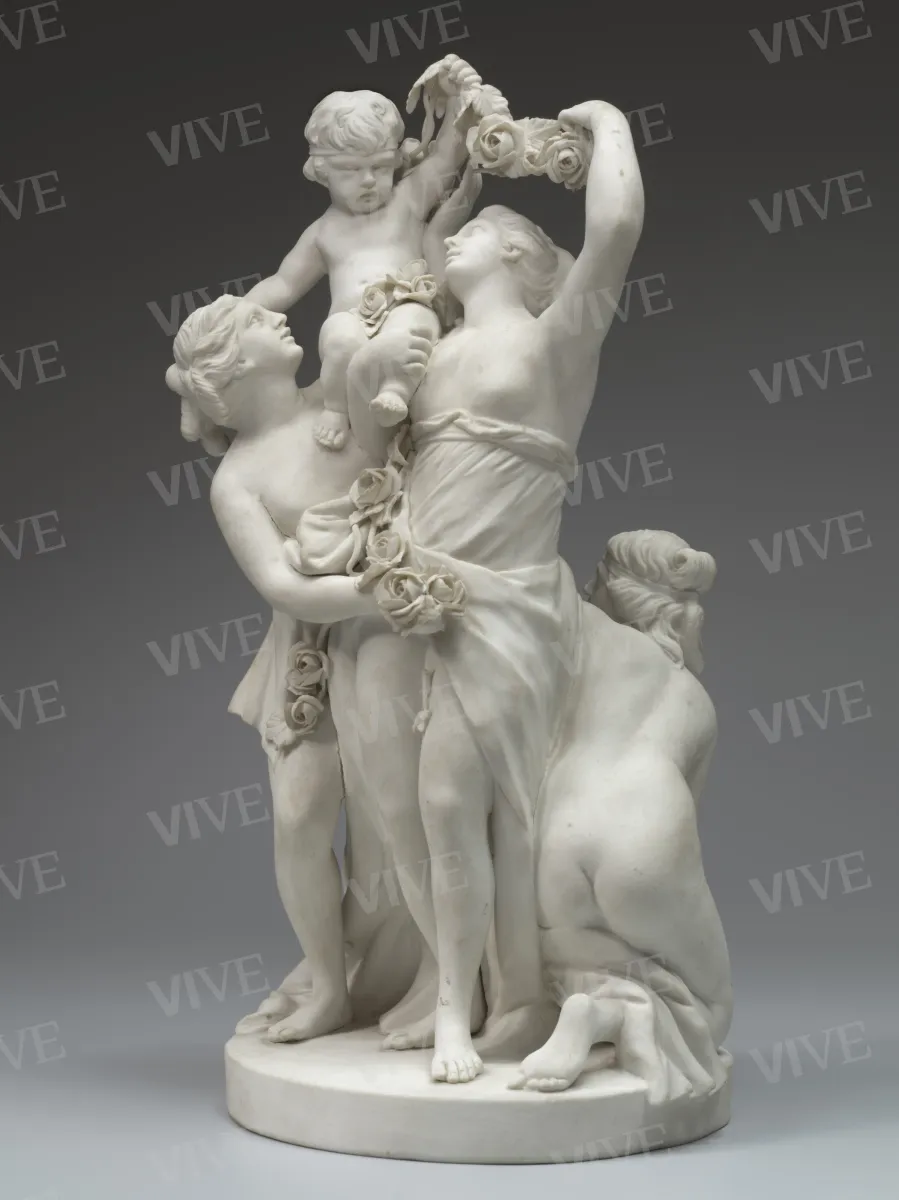


Biscuit porcelain group on a circular base, depicting two semi-nude standing female figures lifting a cherub on their shoulders. A third female figure is kneeling behind them. The cherub and the women hold a festoon of luxuriant roses. The work can be traced back to the production of the Imperial Manufactory in Vienna in the late eighteenth century, when it was competitive with the Sèvres production.
The group consists of the three Graces with Cupid. It is arranged on a circular base. Two goddesses support on their shoulders the winged cherub engaged in lifting a garland of roses; the third – aldo holding a a wreath of flowers – is kneeling on the ground behind. The composition derives from the group L’Amour porté par les Grâces modeled in 1768 by Josse-François-Joseph Le Riche for the Sèvres manufactory, itself a three-dimensional reintepretation of a drawing by François Boucher executed around 1750 (Bourgeois 1909, plate 8, fig. 597).
By the mid-eighteenth century, Boucher’s figurative repertoire, widely disseminated through reproductive prints, became the quintessence of Rococo culture throughout Europe and was even employed in the creation of ceramic models at the Sèvres manufactory, which was the first to introduce biscuit porcelain into sculptural production.
Like other eighteenth-century ceramic manufactories, the Imperial Manufactory in Vienna was captivated by Sèvres biscuit porcelain, to the extent of adopting—often in instances of unabashed artistic plagiarism—the same iconography. The numbers impressed alongside the mark indicate that the example in the Museo di Palazzo Venezia dates back to 1784, placing it in the German manufactory’s third period (1784–1805). During those years, under the direction of Baron Konrad von Sorgenthal, there was a substantial increase in the production of small sculptural groups, reflecting prevailing tastes both in the choice of subjects and in the execution of biscuit porcelain, thus rivaling Sèvres in stylistic sophistication. The grace and elegant neoclassical orientation of these groups are traditionally associated with the sculptor Anton Grassi, chief modeler of the manufactory from 1784. However, the presence of the letter “F” on the object, referring to the modeler Josef Dangel, suggests that this may instead be his invention. Interpreted with formal rigor and supple elegance, similar groups were used as centerpieces in banquet settings, accompanied by small figurines with subjects alluding in some cases to the allegories of the Seasons. At Sèvres, for example, the present piece finds its counterpart in a composition representing Bacchus porté par les Bacchantes, in which three nymphs hold up the young Bacchus and entwine vine tendrils with grape clusters, identified as the Allegory of Autumn (Bourgeois 1909, plate 9, fig. 90). The group in the Museo di Palazzo Venezia may therefore be understood as an Allegory of Spring and considered part of a larger series (Mrazek, Neuwirth 1970, 155, cat. 553, plate 76a). The sculpture perfectly embodies the fashion of the time, that fatuous and light taste reminiscent of boudoirs, delightful frivolity, theatrical affectation, and posing, aiming for a pleasant effect with allusions to the erotic universe. The mythological-pastoral theme, always interpreted in a decorative key, proves to be the most suitable register for recreating a libertine Arcadia, where female deities and nymphs are merely pretexts for trapping desire in smooth bodies, sighs and smiles, and even in the grace of the feet. The remarkable popularity of the subject is evidenced by the existence of numerous examples in public and private collections, clearly executed to satisfy the demands of a broad clientele.
Notable Sèvres examples include models held at the Querini Stampalia Foundation in Venice (Dal Carlo 1998, 160–161), the Cleveland Museum of Art (Neils 1982, 68, cat. 72), the Hermitage Museum in St. Petersburg (inv. ЗФ–25797), and the Hillwood Museum in Washington (inv. 24.166). Additionally, an identical Viennese biscuit is housed at the MAK – Museum für angewandte Kunst in Vienna (Neuwirth 1982, 153, cat. 348).
Giovanni De Girolamo
Entry published on 16 October 2025
Good. Several roses are missing from the festoon.
Shield stamped in the paste, under the base;
“F” and ‘84’ engraved; “26” painted in gray.
Rome, bequest of Herniette Tower Wurts, 1933;;
Rome, Museo Nazionale di Palazzo Venezia, 1933.
Bourgeois Émile, Le Biscuit de Sèvres. Recueil des modèles de la Manufacture de Sèvres au XVIIIe siècle, Paris 1909, p. 8, cat. 597;
Mrazek Wilhelm, Neuwirth Waltraud, Wiener Porzellan. 1718-1864, Wien 1970, p. 155, cat. 553, tav. 76a;
Niels, in Niels Jenifer (a cura di), The World of Ceramics: Masterpieces from The Cleveland Museum of Art, catalogo della mostra (Cleveland, Cleveland Museum of Art, 30 giugno-25 settembre 1982), Cleveland 1982, p. 68, cat. 72;
Neuwirth, in Neuwirth Waltraud (a cura di), Wiener Porzellan 1718-1864, catalogo della mostra (Vienna, Österreichischen Museum für angewandte Kunst, maggio-ottobre 1982), Wien 1982, p. 153, cat. 348;
Dal Carlo, in Dal Carlo Elisabetta (a cura di), Le porcellane dell’ambasciatore, catalogo della mostra (Venezia, Fondazione Querini Stampalia, 19 dicembre 1998-30 maggio 1999), Venezia 1998, pp. 160-161;
Casanova Maria Letizia, Le porcellane europee del Museo di Palazzo Venezia, Roma 2004, pp. 110-111.