Vittoriano


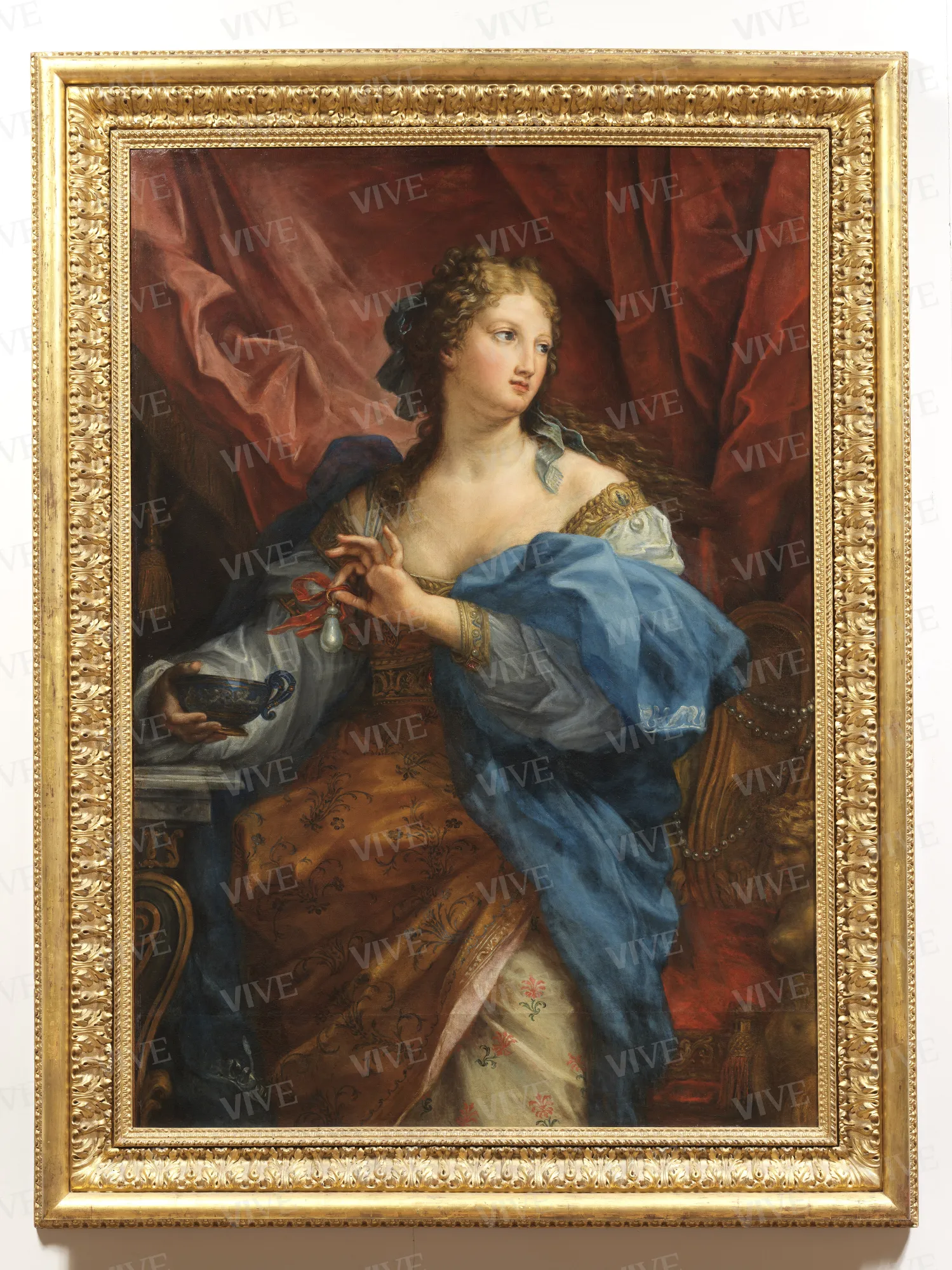
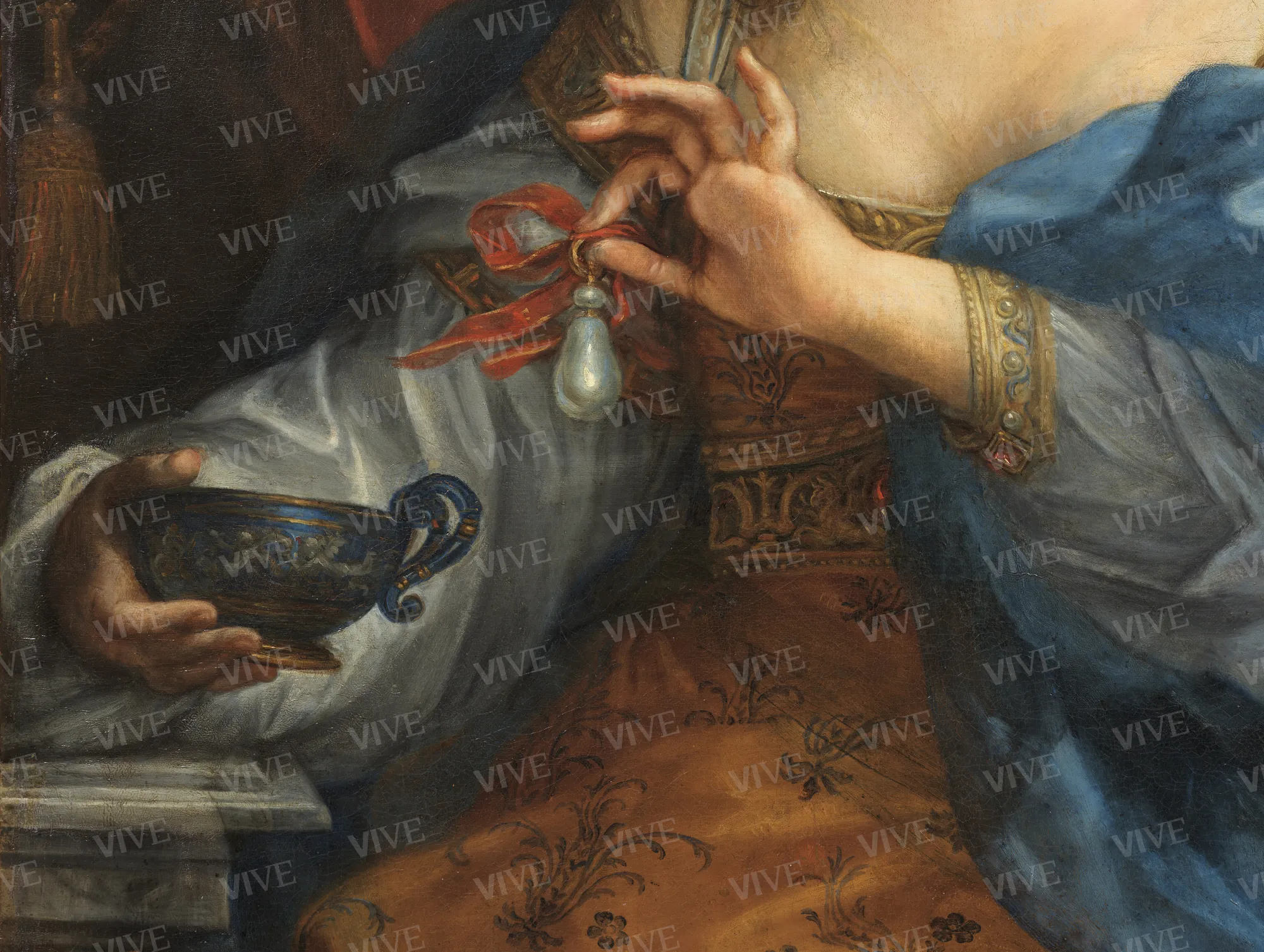
The artwork by Carlo Maratti illustrates a notable event from the life of Cleopatra, the final monarch of Egypt's Ptolemaic dynasty. It portrays the queen, adorned in elaborate attire and surrounded by luxurious furnishings, at the moment she prepares to dissolve one of her renowned pearls in a vessel of vinegar with the intention of drinking it. This act occurred during an opulent banquet as part of a wager with the Roman general Antony, whereby Cleopatra aimed to prove that she could consume a single meal valued at ten million sesterces.
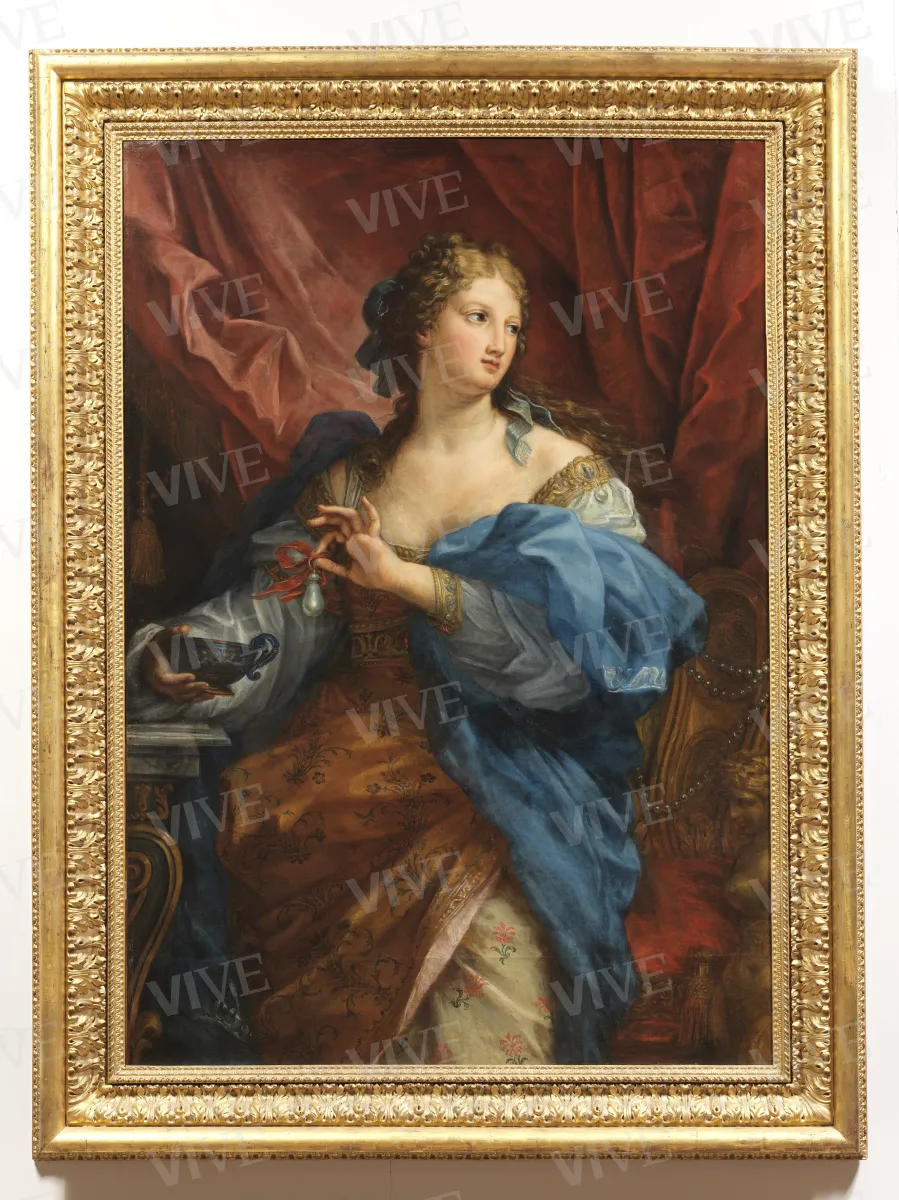
The artwork by Carlo Maratti illustrates a notable event from the life of Cleopatra, the final monarch of Egypt's Ptolemaic dynasty. It portrays the queen, adorned in elaborate attire and surrounded by luxurious furnishings, at the moment she prepares to dissolve one of her renowned pearls in a vessel of vinegar with the intention of drinking it. This act occurred during an opulent banquet as part of a wager with the Roman general Antony, whereby Cleopatra aimed to prove that she could consume a single meal valued at ten million sesterces.
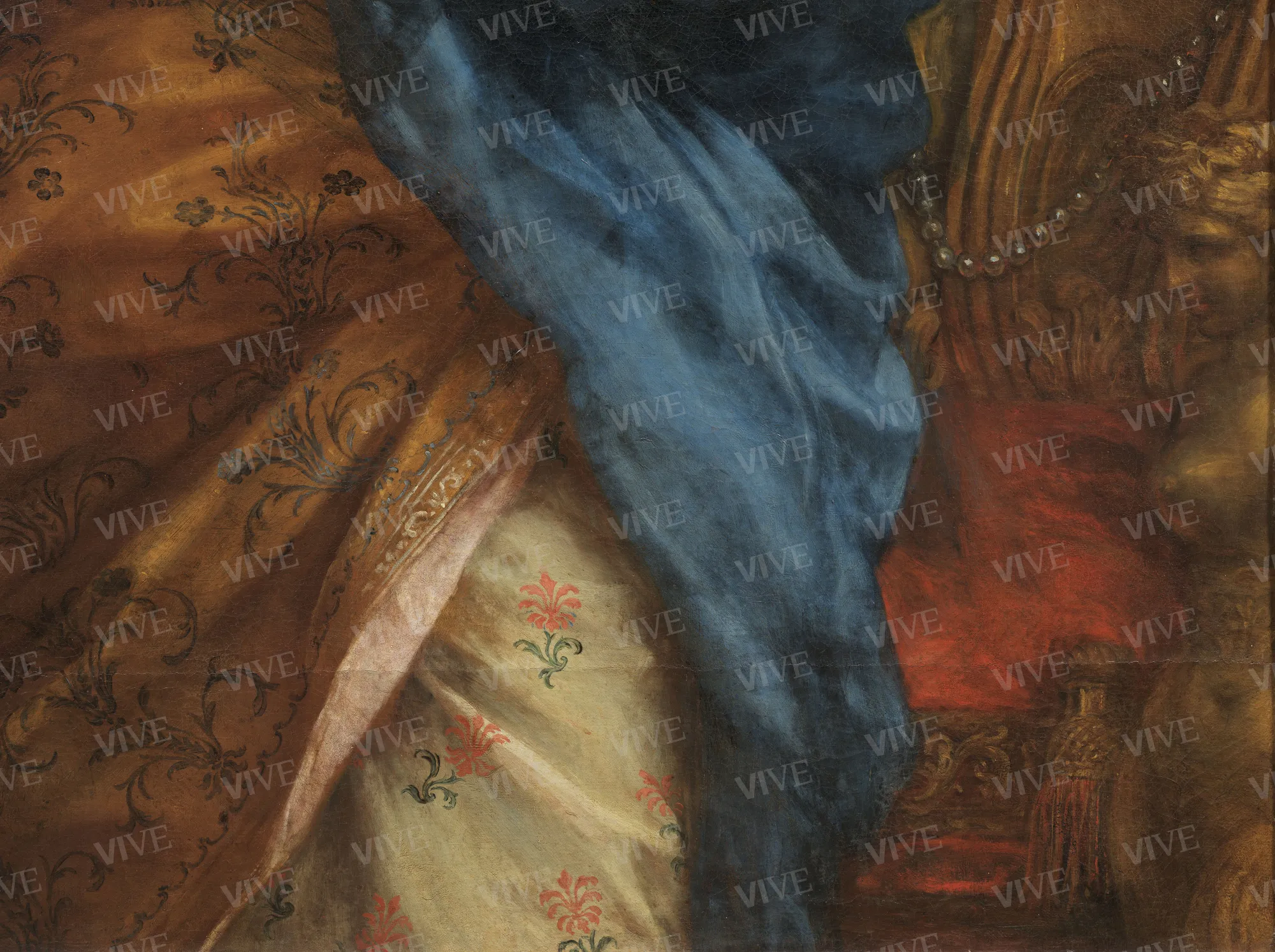
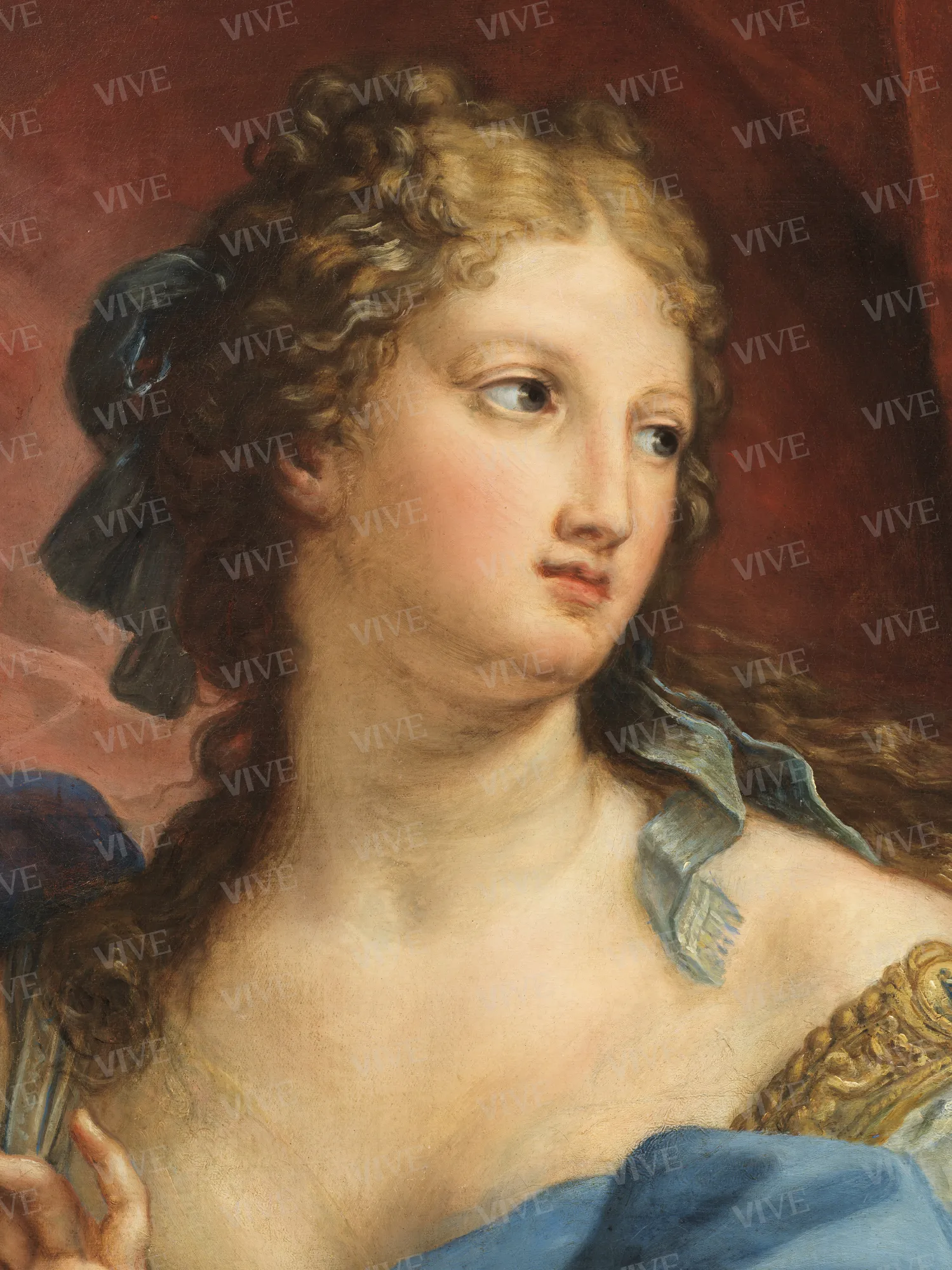
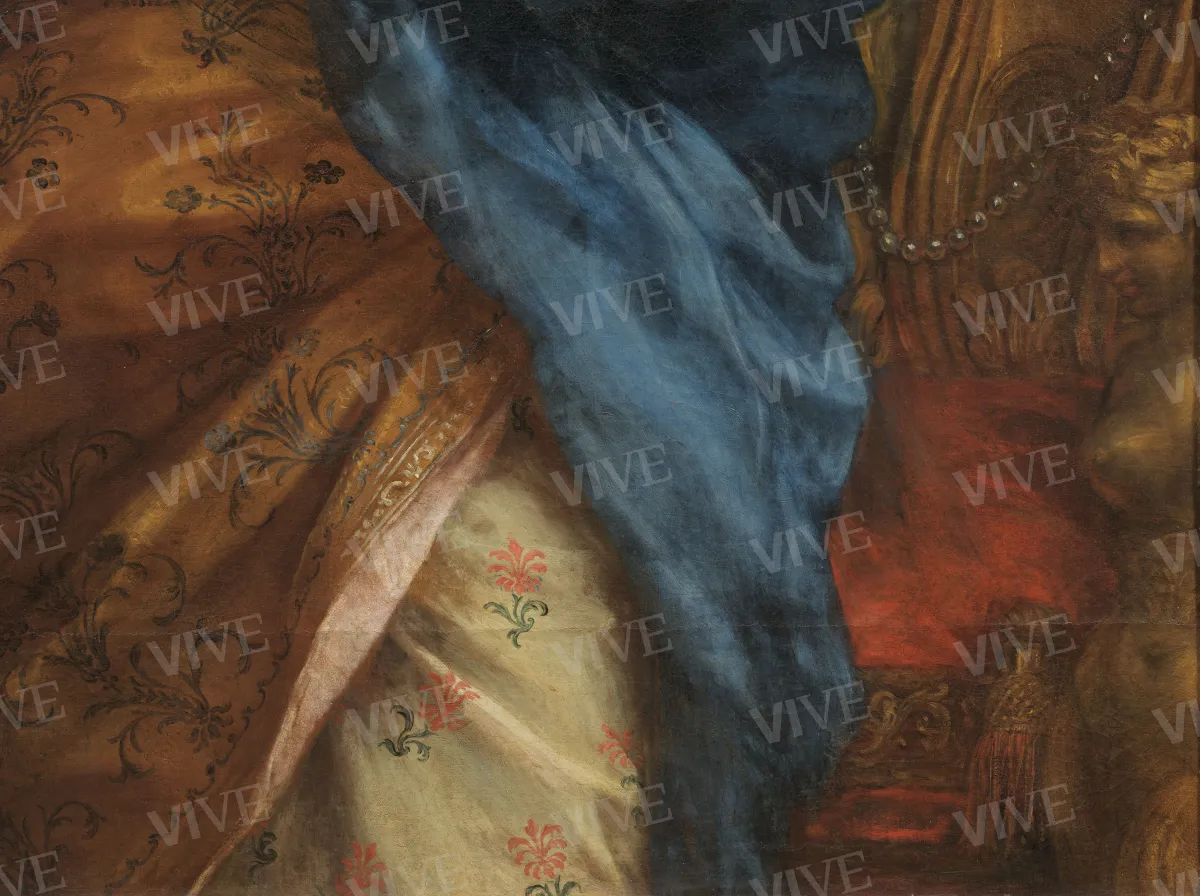
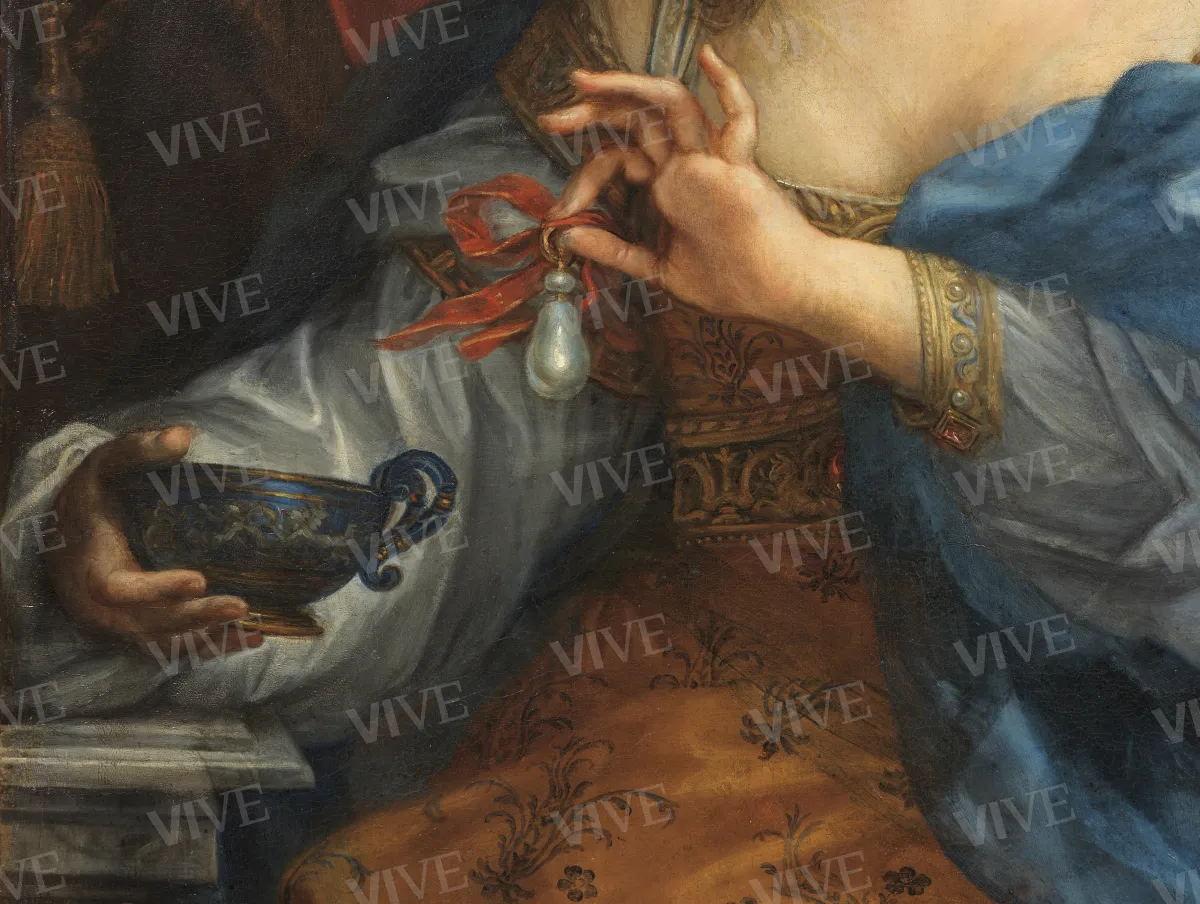
The artwork portrays Cleopatra in a half-length composition, elegantly attired and adorned with an intricate hairstyle, as she loosens a pearl into a cup. The Queen of Egypt is depicted in exceptionally refined garments, highlighting the use of luxurious materials and valuable adornments such as a circular pearl embellishing her left shoulder and additional pearls on the embroidered cuff of her left arm, which is secured by a rectangular gemstone, possibly a ruby. The scene’s opulence is further emphasized by long strands of pearls draped over a richly carved and gilded chair in the background, as well as the blue and gold enamelled, silver-plated cup decorated with cherubs that Cleopatra holds in her right hand. She is shown leaning on a segment of a table or console featuring shelves, topped with thick marble and supported by an intricately carved and gilded wooden frame. A large red curtain adorned with fringes and golden tassels serves as the backdrop for the scene. The painting illustrates a notable episode from the life of the last Ptolemaic ruler, as told by Pliny the Elder in his Naturalis Historia (IX, 119–121). In this event, Cleopatra wagers with Antony that she could consume, by herself, a single meal valued at ten million sesterces. During an opulent banquet, the queen requests a cup of vinegar into which she dissolves one of her two renowned pearls and subsequently drinks the contents, thereby winning the challenge presented to the Roman general.
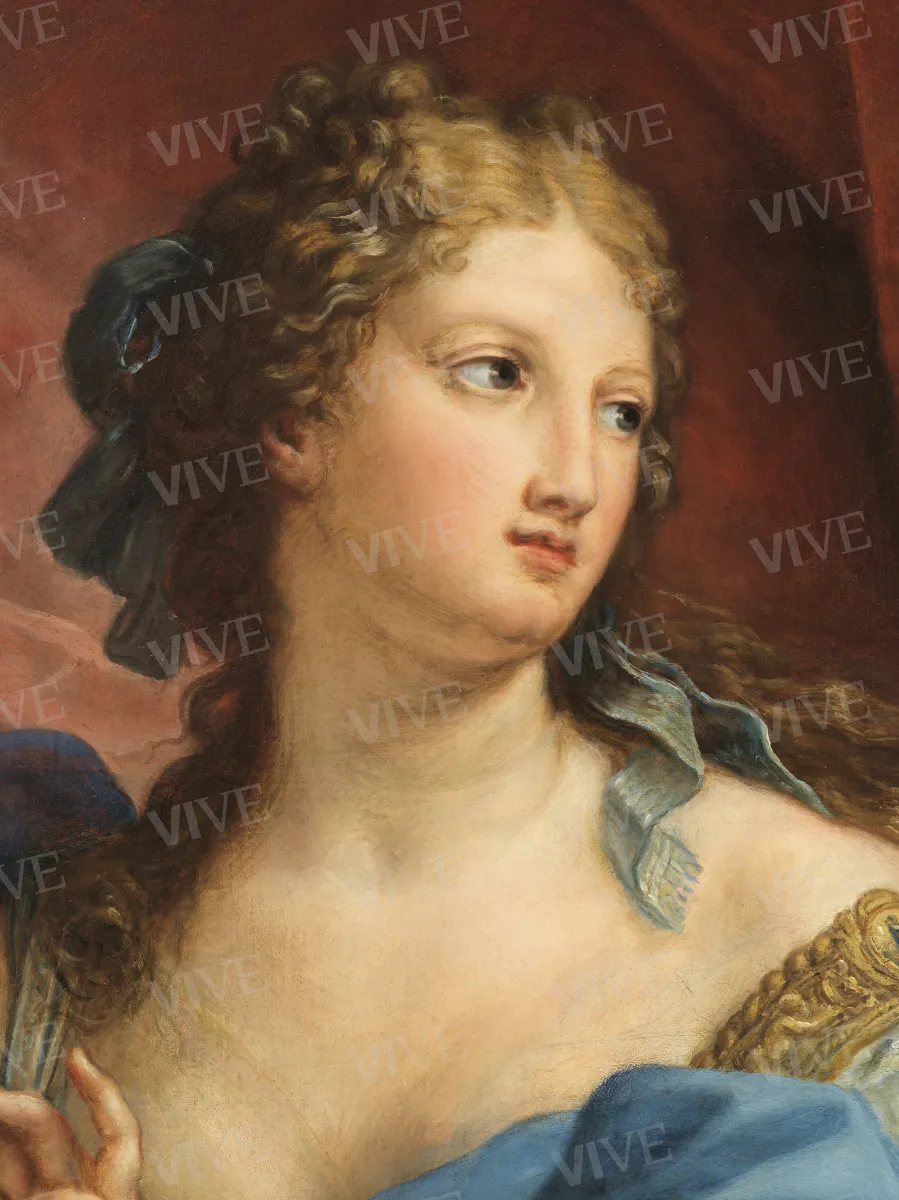
The canvas is part of a series referred to as “six half-figures of illustrious women” mentioned by Giovan Pietro Bellori (Bellori [1672] 2009, 651), who attributed the work to Carlo Maratti (1625–1713), identifying Francesco Montioni (?–1716) from Spoleto as the commissioner. Current research has not clarified whether the painting at the Museo di Palazzo Venezia originated from the Montioni collection or from that of Niccolò Maria Pallavicini (?–1714), another banker and supporter of Maratti’s work. The canvas was later donated posthumously by Cardinal Troiano Acquaviva d’Aragona (1695–1747) to Cardinal Tommaso Ruffo (1663–1753), and subsequently donated by Fabrizio Ruffo di Motta Bagnara between 1915 and 1919 to the Museum of Palazzo Venezia. Cardinal Ruffo’s inventory states that the work was acquired for five hundred scudi by Marquis Pallavicini (De Angelis 2013, 208, note 107), though it does not clarify whether the purchase was made directly from the artist. Among the cycle of illustrious women referenced by Bellori, only this Cleopatra and the Vestal Tuccia are extant (Rudolph 1995, 98). The series of female figures served as representations of virtues attributed to heroines, queens, saints, and notable individuals from antiquity, whether historical or mythical, acting as exempla virtutis. Notably, the face of the Egyptian queen in this painting is modeled on Faustina Maratti (1679–1745), a poet and member of the Arcadian Academy who was the artist’s daughter and model, also featured in the Allegory of Painting held at Palazzo Corsini (inv. 220, oil on canvas, 61x50 cm), dated to the late seventeenth century. A comparable timeframe, specifically between 1693 and 1695, may be proposed for the creation of Cleopatra, distinguished by its assured and decisive stroke, meticulous attention to the materials of garments and fabrics, and refined light effects on the jewelry and sweeping drapery. Formerly part of the Ruffo collection, this painting achieved notable recognition, as evidenced by several known oil reproductions—many executed by Maratti’s students and followers. Examples include the version housed at the Rhode Island School of Design Museum in Providence (Clark 1959, 4), as well as another highly similar painting, once attributed to Maratti himself but now attributed to Andrea Procaccini, located at the Raclin Murphy Museum of Art (Notre Dame, Indiana) and donated by Richard E. Berlin (Rudolph 1995, 98, 105, fig. 63, with an incorrect location listed).
Dario Beccarini
Entry published on 16 October 2025
Good. The color palette selected by the artist is not immediately discernible, with both warm and cool tones appearing together in a balanced contrast. There is a reduction of the original strokes of color in certain areas of the painted surface, such as on the subject's right shoulder and beneath the curls, where a possible pentimento—potentially a jewel or string of pearls—can be observed; another possible pentimento may be present at Cleopatra’s waist. The lower section of the canvas is less distinct, featuring brushstrokes that become more irregular, along with visible retouching.
Bequeathed by Cardinal Troiano Acquaviva d’Aragona in 1747 to Cardinal Tommaso Ruffo in Rome; Donated by Don Fabrizio Ruffo di Motta Bagnara 1915–1919;
Rome, Museo Nazionale di Palazzo Venezia, 1919.
Inventory of Cardinal Tommaso Ruffo’s possessions: “Famous painting by Carlo Maratta depicting Cleopatra, approximately eight palms high with a gilded frame, which was paid for by Signor Marchese Pallavicino, sc. 500” (State Archives of Rome, Notaries AC, vol. 3818, February 21, 1753, f392 verso);
Archvio del Museo di Palazzo Venezia, Registro dipinti (without signature), no. 31, unnumbered page, under “state of conservation” the painting is listed as “restored” and under “location” it is listed as being in “II DEP. DORA”, inscription in pencil dated July 15, 1986.
Bellori Giovan Pietro Le vite de’ pittori scultori e architetti moderni [1672], Borea Evelina, Previtali Giovanni (a cura di), Torino 1999;
Donazione Ruffo di Motta Bagnara. Inventario della collezione del principe Ruffo donata allo Stato, 1915, n. 4;
Museo di Palazzo Venezia. Catalogo. Dipinti, Santangelo Antonino (a cura di), Roma 1947, p. 49, fig. 63;
Mezzetti Amalia, Contributi a Carlo Maratti, in «Rivista dell’Istituto Nazionale d’Archeologia e Storia dell’arte», 4, 1955, p. 343, n. 142, fig. 53;
Clark Anthony M., Five Roman Masters of the Settecento, in «The Rhode Island School of Design Bulletin», 45, 1959, 4, p. 4;
Miller Dwight C. (a cura di), Seventeenth and Eighteenth-Century Paintings from the University of Notre Dame, catalogo della mostra (Champaign, Krannert Art Museum, 3-25 febbraio 1962), Indiana 1962, p. 26;
Enggass, in Cummings Frederick (a cura di), Art in Italy: 1600-1700 catalogo della mostra (Detroit, The Detroit Institute of Arts, 6 aprile-9 maggio 1965), New York 1965, pp. 66-67, n. 55;
Borroni Salvadori Fabia, Le esposizioni d’arte a Firenze dal 1674 al 1767, in «Mitteilungen des Kunsthistorischen Institutes in Florenz», 18, 1974, 1, n. 100;
Waterhouse Ellis, Roman Baroque Painting: A List of the Principal Painters and Their Works in and around Rome, Oxford 1976, p. 91;
Westin Jean Kathryn, A Documentary and Stilistic Investigation of the Late Works of Carlo Maratti as Seen in the Presentation Chapel in St. Peter’s, University Park 1979, pp. 114-115, 319;
Rudolph Stella, An Instance of Time Thwarted by Love: Carlo Maratti’s Portrait of an Unusual Lady, in «Labyrinthos», 21-24, 1992-1993, p. 196;
Rudolph Stella, Una visita alla capanna del pastore Disfilo “primo dipintore di Arcadia” (Carlo Maratti), in «Atti e memorie. III Centenario dell’Arcadia», 2-4, 1991-1994, p. 398, n. 35;
Zampetti Pietro, La pittura nelle Marche. Dal Barocco all’età moderna, Firenze 1991, fig. 20 a p. 63;
Sestieri Giancarlo, Repertorio della pittura romana della fine del Seicento e del Settecento, 3 voll., Torino 1994., I, p. 119;
Rudolph Stella, Niccolò Maria Pallavicini. L’ascesa al tempio della Virtù attraverso il mecenatismo, Roma 1995, pp. 98-100, 102, tav. 17;
Barroero Liliana, Susinno Stefano, Roma arcadica capitale universale delle arti del disegno, in «Studi di Storia dell’Arte», 10, 1999, p. 95;
Barroero Liliana, Susinno Stefano, Arcadian Rome, Universal Capital of the Arts, in Bowron Edgar Peters, Rishel Joseph J. (a cura di), Art in Rome in the Eighteenth Century, catalogo della mostra (Philadelphia, Philadelphia Museum of Art, 16 marzo-28 maggio 2000; Houston, The Museum of Fine Arts, 25 giugno-17 settembre 2000), Philadelphia 2000, p. 50;
Rudolph Stella, Carlo Maratti, in Borea Evelina, Gasparri Carlo (a cura di), L'Idea del Bello. Viaggio per Roma con Giovan Pietro Bellori, catalogo della mostra (Roma, Palazzo delle Esposizioni ed ex Teatro dei Dioscuri, 29 marzo-26 giugno 2000), 2 voll., Roma 2000, II, pp. 476-477, n. XVII.22;
Rudloff-Azzi, in Ritschard Claude, Morehead Allison, Bal Mieke, Baumgärtel Bettina (a cura di), Cléopâtre dans le miroir de l’art occidental, catalogo della mostra (Ginevra, Musée Rath, 25 marzo-1 agosto 2004), Milano 2004, pp. 140-143, n. 31, fig. 2;
Battista Stefania, La collezione Ruffo di Bagnara: alcuni documenti inediti, in Pavone Mario Alberto, Giannone Antonio L. (a cura di), Percorsi d’arte. Dal collezionismo dei Ruffo all’evoluzione pittorica di Mino delle Site, catalogo della mostra (Cavallino di Lecce, 30 gennaio-13 marzo 2005; Salerno, Pinacoteca Provinciale, 23 marzo-1 maggio 2005), Salerno 2005, pp. 76-78;
Pavone Mario Antonio, Caratteri del collezionismo dei Ruffo, in in Pavone Mario Alberto, Giannone Antonio L. (a cura di), Percorsi d’arte. Dal collezionismo dei Ruffo all’evoluzione pittorica di Mino delle Site, catalogo della mostra (Cavallino di Lecce, 30 gennaio-13 marzo 2005: Salerno, Pinacoteca Provinciale, 23 marzo-1 maggio 2005), Salerno 2005, pp. 35, 66;
Sconci, in Barberini Maria Giulia, Sconci Maria Selene (a cura di), Guida al Museo Nazionale del Palazzo di Venezia, Roma 2009, p. 34;
De Angelis Maria Antonietta, I dipinti del cardinale Tommaso Ruffo (1663-1753): la quadreria di un alto prelato nella Roma del Settecento, in Debenedetti Elisa (a cura di), Collezionisti, disegnatori e pittori dall’Arcadia al Purismo, Roma 2010, pp. 58, 61, 64, 74;
Draghi, in Papetti Stefano, Sgarbi Vittorio (a cura di), Da Rubens a Maratta. Le meraviglie del Barocco nelle Marche, catalogo della mostra (Osimo, Palazzo Campana, 29 giugno-15 dicembre 2013), Cinisello Balsamo 2013, pp. 160-161, n. 46;
De Angelis Maria Antonietta, L’ultimo soggiorno a Roma del cardinale Tommaso Ruffo (1738-1753), in Pavone Mario Alberto (a cura di), Il collezionismo del cardinale Tommaso Ruffo tra Ferrara e Roma, Roma 2013, p. 186, tav. XVII;
Pedone, in Papetti Stefano, Sgarbi Vittorio (a cura di), Da Rubens a Maratta. Le meraviglie del Barocco nelle Marche, catalogo della mostra (Osimo, Palazzo Campana, 29 giugno-15 dicembre 2013), Cinisello Balsamo 2013, pp. 166-167;
Pedone Silvia, I Corsini collezionisti di Carlo Maratti. I dipinti della Galleria Corsini di Roma, in Sgarbi Vittorio (a cura di), Un capolavoro di Carlo Maratti per Camerano. Rebecca ed Eliezer al pozzo della Galleria Nazionale d’Arte Antica in Palazzo Corsini, catalogo della mostra (Camerano, Chiesa di Santa Faustina, 28 giugno-18 ottobre 2014), Acqui Terme 2014, pp. 70-72;
Rudolph Stella, Appunti per la contestualizzazione della “Rebecca” Corsini nell’evoluzione artistica di Carlo Maratti, in Sgarbi Vittorio (a cura di), Un capolavoro di Carlo Maratti per Camerano. Rebecca ed Eliezer al pozzo della Galleria Nazionale d’Arte Antica in Palazzo Corsini, catalogo della mostra (Camerano, Chiesa di Santa Faustina, 28 giugno-18 ottobre 2014), Acqui Terme 2014, pp. 18-19;
Cracolici Stefano, Su carlo e Faustina Maratti: Disfilo e Aglauro in Arcadia, in Barroero Liliana, Prosperi Valenti Rodinò Simonetta, Schütze Sebastian (a cura di), Maratti e l’Europa, Atti del convegno (Roma 2013), Roma 2015, pp. 322-323, fig. 3;
Rudolph Stella, Carlo Maratti 1625-1713, Nicholas Hall, New York, 2017, pp. 14-15;
Bei Marco, Considerazioni intorno a Maratti inventore di cornici, in «Studi secenteschi», 61, 2020, p. 189;
Filipponi Fernando, Ricci Roberto, Ceramiche, dipinti, oggetti di lusso, arredi: Troiano Acquaviva d’Aragona, collezionista à la page, in «Faenza», a. 107, n. 2, 2021, pp. 28-52.