Vittoriano


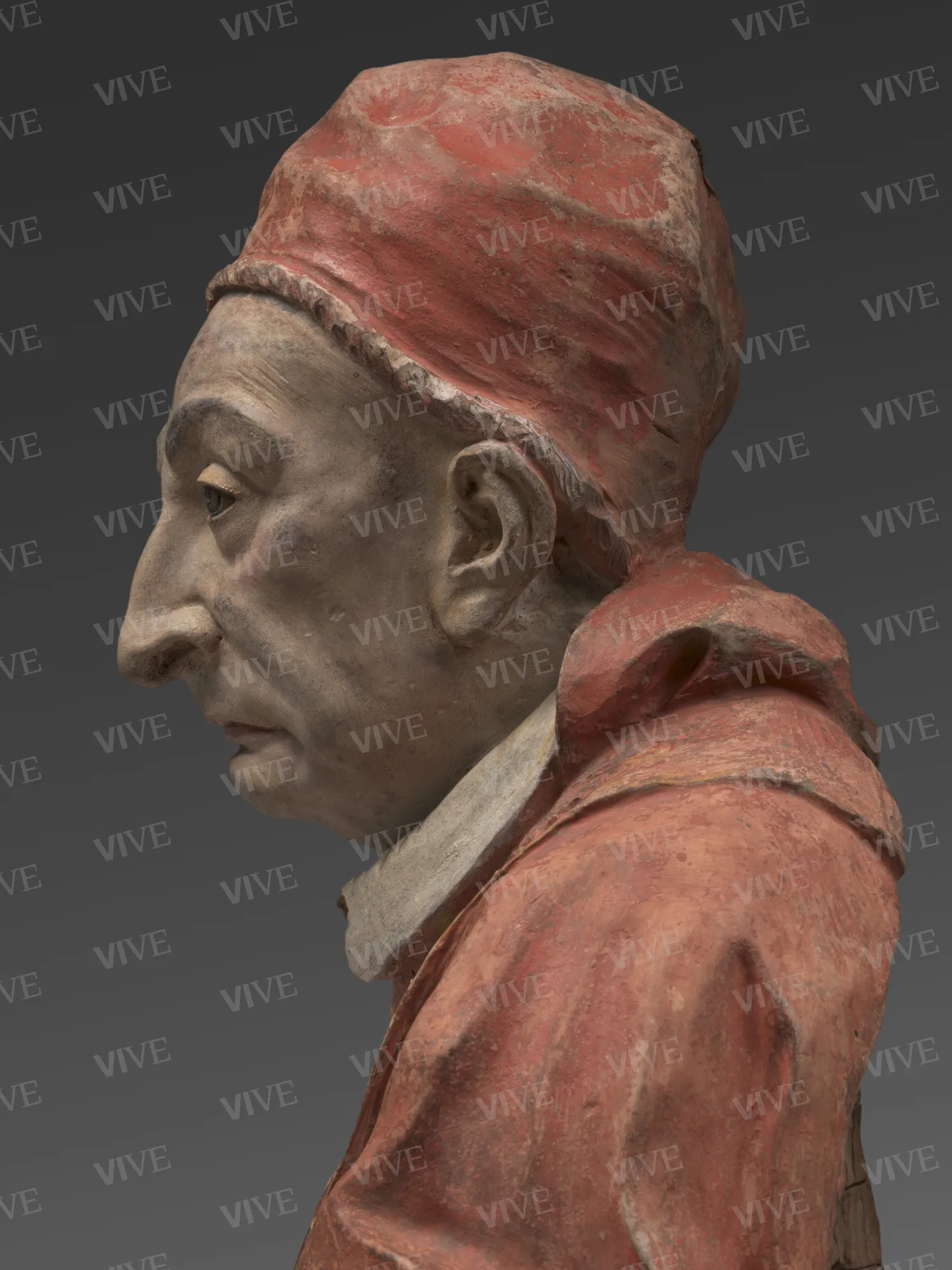
The painted terracotta bust, crafted by Bartolomeo Mazzuoli, depicts Pope Benedict XIII Orsini (papacy: 1724–1730) attired in a camauro, mozzetta, and stole. The figure is represented with his head turned to the left, as if engaged with an unseen interlocutor. Mazzuoli’s rendering of the pontiff’s physiognomy demonstrates meticulous attention to naturalistic detail, capturing features such as the sagging, wrinkled skin, aquiline nose, thin lips, and weary eyes. The use of pigments further accentuates the expressive qualities of the finely modeled forms.



The painted terracotta bust, crafted by Bartolomeo Mazzuoli, depicts Pope Benedict XIII Orsini (papacy: 1724–1730) attired in a camauro, mozzetta, and stole. The figure is represented with his head turned to the left, as if engaged with an unseen interlocutor. Mazzuoli’s rendering of the pontiff’s physiognomy demonstrates meticulous attention to naturalistic detail, capturing features such as the sagging, wrinkled skin, aquiline nose, thin lips, and weary eyes. The use of pigments further accentuates the expressive qualities of the finely modeled forms.
Federico Hermanin (1929–1930, pp. 254–262) attributed the bust to Pietro Bracci (Rome, 1700–1773), establishing a connection between the terracotta sculpture and the marble effigy of Pope Benedict XIII exhibited in Santa Maria Maggiore, positioned on the right wall of the Baptistery.
As the inscription below attests, the portrait was commissioned by the chapter and canons of the Liberian Basilica as a sign of gratitude to Pope Orsini for his involvement in the restoration of the basilica’s roof, prior to the Jubilee of 1725. Initially situated in the sacristy, the portrait, along with its oval niche, was subsequently relocated to its present position.
Antonino Santangelo (1954, 79) endorsed Hermanin’s attribution, proposing an early date for the terracotta model, dating back to at least 1724. Subsequent scholars maintained the attribution to Bracci (Santangelo 1959, 68–69; Salmi 1967, 230; Radcliffe 1992, 138–141; Boucher 1998, 78), until Jennifer Montagu (2002, 375–387) questioned it on stylistic grounds, and pointed out the lack of documentary evidence supporting the attribution.In 2008, Eike Dieter Schmidt (2008, 104–107) published a document (found by Michael Erwee) showing that the bust of Pope Benedict XIII was paid for by Bartolomeo Mazzuoli (Siena, 1673–1749). Cristiano Giometti (2011, 92–93) assigned the terracotta bust to Giuseppe Mazzuoli (Volterra, 1644–Rome, 1725), Bartolomeo’s uncle, and attributed the marble bust to Bartolomeo himself. This attribution aligns with Alessandro Angelini’s interpretation of the internal organization within the extensive Mazzuoli workshop (Angelini 1995, 89, 64). Notably, Bartolomeo Mazzuoli's most distinguished portraiture, such as the busts of Counts Camillo and Virgilio De’ Vecchi in San Martino, Siena (1706), were executed following models established by Giuseppe.
The notable stylistic resemblance between the terracotta bust in the Museo di Palazzo Venezia and the marble counterpart in Santa Maria Maggiore strongly indicates that both representations of Pope Orsini were created by the same artist who demonstrated a capacity for accurately depicting the physiognomic features of Benedict XIII with a naturalistic approach, deliberately avoiding the idealization commonly associated with official portraiture. Here we see characteristics of marked naturalism, such as sagging, wrinkled cheeks, a sharp, strongly curved nose, thin lips, and wide eyes displaying an expression that appears somewhat incongruous with the subject's role—traits that are not present in Giuseppe Mazzuoli’s portraits. Mazzuoli consistently imparts a sense of moral dignity and proud bearing to his subjects, a quality particularly apparent in the transition from model to marble.
The bust of Santa Maria Maggiore contrasts with Giuseppe’s stylistic approach, as the marble is crafted to exhibit a pliant softness that accentuates the depiction of a relaxed, less toned complexion, accurately reflecting the features of the pontiff. The terracotta and marble of Benedict XIII convey a sense of approachable humanity, which almost contrasts with the camauro, mozzetta, and stole, symbols of the high ecclesiastical rank occupied by Pope Orsini, and which we find in Bartolomeo’s early mature portraiture, from the stucco effigy of Niccolò Parri in the cathedral of Montepulciano (1704), to the aforementioned busts by De’ Vecchi, to the marble portrait of Francesco Sansebastiani in San Niccolò al Carmine in Siena (1708), to the high relief of the monument to Bonaventura Chigi Zondadari in the collegiate church of San Quirico d’Orcia (circa 1719, Di Gennaro 2016, 125, 162–167, 185–187). The close similarity in the depiction of clothing in both terracotta and marble, particularly the arrangement of the mozzetta reminiscent of the late seventeenth century, substantiates Bartolomeo’s apprenticeship with his uncle. Additionally, the meticulous rendering of every intricate detail in the marble—such as the embroidery on the stole—reflects an emerging eighteenth-century sense of refinement and sophistication. The documentation concerning Giuseppe Mazzuoli’s final work does not specifically reference either the model or the marble bust (Di Gennaro 2016, 8–10). Consequently, the record of payment to Bartolomeo Mazzuoli for the Portrait of Pope Benedict XIII at Santa Maria Maggiore substantiates the attribution, which is advanced here on stylistic criteria, to a sculptor who has yet to receive sufficient recognition from scholars.
Vincenzo Di Gennaro
Entry published on 16 October 2025
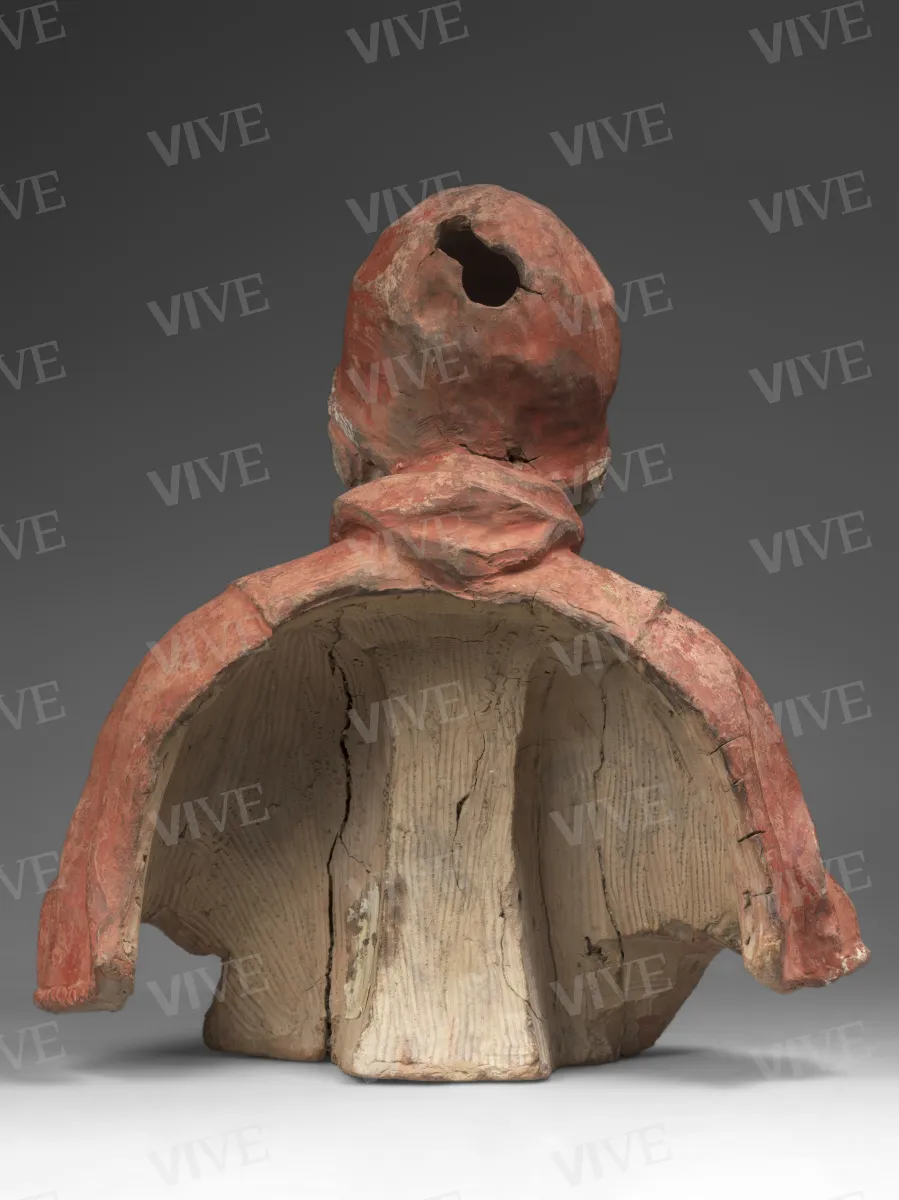
Fair. The front of the bust is coated with polychrome paint, the result of repainting carried out after the original work, while diagnostic tests have revealed traces of older pigments on the back, indicating that it was originally painted. A hole is present at the crown, which served as a technical measure to facilitate the release of gases during firing. However, in this case, this expedient did not prevent the formation of cracks in both the head and torso, signs of imperfect adhesion of the clay portions, ultimately causing the detachment of clay fragments. The preparatory paint layer and the overlying pigments masked the irregularities created on the surface of the bust (Falcucci, Pelosi 2011, 197–198).
2010: restoration;
2011: diagnostic investigations, Getty Foundation project in Los Angeles.
“BENEDICTO XIII. M. | OB TEMPLI TRABES AEVO CORROSAS | IN DEIPARAE CULTUM RENOVATAS | CAPITULUM ET CANONICI | GRATI ANIMI MONUMENTUM | | ANNO IUBILAEI MDCCXXV.”
Rome, Galleria Alessandro Jandolo;
Rome, Museo Nazione di Palazzo Venezia, 1919.
Rome, Palazzo delle Esposizioni, Il Settecento a Roma, Rome, March 19–May 31, 1959;
Malibu, Paul Getty Museum, The Color of Life. Polychromy in Sculpture from Antiquity to the Present, March 6–June 23, 2008.
Hermanin Federico, Due busti di Pietro Bracci, in «Dedalo», 10, 1929-1930, 1, pp. 254-262;
Museo di Palazzo Venezia. Catalogo delle sculture, Santangelo Antonino (a cura di), Roma 1954, p. 79;
Santangelo, in Il Settecento a Roma, catalogo della mostra (Roma 19 marzo-31 maggio 1959), Roma 1959, pp. 68-69;
Salmi Mario, La donazione Contini Bonacossi, in «Bollettino d’arte», 52, 1967, 4, p. 230
Sisi, in Gentilini Giancarlo, Sisi Carlo (a cura di), La scultura. Bozzetti in terracotta piccoli marmi e altre sculture dal XIV al XX secolo, catalogo della mostra (Siena Palazzo Chigi Saracini), Firenze 1989, vol. II, 107, pp. 315-316, 364-365, nn. 85;
Radcliffe, in Radcliffe Anthony (a cura di), The Thyssen-Bornemisza Collection: Renaissance and Later Sculpture, with Works of Art in Bronze, Milano 1992, pp. 138-141, n. 19;
Angelini Alessandro, Giuseppe Mazzuoli, la bottega dei fratelli e la committenza della famiglia De’ Vecchi, in «Prospettiva», 79, 1995, pp. 78-100;
Boucher Bruce, Italian Baroque Sculpture, London 1998, p. 78;
Montagu Jennifer, Houston and London: Earth and Fire, in «The Burlington Magazine», 144, 2002, pp. 375-387
Schmidt, in Panzanelli Roberta (a cura di), The Color of Life. Policromy in Sculpture from Antiquity to the Present, catalogo della mostra (Malibu, Pail Getty Museum, 6 marzo-23 giugno 2008), Los Angeles 2008, pp. 104-107;
Falcucci Claudio, Pelosi Claudia, Indagini diagnostiche su alcune sculture in terracotta del Museo del Palazzo di Venezia a Roma, in Giometti Cristiano (a cura di), Museo Nazionale del Palazzo di Venezia. Sculture in terracotta, Roma 2011, pp. 197-198;
Giometti Cristiano (a cura di), Museo Nazionale del Palazzo di Venezia. Sculture in terracotta, Roma 2011, pp. 92-93;
Di Gennaro Vincenzo, Arte e industria a Siena in età barocca. Bartolomeo Mazzuoli e la bottega di famiglia nella Toscana meridionale, Sinalunga 2016, pp. 8-10, 125, 162-167, 185-187.