Vittoriano


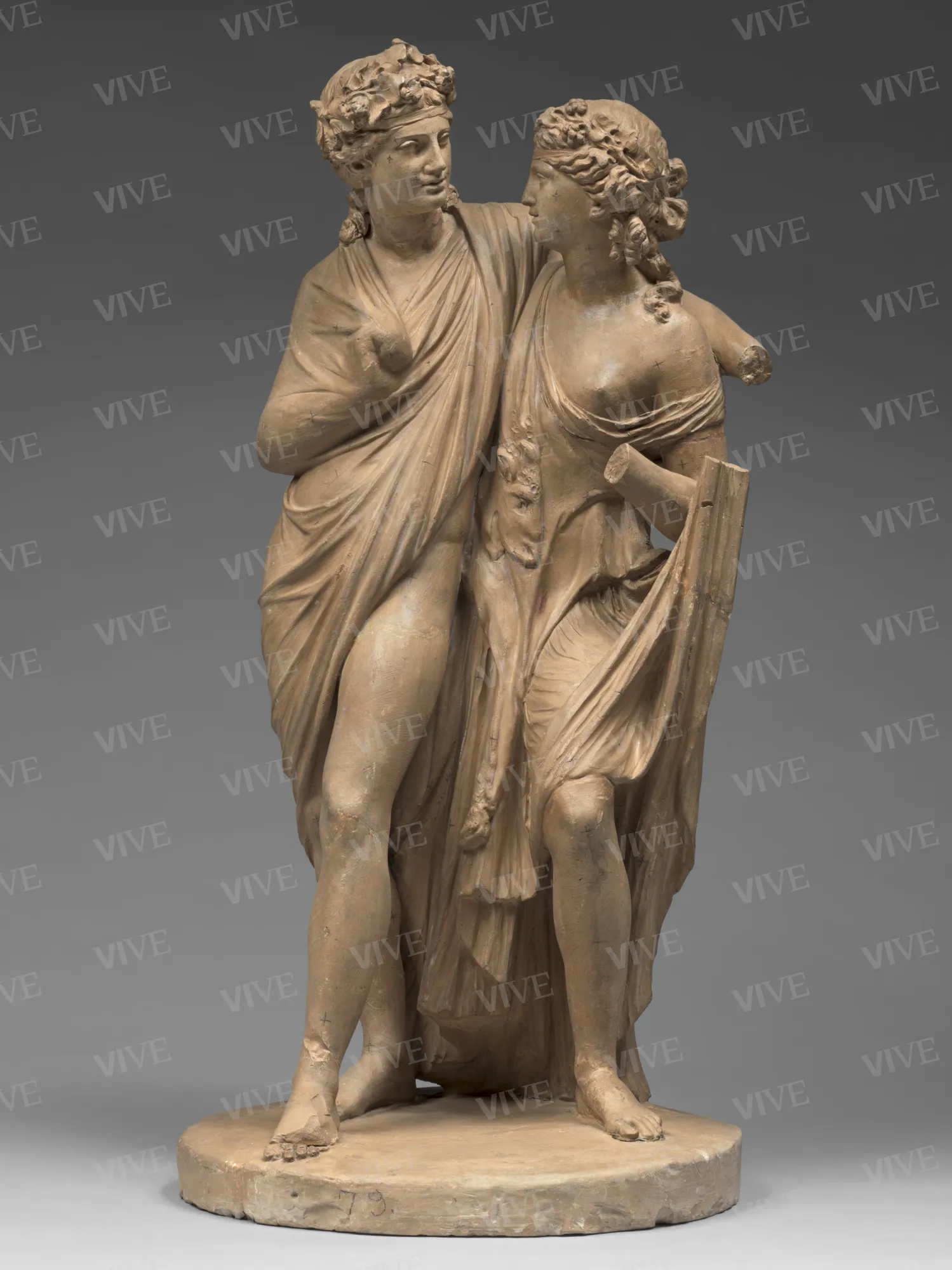
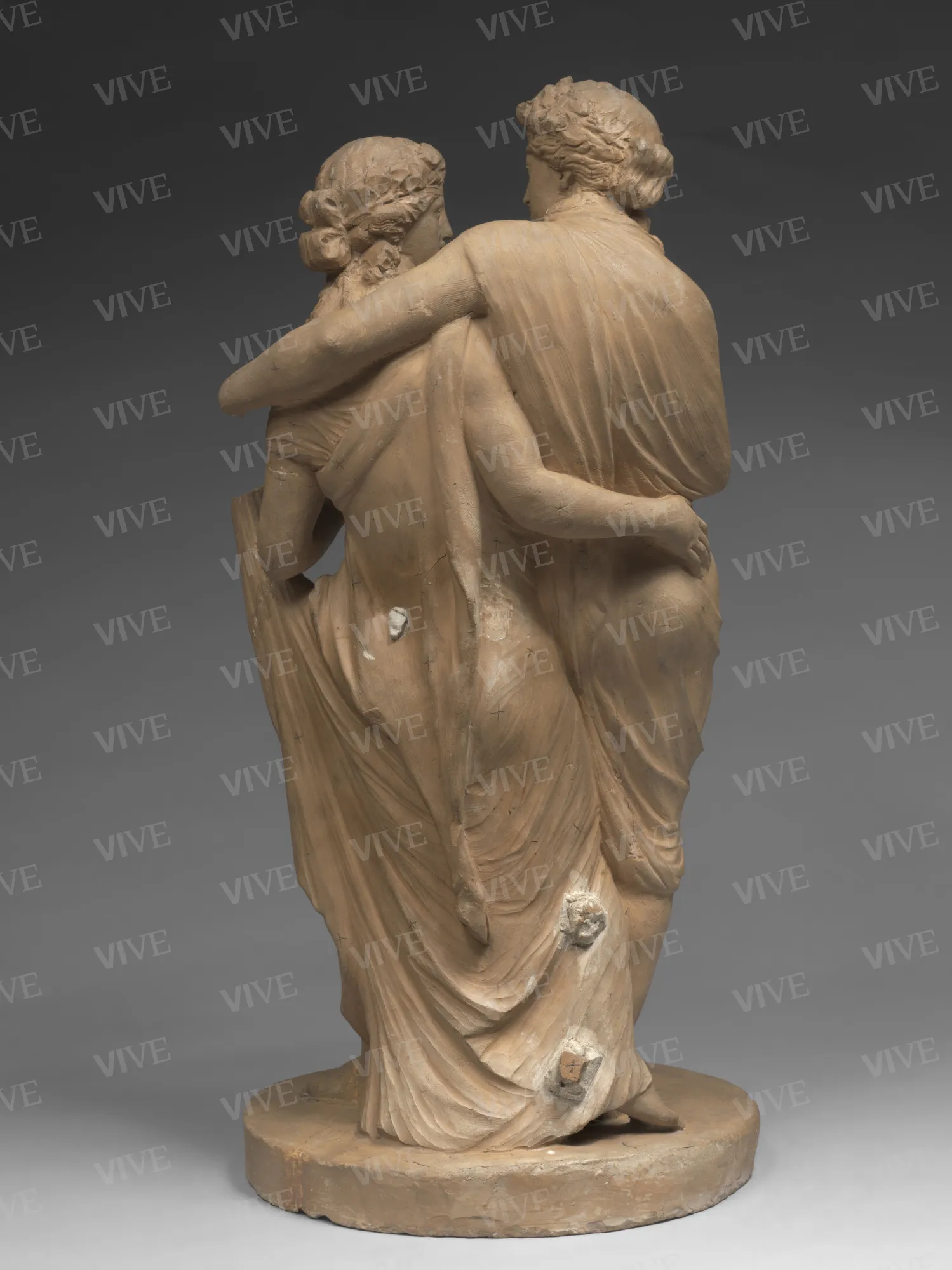
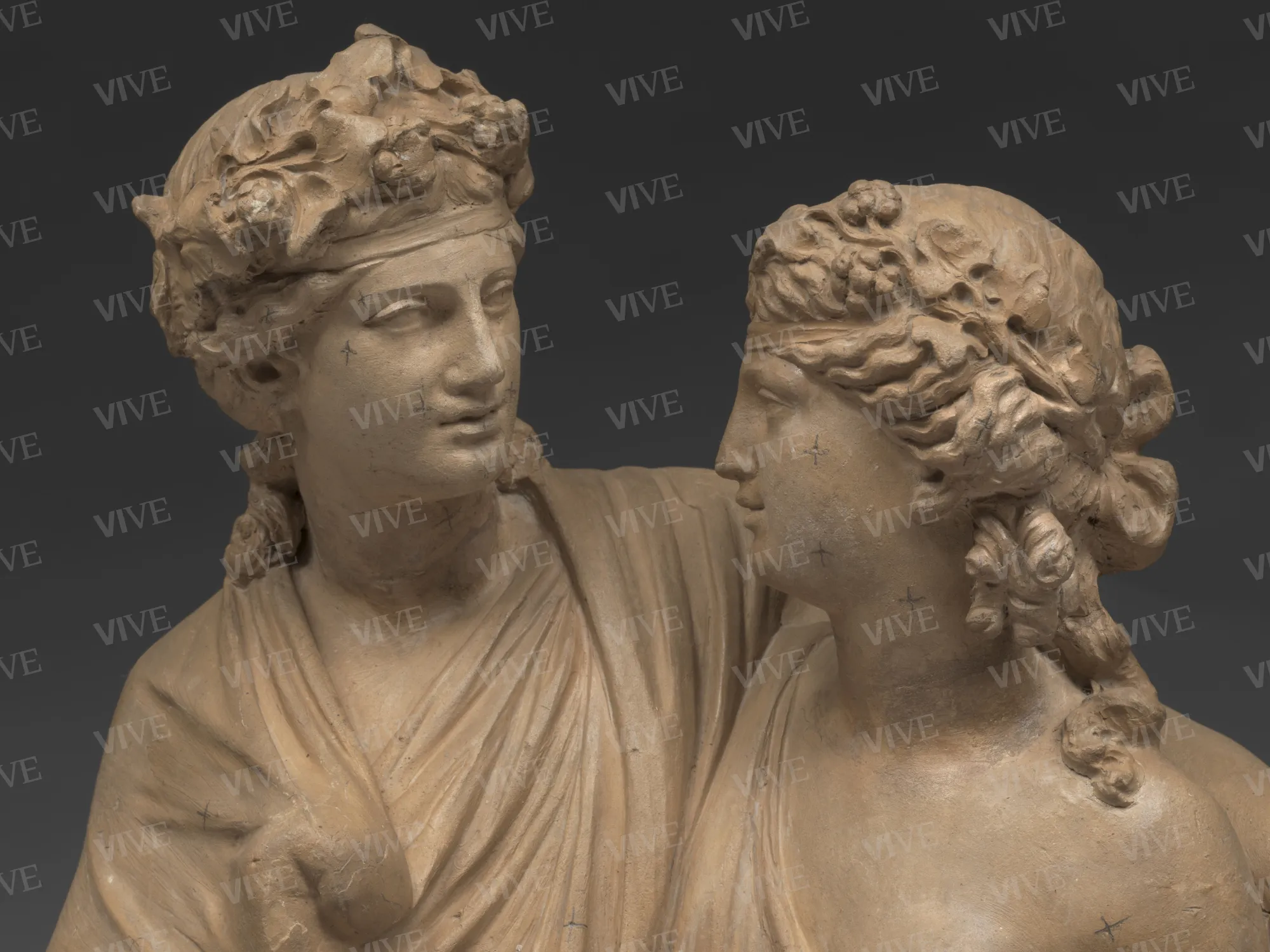
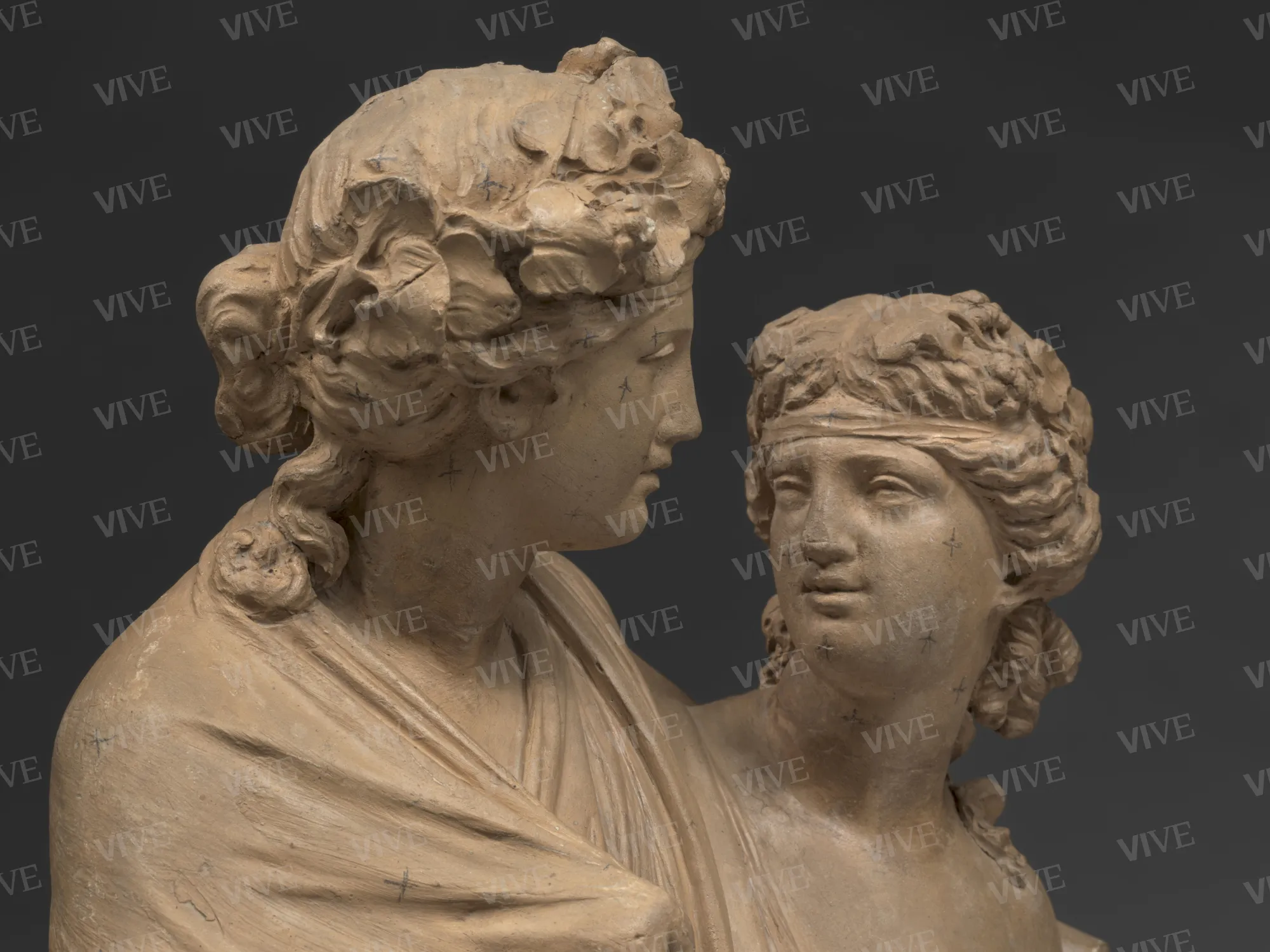
The terracotta sculpture, created by Bartolomeo Cavaceppi, represents a reduced version of the ancient group commonly identified as Bacchus and Ariadne. The figures are portrayed walking together in an embrace, gazing at one another. Both wear wreaths of vine leaves adorned with grape clusters on their heads. Their garments, distinguished by intricately rendered folds, partially disclose the contours of their bodies.
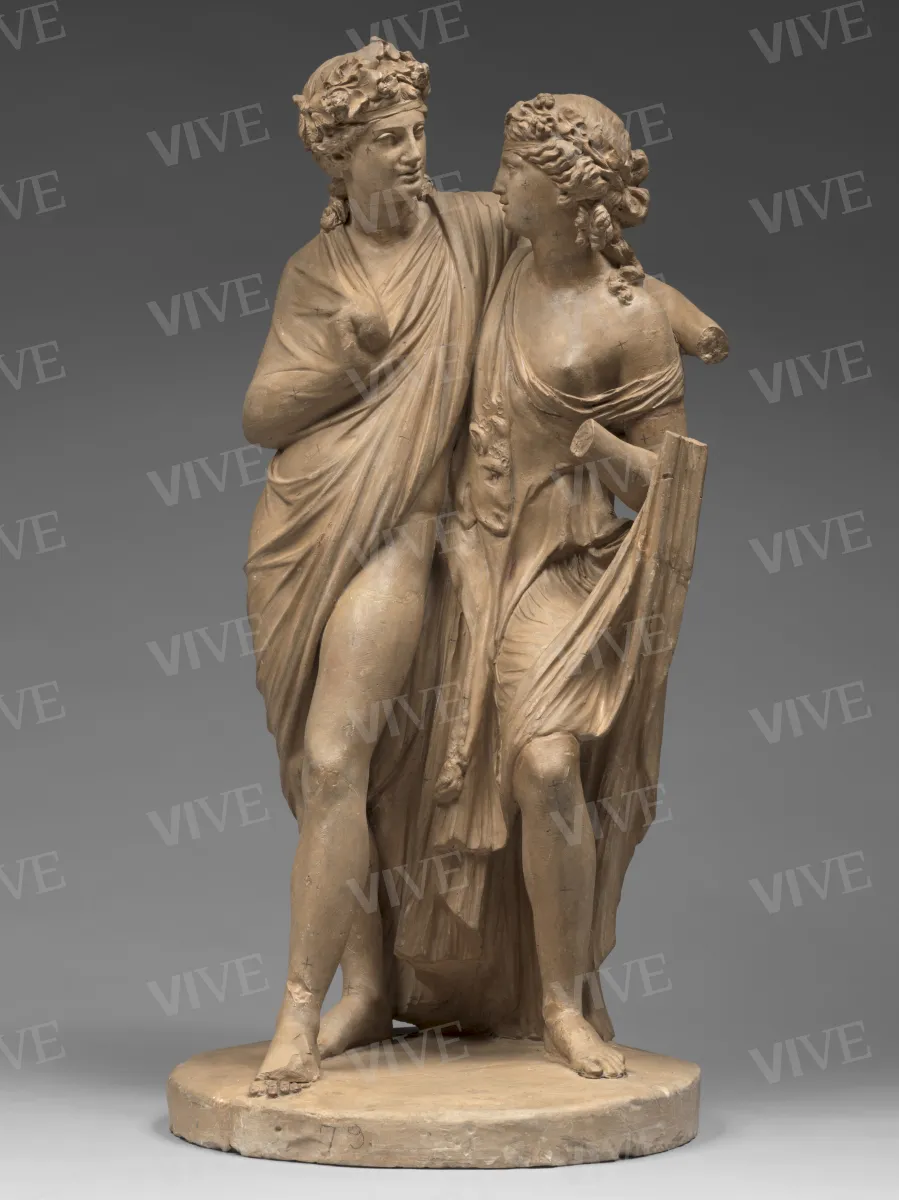
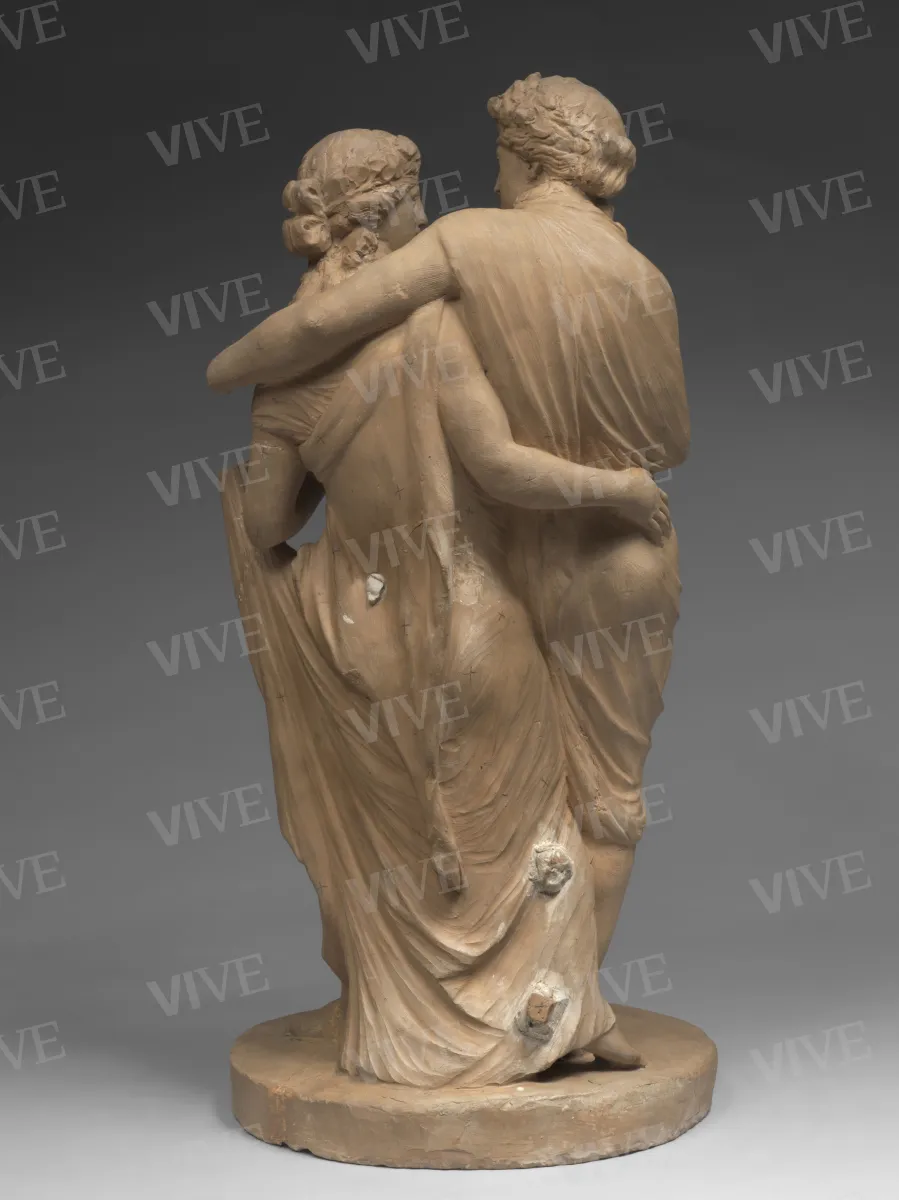
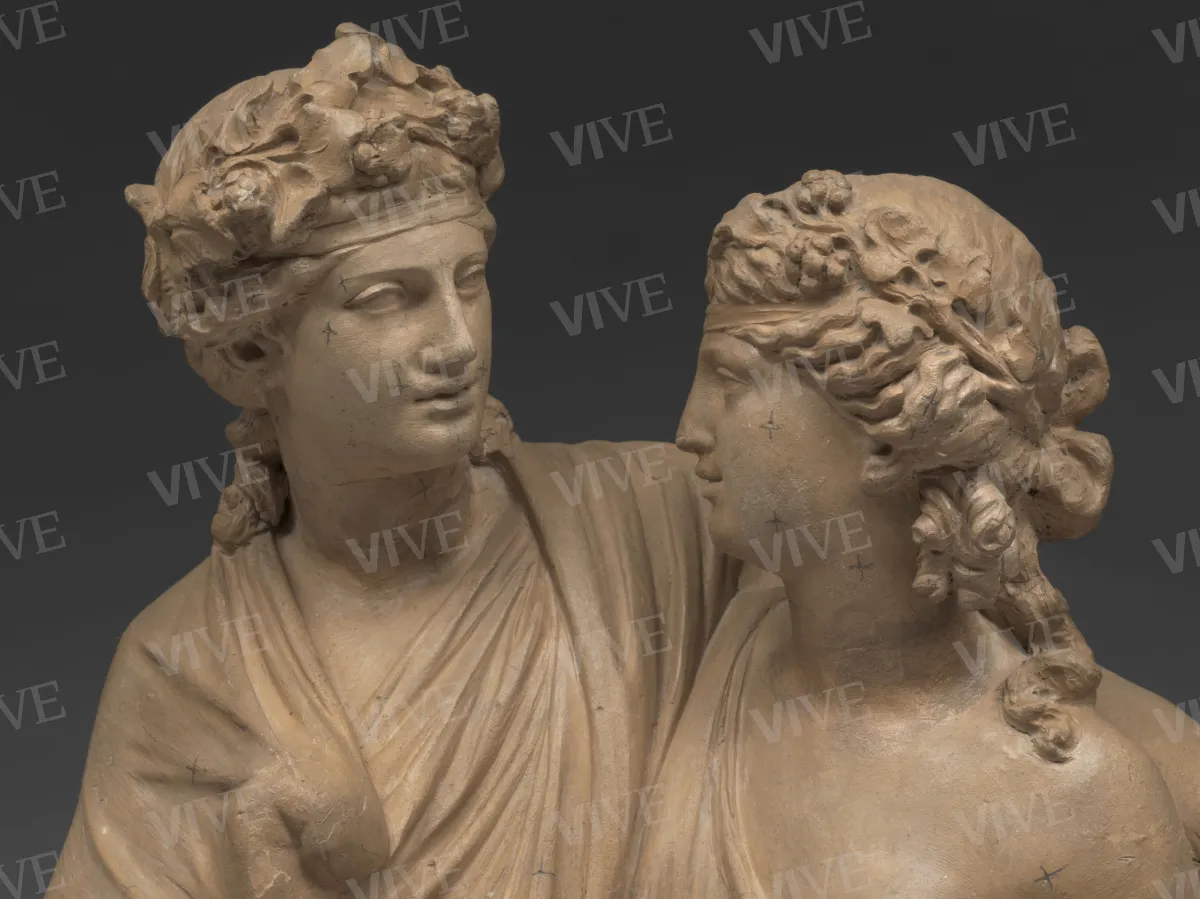
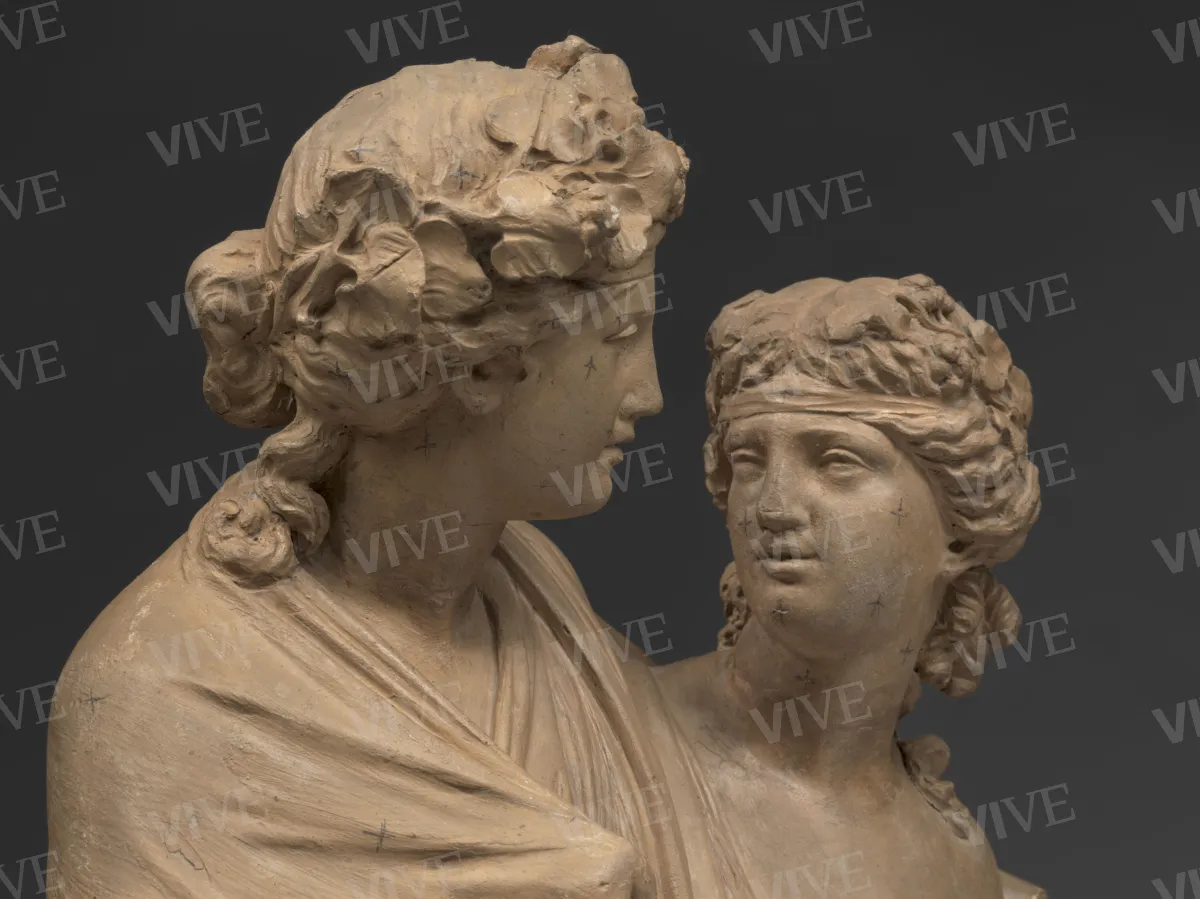
The terracotta sculpture, created by Bartolomeo Cavaceppi, represents a reduced version of the ancient group commonly identified as Bacchus and Ariadne. The figures are portrayed walking together in an embrace, gazing at one another. Both wear wreaths of vine leaves adorned with grape clusters on their heads. Their garments, distinguished by intricately rendered folds, partially disclose the contours of their bodies.
This sculpture forms part of a group of terracotta works from the collection of Bartolomeo Cavaceppi (1716–1799), who maintained models by renowned artists and replicas of classical antiquities in his studio for multiple professional purposes.His studio on Via del Babuino served as an influential hub within the Roman artistic community, primarily focusing on the antiquities trade (Piva 2010, 59–64). Cavaceppi maintained connections with prominent individuals, including Johann Joachim Winckelmann, whose aesthetic principles he adopted and integrated into his approach to restoring ancient marbles. Widely regarded as the leading restorer of his era, he published the notable work Raccolta di antiche Statue (1768–1769), which featured representations of several of his restorations (Meyer, Piva 2011).
Following his passing, the sculptor bequeathed "every last nail and the smallest flake" to the Academy of San Luca, expressing the wish that his extensive collection of models and sculptures would serve in the education and development of young artists. Following legal action brought by the artist’s relatives against the Roman institution, a portion of the sculptures was subsequently acquired by the Torlonia family (Gasparri, Ghiandoni 1994). Terracotta replicas of ancient originals, regarded by some as less significant, were introduced to the Roman market in the late nineteenth century. These pieces were subsequently acquired by the tenor Evangelista (Evan) Gorga, an avid collector (Collezioni Gorga 1948; Cionci 2004).Following an agreement between the singer and the Ministry of Education, the items were incorporated into the collections of the Museo di Palazzo Venezia in 1949 and subsequently placed in storage. They were later rediscovered and appropriately returned to Cavaceppi in 1990 (Barberini 1994a, 79–84).
The terracotta is a reduced replica of the ensemble known as Bacchus and Ariadne (Barberini 1994b, 106, n. 21), which garnered significant recognition throughout the eighteenth century. Numerous documented replicas exist in a variety of media, including bronze versions produced by the Righetti or Zoffoli workshops, as well as marble reproductions, such as those created in 1771 by Carlo Albacini, a student of Cavaceppi. These copies are frequently displayed alongside Cupid and Psyche in the Capitoline Museum (Haskell, Penny 1984, 172–173), brought together by their shared themes of tenderness and love.
The original marble is a reinterpretation of ancient fragments, possibly depicting Bacchus or Priapus with a Maenad, discovered at an undetermined time and subject to substantial restoration. Following its restoration, the piece was sold by Thomas Jenkins, an English merchant based in Rome, initially to William Henry, Duke of Gloucester (brother of King George III), and subsequently to the collector James Hugh Smith Barry for his Marbury Hall estate (Giometti 2011).
González-Palacios (2008, 17) proposed that Cavaceppi was responsible for the interpretative restoration of the ancient works. Consequently, the terracotta examined in this study may have served as the model for completing the marble piece.
This piece, consistent with other terracottas in the sculptor’s collection, features pencil crosses placed at key locations on the face, including the nose, chin, and cheeks, as well as on the garment folds. These markings served as crucial guides for transferring the model into marble using compasses and frames, a technical process commonly employed by Roman copyists.The inclusion of these features indicates that this terracotta likely served as a utilitarian model used in the production of replicas, for which the sculptor’s workshop was renowned in antiquity.
The dimensions of this sculpture (54 cm, equivalent to two Roman palms during the eighteenth century) align with formats observed in other models, such as the Capitoline Flora (Museo Nazionale di Palazzo Venezia, inv. 13393). This size is typical of scaled-down replicas of ancient artworks that were designed to serve as luxury decorative accessories. The work under consideration, like the terracotta derived from marble in the Capitoline Museums, was appraised at “5 scudi” by Vincenzo Pacetti in the 1802 inventory of models from the Cavaceppi studio ("B.I.A.S.A., Manuscript Lanciani 5, f. 60r, n. 73, as referenced in Barberini 1994b, 106, n. 21).
Valeria Rotili
Entry published on 16 October 2025
Poor. The terracotta sculpture exhibits several areas of loss, including Bacchus’ right hand, Ariadne’s left hand, and a portion of the drapery from her dress.
Several repairs are evident throughout the piece. The base exhibits a clean fracture that has been restored using matching filler, which has since developed a darker patina.
Plasterwork completed subsequent to 1994.
Rome, Collezione Cavaceppi, 1800;
Collezione Torlonia, 1800;
Rome, Collezione Evangelista (Evan) Gorga, 1949;
Rome, Museo Nazionale di Palazzo Venezia, 1949.
Rome, Museo Nazionale di Palazzo Venezia, Bartolomeo Cavaceppi (1717–1719), January 15–March 15, 1994, cat. 21.
Rome, B.I.A.S.A., Lanciani Manuscript 5, Catalogs of the Cavaceppi Collection, 1802–1810, f. 60r, n. 73;
Rome, Museo Nazionale di Palazzo Venezia, Archivio, Inventari, book IX, 77v.
Collezioni Gorga. Raccolte archeologiche e artistiche, Roma 1948;
Haskell Francis, Nicholas Penny, L’antico nella storia del gusto. La seduzione della scultura classica 1500-1900, Torino 1984;
Gasparri Carlo, Ghiandoni Olivia, Lo studio Cavaceppi e le collezioni Torlonia, in «Rivista dell’Istituto Nazionale d’Archeologia e Storia dell’Arte», XVI, 1993 (1994);
Barberini Maria Giulia, “Delli modelli che si trovano nello studio Cavaceppi”. Le terrecotte del Museo di Palazzo Venezia, in Barberini Maria Giulia, Gasparri Carlo (a cura di), Bartolomeo Cavaceppi scultore romano (1717-1799), Roma 1994, pp. 79-84 (Barberini 1994a);
Barberini, in Barberini Maria Giulia, Gasparri Carlo (a cura di), Bartolomeo Cavaceppi scultore romano (1717-1799), Roma 1994 p. 95, n. 10 (Barberini 1994b);
Cionci Andrea, Il tenore collezionista. Vita, carriera lirica e collezioni di Evan Gorga, Firenze 2004;
Piva Chiara, Bartolomeo Cavaceppi tra mercato e restauro, in Carolina Brook, Curzi Valter (a cura di), Roma e l’antico. Visione e Realtà nel '700, catalogo di mostra (Roma, Fondazione Roma 30 novembre 2010-06 marco 2011), Genève 2010, pp. 59-64.
Giometti Cristiano (a cura di), Museo Nazionale del Palazzo di Venezia. 4. Sculture in terracotta, Roma 2011, p. 112, cat. 123;
Meyer Susanne Adine, Piva Chiara, L’arte di ben restaurare. La "Raccolta d’antiche statue" (1768-1772) di Bartolomeo Cavaceppi, Firenze 2011;
González-Palacios Alvar, Souvenirs de Rome, in d’Agliano Andreina, Melegati Luca (a cura di), Ricordi dell’antico. Sculture, porcellane e arredi all’epoca del Grand Tour, catalogo della mostra (Roma, Musei Capitolini, 7 marzo-8 giugno 2008), Roma 2008, pp. 14-59;
Meyer Susanne Adina, Piva Chiara, L'arte di ben restaurare. La Raccolta d'antiche statue (1768-1772) di Bartolomeo Cavaceppi, Firenze 2011.