Vittoriano


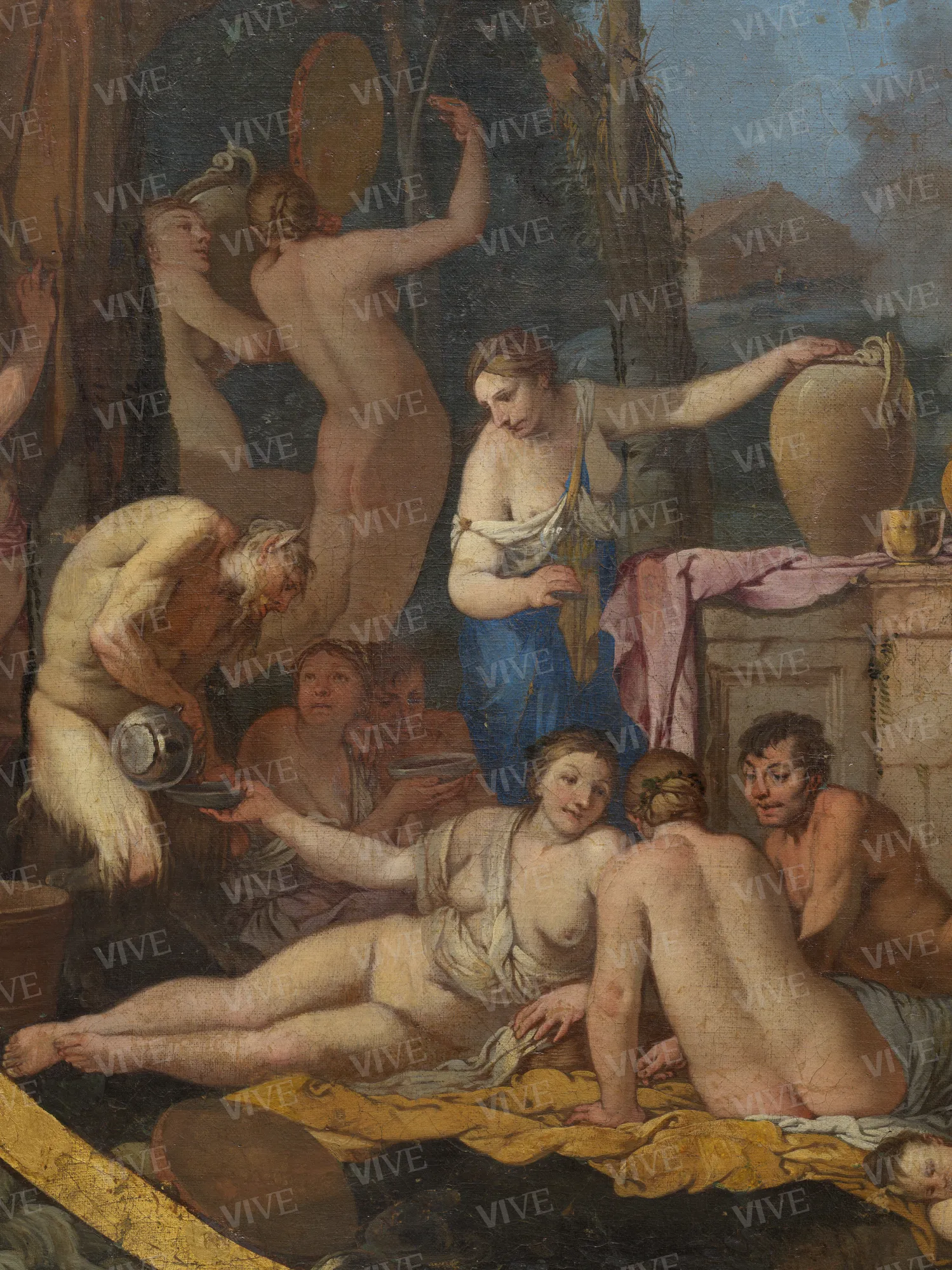
The canvas features a prominent mythological theme frequently explored by the Venetian painter Giulio Carpioni, drawing inspiration from Titian’s Bacchanals. Its companion piece Iris in the Cave of Hypnos is also housed in the Museo Nazionale di Palazzo Venezia (inventory no. 1085).

The canvas features a prominent mythological theme frequently explored by the Venetian painter Giulio Carpioni, drawing inspiration from Titian’s Bacchanals. Its companion piece Iris in the Cave of Hypnos is also housed in the Museo Nazionale di Palazzo Venezia (inventory no. 1085).
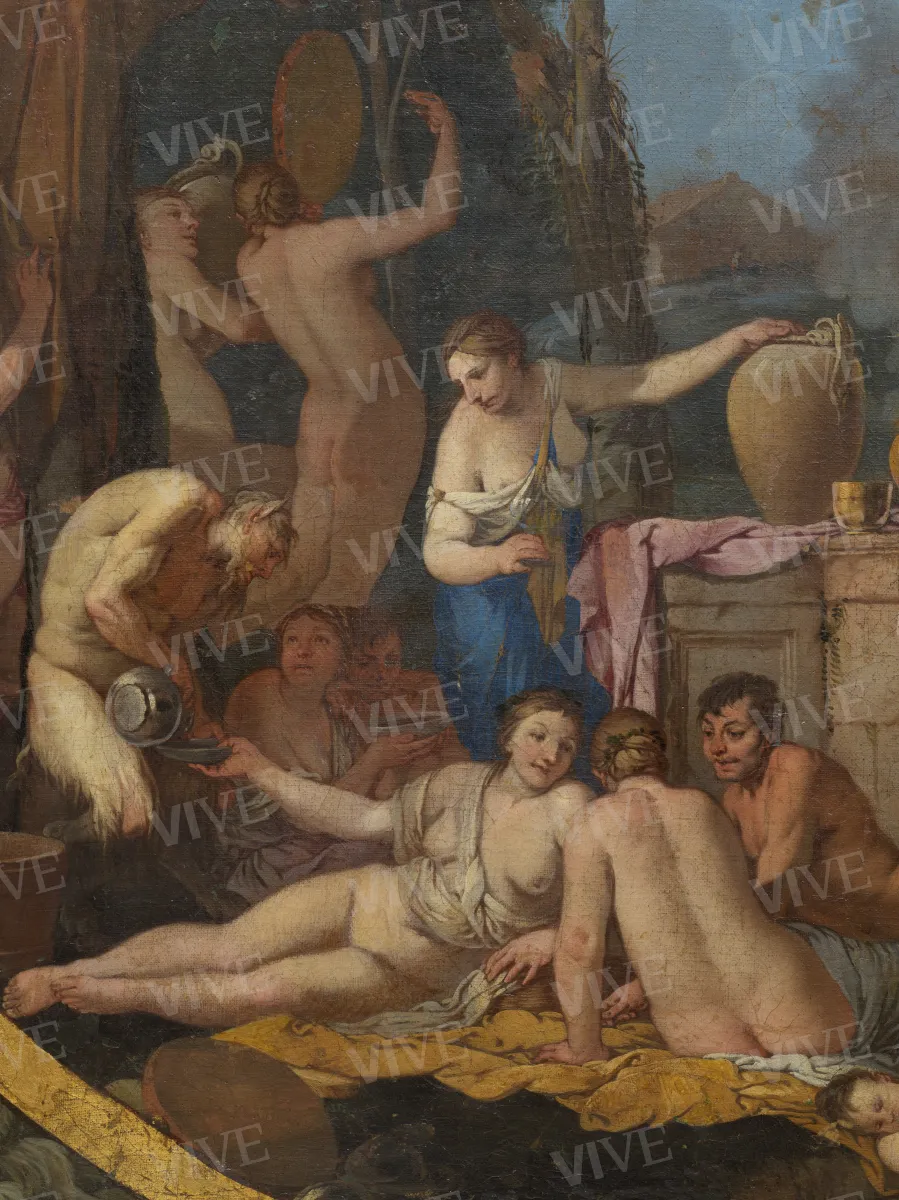
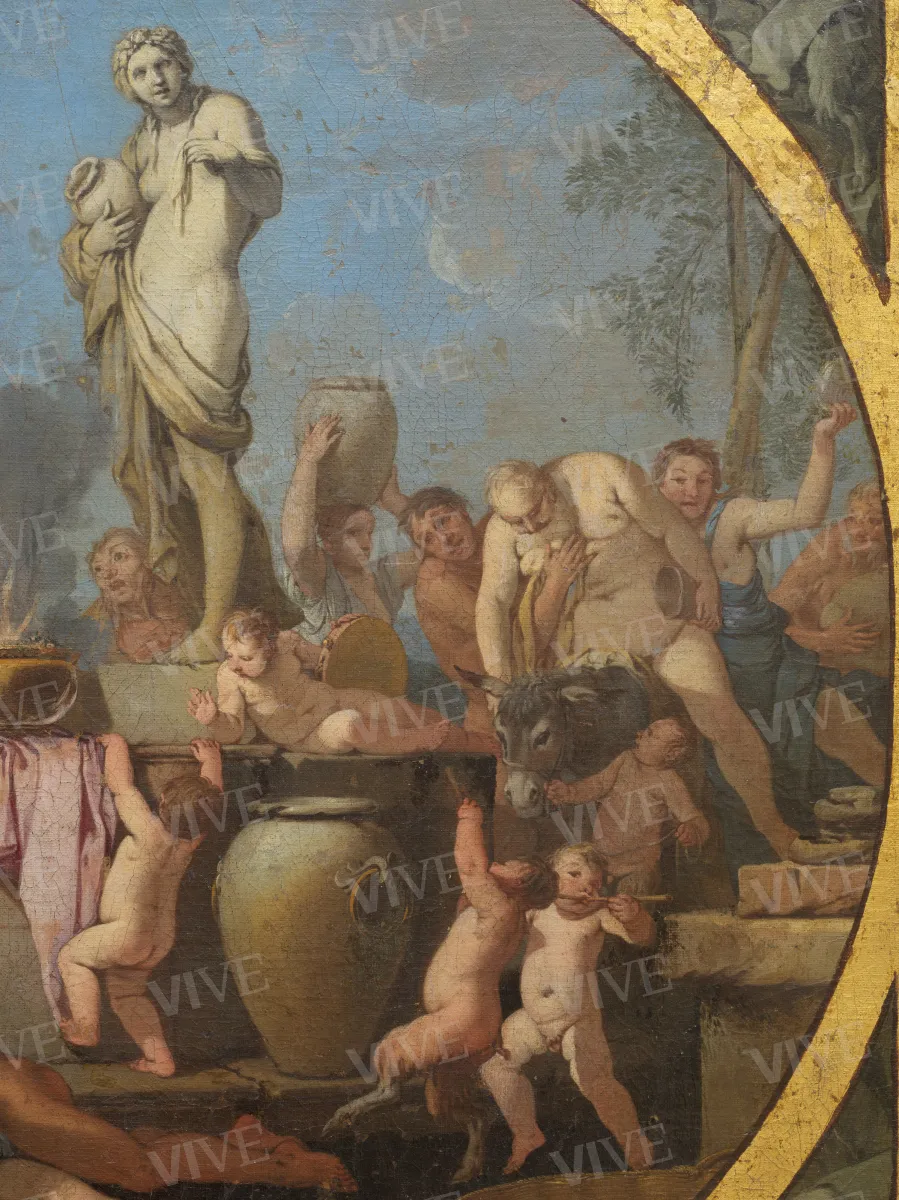
The painting illustrates a prominent mythological theme of the seventeenth century (Albl, Ebert-Schifferer 2019), and particularly one favored by Giulio Carpioni (1613–1678). Notable examples of his many works on this subject can be found in various collections, including the Landesmuseum in Darmstadt; the Museo Thyssen–Bornemisza in Madrid; Castello Sforzesco and Collezione Cova Minotti in Milan; Musée du Louvre in Paris; Banca Popolare and private collections in Vicenza; and Ca’ Rezzonico and Collezione Martini in Venice. The composition portrays a celebratory ritual honoring Bacchus, conceived as a pagan liturgy set within a pastoral landscape with a propitiatory intent. This subject is derived from Ovid’s Metamorphoses (III, vv. 511–733), which details the participation of a throng of men and women engaging in the festivities—some indulging in copious wine, others dancing to drums alongside satyrs, nymphs, maenads, and young fauns (Morel 2016).
The arrangement of the figures in the foreground—specifically, the satyr bending to pour wine and the woman depicted from behind—closely resembles a compositional approach found in one of the artist’s works dedicated to the Death of Leander (Padua, Museo Civico; with a preparatory drawing located in Vicenza, Braga Collection, Pilo 1961, 56, 105), which was also created during the later period of his career.
The depiction of Silenus’ triumph on a donkey, located at the far right, is a motif that Carpioni frequently explored as a standalone subject (see, for example: Accademia Carrara, Bergamo; Musée des Beaux-Arts, Bordeaux; Städelsches Kunstinstitut, Frankfurt; Kunsthistorisches Museum, Vienna; Gallerie dell’Accademia, Venice; and private collection, Cevese 1978, 323). Distinctive features such as open-air temple ruins, multiple wine-filled jars, and a marble simulacrum elevated on a pedestal are also present in Carpioni’s renditions of the Offering to Venus (see the canvas in a private collection in Belluno, Pilo 1961, 86, fig. 100; Merelli 2012).
The work was conceived as a pendant to another Ovidian-themed piece, Iris in the Cave of Hypnos (also housed at the Museo Nazionale di Palazzo Venezia, inv. 1085; see the corresponding entry here). This relationship is evident from the matching dimensions and the identical oval frame, distinguished by four monochrome cherubs positioned in the corners. A comparable frame appears in the canvas depicting the Triumph of Silenus, as documented by Cevese (1978, 323) and Morello (2002, 22), currently in a private collection in Vicenza, though it is oriented vertically.
The broad circulation and notable popularity of Carpioni’s easel paintings among collectors present challenges in establishing precise dates for these works. Nevertheless, stylistic analysis indicates they likely originate from the mid-1660s (Merelli 2012), during the mature period of Carpioni’s career. By this time, he had become a prominent figure in the Vicenza art community, where he began working in 1638 (Zorzi 1961) and further solidified his reputation, particularly following Francesco Maffei’s relocation to Padua in 1656. In this context, the plasticity of the figures is less firm and geometric than in the artist’s earlier and more mature work. Instead, it is softened by the application of a gradual chiaroscuro with reddish undertones, resulting in what Pallucchini (1981, 215) describes as a "pictorial texture diluted in luminosity." The primary point of contrast emerges from the drapery, whose matte, velvety pink and blue hues distinctly offset the flesh tones.
Although this work and its companion piece were first documented in 1920 as part of Carlo Giuliani's bequest, Colasanti (1918) had previously noted the donation of both Carpioni paintings “to the State for the Real Galleria d’Arte Antica at Palazzo Corsini in Rome,” which were subsequently made available to the public. Colasanti also highlighted their affinity with the work of Simone Cantarini da Pesaro, particularly referencing the “interesting ashen glazes” that serve to harmonize and soften the depicted figures. The two canvases are not recorded in the catalogs of the Museo di Palazzo Venezia by Santangelo and Zeri. They have been included in the collection of the Galleria Nazionale of Palazzo Corsini since Pilo’s 1961 monograph, alongside two additional canvases by Carpioni: Putti with Symbols of Power and Putti with Symbols of Abundance, as well as a Bacchanal, which was previously part of the Galleria Benigno Crespi in Milan (Venturi 1900, pp. 175–177).
Orlandi (1704, 235; see also Zanetti 1771, 371) was the first to identify the painter’s apprenticeship under Alessandro Varotari, known as Il Padovanino—a view later situated in the early 1730s by Pallucchini (1959). He also observed that Carpioni, throughout his career, devoted significant effort to idealized subjects, including dreams, sacrifices, bacchanals, triumphs, and dances of cherubs, producing capriccios of exceptional quality unmatched by his contemporaries.
Venturi (1900) identified the theme as being directly derived “from Venetian painting of the golden age,” specifically referencing Titian’s Bacchanal series created for Alfonso d’Este’s study in the castle of Ferrara. These works were later transferred to Rome following the city's incorporation into the Papal States in 1598. Venturi further associated this interest with the artist’s formative training under Padovanino.
Subsequent scholarship has instead emphasized the possibility of interpreting this engagement with Titian’s major works via alternative avenues: notably, through the influence of Nicolas Poussin (Jacobsen 1901; Fiocco 1929), potentially encountered during an unrecorded visit to Rome (Longhi 1963; Barbieri 1977), or by way of Pietro Testa’s engravings (Pilo 1961; Pallucchini 1981).
This Bacchanal is notable for its particularly melancholic, at times languid tone, typical of Carpioni’s classicism, “more akin to the spirit of the Roman ‘bamboccianti’ than to the heroic fury of a Poussin” (Pallucchini 1959, 100; Pallucchini 1981, 212). The painting demonstrates an association with mid-seventeenth-century Veronese art, as exemplified by Alessandro Turchi, Marcantonio Bassetti, and Pasquale Ottino. This style integrates post-Caravaggesque perspectives on light—acquired in part from Carlo Saraceni upon his return from Rome (Pallucchini 1959 and 1981)—with established Venetian pictorial traditions.
Mariaceleste Di Meo
Entry published on 16 October 2025
Excellent.
Donated by architect Carlo Giuliani, 1920;
Rome, Museo Nazionale di Palazzo Venezia, January 2, 1920.
Orlandi Pellegrino Antonio, Abecedario pittorico nel quale compendiosamente sono descritte le Patrie, i Maestri, ed i tempi, ne’ quali fiorirono circa quattro mila Professori di Pittura, di Scultura, e d’Architettura, Bologna 1704, p. 235;
Zanetti Anton Maria, Della pittura veneziana e delle opere pittoriche di Veneziani maestri, Venezia 1771;
Venturi Adolfo, La Galleria Crespi in Milano, Milano 1900, pp. 175-177;
Jacobsen Emil, La Galleria del Castello Sforzesco di Milano, in «L’Arte», 4, 1901, pp. 297-309;
Colasanti Arduino, Due dipinti del Carpioni, in «Bollettino d’arte», 12, 1918, p. 64;
Fiocco Giuseppe, La pittura veneziana del Seicento e del Settecento, Verona 1929, pp. 276-278;
Hermanin Federico, Il palazzo di Venezia, Roma 1948, p. 235;
Zampetti Pietro (a cura di), La pittura del Seicento a Venezia: catalogo della mostra, catalogo della mostra (Venezia, Ca’ Pesaro, 27 giugno-25 ottobre 1959), Venezia 1959;
Pilo Giuseppe Maria, Carpioni, Venezia 1961, p. 108;
Pallucchini Rodolfo, Inedite della pittura veneta del Seicento, in «Arte antica e moderna», 1959, pp. 97-102;
Muraro Michelangelo, Giulio Carpioni, in «Acropoli», 1, 1960, pp. 67-78;
Zorzi Giangiorgio, Il testamento del pittore Giulio Carpioni. Alcune notizie sulla sua vita e sulle sue opere, in «Arte Veneta», 15, 1961, pp. 219-222;
Longhi Roberto, recensione a Pilo Giuseppe Maria, Carpioni, Venezia 1961, in «Paragone. Arte», 14, 1963, 157, p. 78;
Barbieri Franco, Carpioni, Giulio, ad vocem, in Dizionario biografico degli Italiani, XX, Roma 1977, pp. 609-615;
Cevese Renato, Quattro dipinti sconosciuti di Giulio Carpioni, in «Arte Veneta», 32, 1978, pp. 322-325;
Pallucchini Rodolfo, La pittura veneziana del Seicento, I, Milano 1981, pp. 206-216;
Morello Federica, Giulio Carpioni e la Vicenza del Seicento, Urbana 2002;
Merelli Grazia, Il classicismo visionario di Giulio Carpioni in due dipinti conservati nel Museo di Palazzo Venezia, in «Lazio ieri e oggi», 48, 2012, 571, pp. 172-175;
Philippe Morel, Ménade et nymphes bachique dans l’art des XVIIe et XVIIIe siècles, in Buratti-Hasan Sandra, Vitacca Sara (a cura di), Bacchanales modernes! Le nu, l’ivresse et la danse dans l’art français du XIXe siècle, catalogo della mostra (Bordeaux, Musée des Beaux-Arts, 12 febbraio-23 maggio 2016; Ajaccio, Palais Fesch-Musée des Beaux-Arts, 1 luglio-3 ottobre 2016), Cinisello Balsamo 2016, pp. 31-39;
Albl Stefan, Ebert-Schifferer Sybille, La fortuna dei Baccanali di Tiziano nell’arte e nella letteratura del Seicento, Roma 2019.