Vittoriano


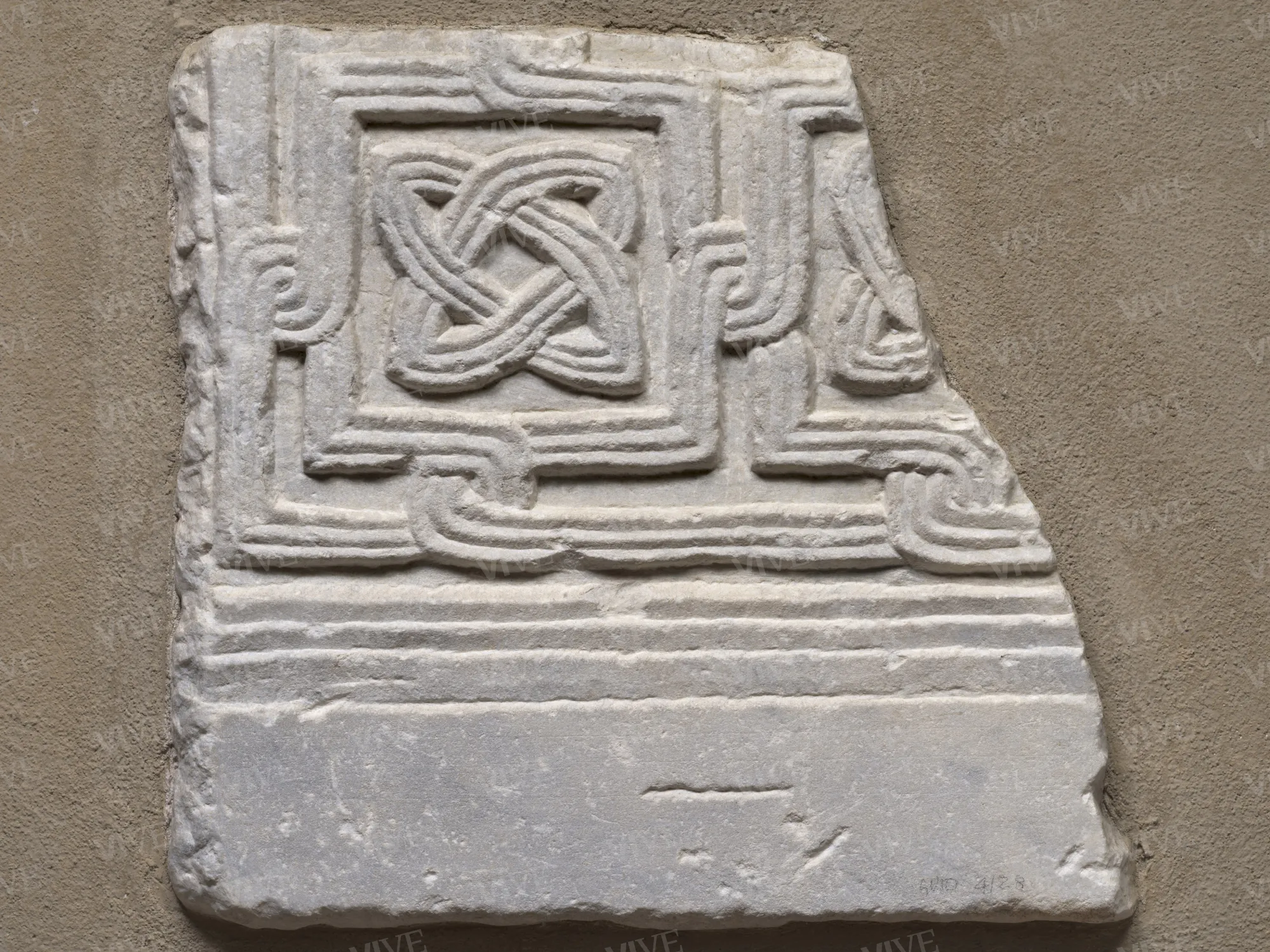
Fragment of marble slab decorated with a network of square meshes of two-lined wicker ribbon, knotted together and filled with Solomon’s knots, within a sawtooth frame.
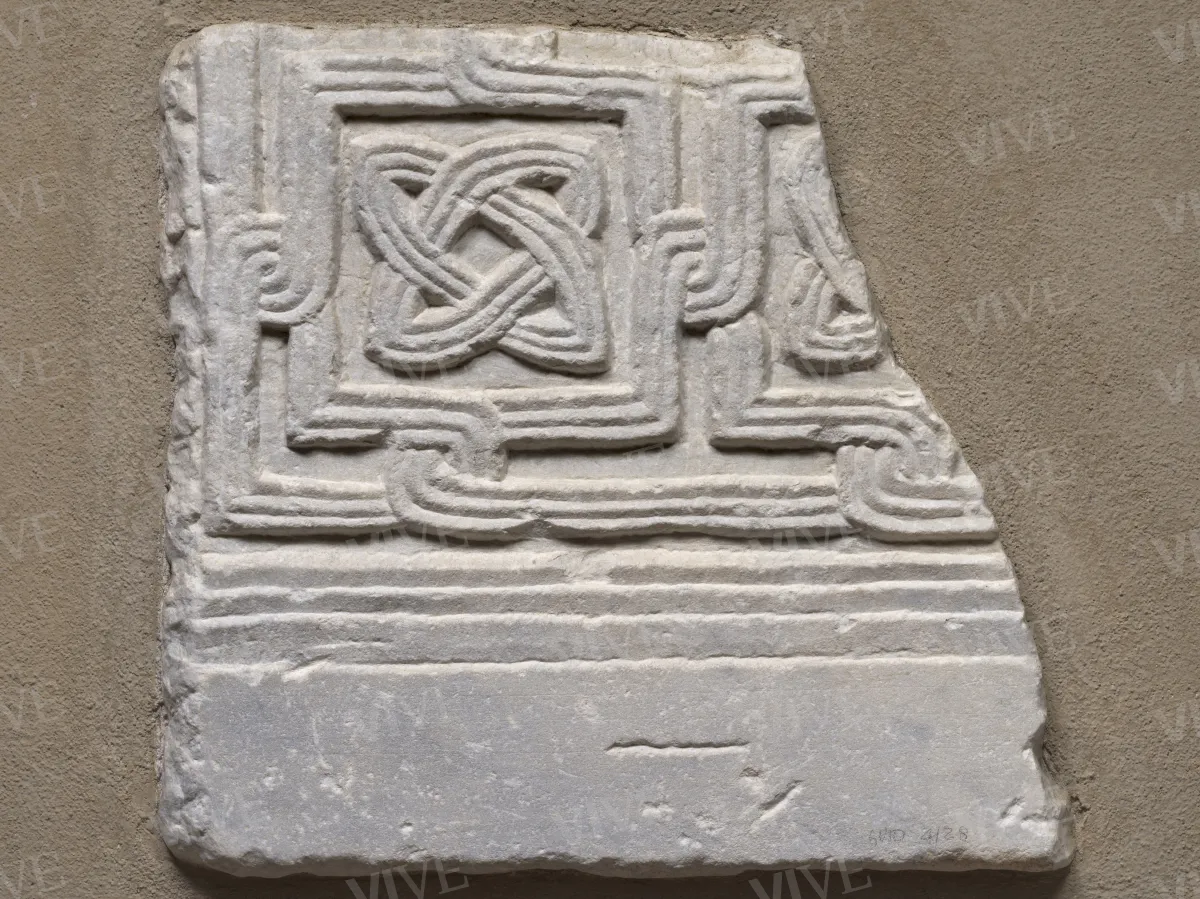
Fragment of marble slab decorated with a network of square meshes of two-lined wicker ribbon, knotted together and filled with Solomon’s knots, within a sawtooth frame.
The marble slab fragment, cut into a trapezoidal shape on the right side for possible repurposing, bears a sequence of square links within a sawtooth frame, following a decorative motif very common in Roman artifacts from the first half of the ninth century (Kautzsch 1939; Seminario 1976; Roperti 2007). The quadrilaterals, drawn from the bisected wicker ribbon, are knotted together in the center of each side and are connected by a knot (or two, as can be seen in the angular quadrilateral), to a straight wicker ribbon running parallel to the frame.
This motif is filled with the early Christian symbol of Solomon’s knot, which is also very common in Lombard- and Carolingian-era sculpture in central and northern Italy (e.g., at Müstair, Roth-Rubi 2015, fig. 3.37) and was considered to be salvific and auspicious (Romanini 1975; Righetti Tosti-Croce 2005).
Formally, the poor state of preservation makes the artifact difficult to read. The most obvious comparison is offered by the fragments of a pluteus from San Giovanni a Porta Latina (Melucco Vaccaro 1974, figs. 32–33), dated to the first quarter of the ninth century, which, however, must be directly compared with the later modification of the motif found in a pluteus from San Giovanni in Laterano (id., fig. 48), where the nodes seem to be geometrically similar to those in our fragment.
Valentina Brancone
Entry published on 12 February 2025
Mediocre. Cropped and chiseled with numerous nicks.
1999 (cleaning).
Unknown. Found during excavations for the Palazzetto, as part of demolition carried out in the area for the relocation of the Palazzetto di Venezia (1910–1914).
Rome, Archivio del Museo del Palazzo di Venezia, inventorying the sculptures of the lower and upper loggias (manuscript inventory edited by Maria Vittoria Brugnoli, 1973).
Seminario sulla tecnica e il linguaggio della scultura a Roma tra VIII e IX secolo, in Atti del simposio su Roma e l'Età carolingia, coordinated by Avagnina Maria Elisa, Istituto di Archeologia e Storia dell'arte, Rome 1976.
Kautzsch Rudolf, Die römische Schmuckkunst in Stein vom 6. bis zum 10 Jahrhundert, in «Römisches Jahrbuch für Kunstgeschichte», III, 1939, pp. 3-73;
Melucco Vaccaro Alessandra, La Diocesi di Roma, t. III, La II regione ecclesiastica, Corpus della scultura altomedievale, VII, Spoleto 1974;
Romanini Angiola Maria, Tradizione e "mutazioni" nella cultura figurativa precarolingia, in La cultura antica nell’Occidente latino dal VII all’XI secolo, XXII Settimana di studio del CISAM, Spoleto 1975, pp. 759-789;
Macchiarella Gianclaudio et al., Seminario sulla tecnica e il linguaggio della scultura a Roma tra VIII e IX secolo, in Istituto di Storia dell’Arte dell’Università di Roma (a cura di), Roma e l’età carolingia. Atti delle giornate di studio (Roma, 3-8 maggio 1976), Roma 1976, pp. 267-288;
Latini Massimo, Sculture altomedievali inedite del Museo Nazionale del Palazzo di Venezia in Roma, in «Rivista dell’Istituto Nazionale d’Archeologia e Storia dell’Arte», 57, 2003, pp. 113-152;
Righetti Tosti-Croce Marina, Spolia e modelli altomedievali nella scultura cistercense con una nota sul nodo di Salomone, in Quintavalle Arturo Carlo (a cura di), Medioevo: immagini e ideologie, Atti del Convegno internazionale di studi (Parma 23-27 settembre 2002), Milano 2005, pp. 644-656;
Roperti Antonella, Note sulla scultura, in Bonacasa Carra Rosa Maria, Vitale Emma (a cura di), La cristianizzazione in Italia tra Tardoantico ed Altomedioevo. Atti del IX Congresso Nazionale di Archeologia cristiana (Agrigento, 20-25 novembre 2004), vol. I, Palermo 2007, pp. 411-420;
Latini Massimo, in Barberini Maria Giulia (a cura di), Tracce di pietra. La collezione dei marmi di Palazzo Venezia, Roma 2008, pp. 175-194, schede 1-29;
Roth-Rubi Katrin (in collaborazione con Sennhauser Rudolph), Die frühe Marmorskulptur aus dem Kloster St. Johann in Müstair, Ostfildern 2015.