Vittoriano


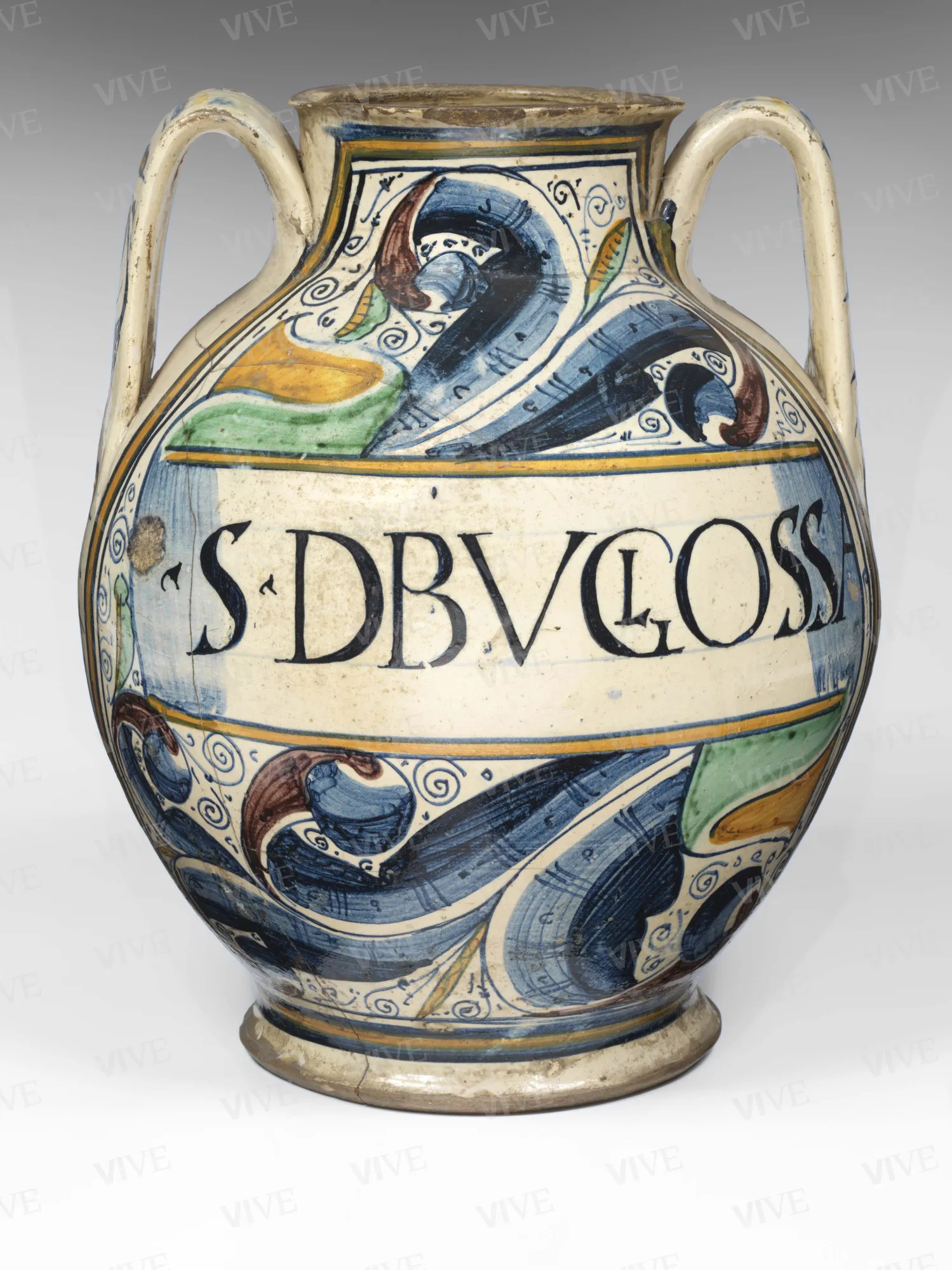
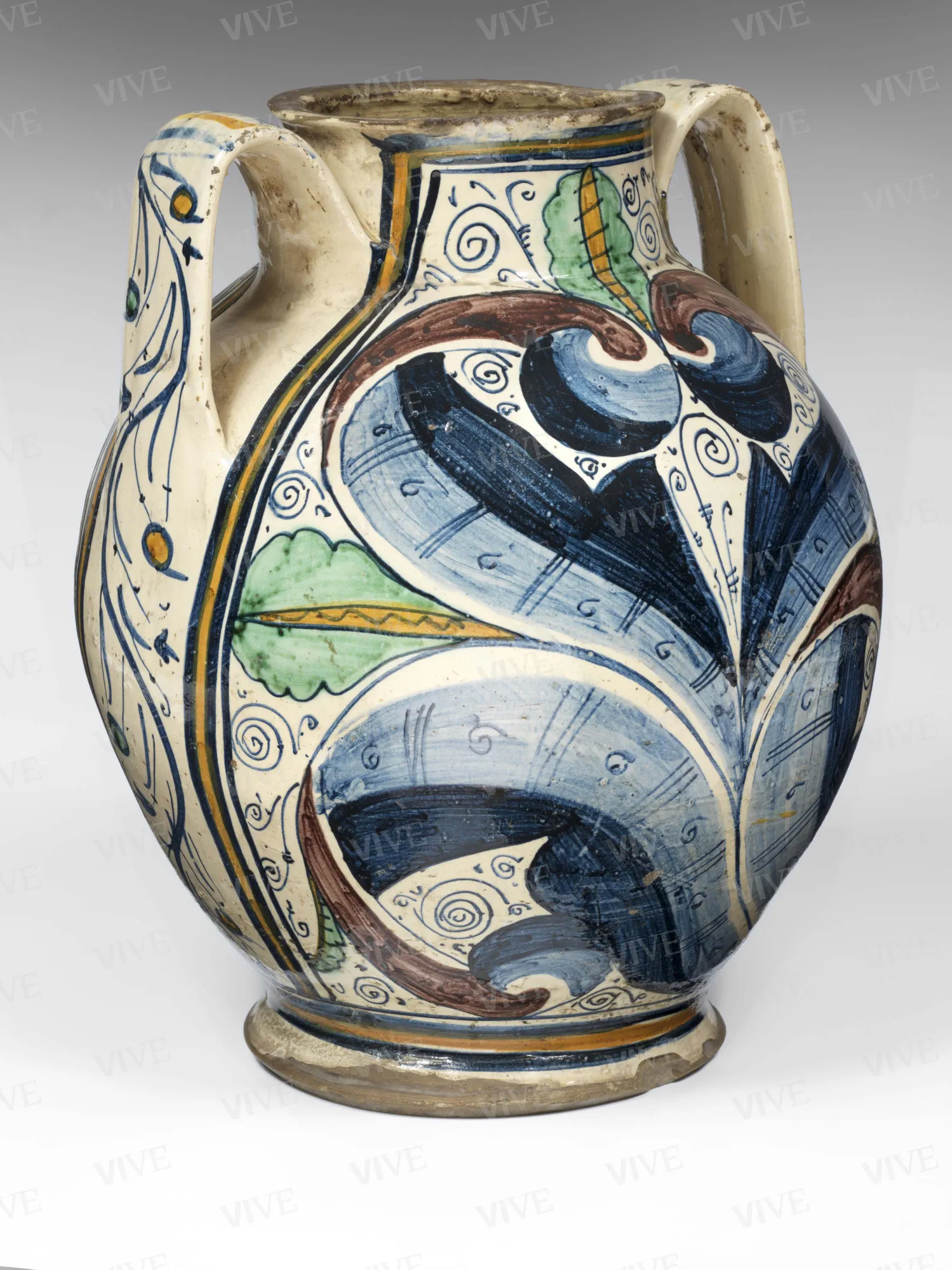
A polychrome majolica apothecary jar, decorated with blue, brown, green, and orange colors, features a crumpled leaf motif and a scroll that indicates the name of the medicine contained inside.
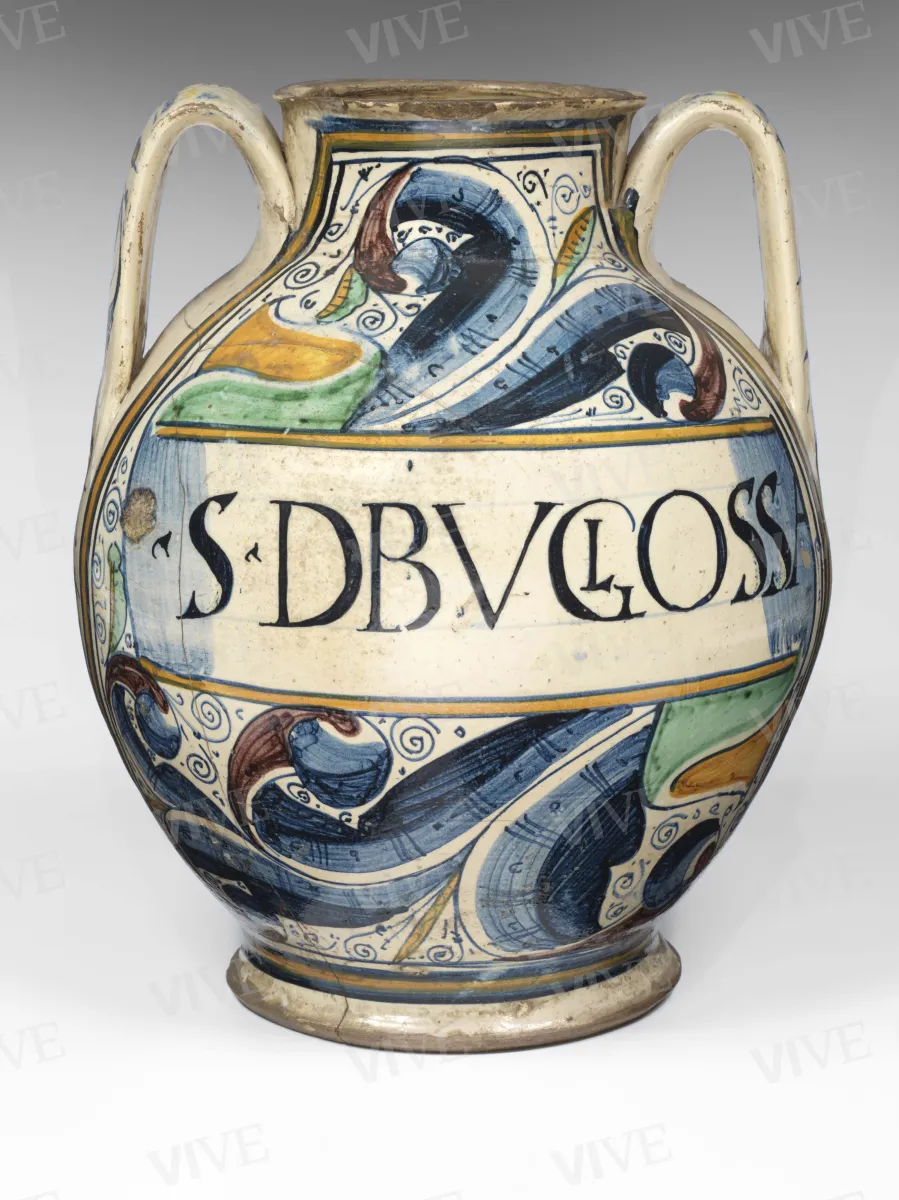
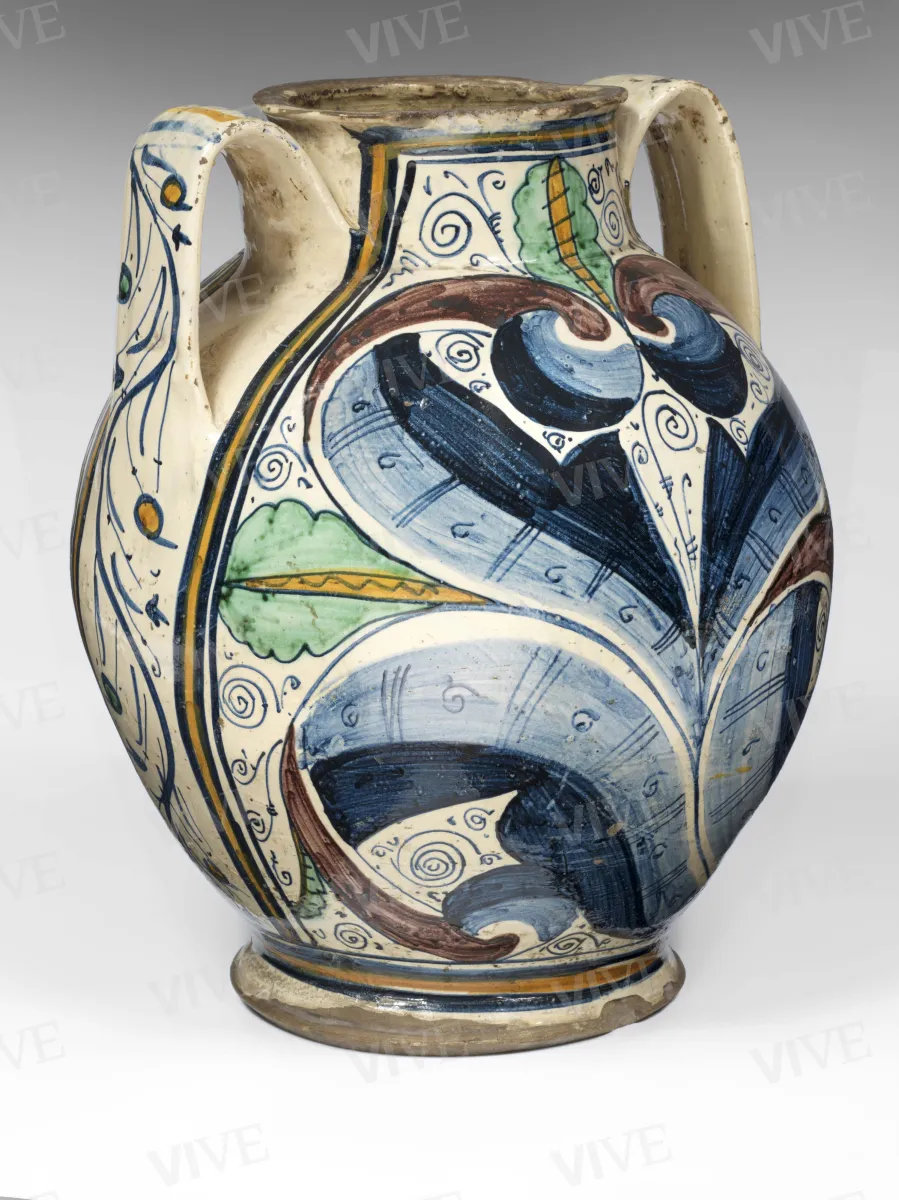
A polychrome majolica apothecary jar, decorated with blue, brown, green, and orange colors, features a crumpled leaf motif and a scroll that indicates the name of the medicine contained inside.
The small jar has a shape and decoration that closely resemble another majolica container in the Museo di Palazzo Venezia (inv. TR 52). It features a globular body, a slightly flared disc-shaped foot, a tall flared neck, and two ribbon-shaped handles positioned opposite each other that start at the central part of the neck and extend vertically to the widest part of the body.
The colors used for the decoration on the stanniferous glaze coating include blue, brown, green, and orange. The decorative motif repeated on both the front and back is the “crumpled leaf,” which was widely used in various production centers in central and northern Italy between the fifteenth and sixteenth centuries. This motif is sometimes combined with other patterns such as the “peacock feather” and “fern leaf” (or “fan palmette”). During the sixteenth century, this particular form (originally intended for syrups) was replaced by smaller jars equipped with a single handle and a pouring spout in apothecary collections.
On the front of the container, the decorative motif features a large horizontal band bearing a scroll with the name of the medicine: “S. D BVGLOSSA” (bugloss syrup). The two small jars, which are part of the same apothecary set, appear to have been crafted in the same workshop, likely commissioned by a pharmacy. Previously attributed to “Tuscan manufacture” without substantial documentary evidence, there remains the possibility that it was produced by workshops in Rome or northern Lazio, where many Tuscan and Umbrian potters had been active since the fifteenth century. A large apothecary jar preserved in the Museo di Roma (inv. MR 17558) with similar decoration, though differing in color usage, has been attributed by Otto Mazzucato to a “probable Roman workshop” (Mazzucato 1990, p. 41, n. 16).
This item has never before been displayed.
Luca Pesante
Entry published on 27 March 2025
Good.
"S. D BVGLOSSA" (bugloss syrup).
Mazzucato Otto (a cura di), Le ceramiche da farmacia a Roma tra '400 e '600, catalogo della mostra (Roma, Palazzo Braschi, 30 marzo-6 maggio 1990), Viterbo 1990, p. 41, n. 16.